


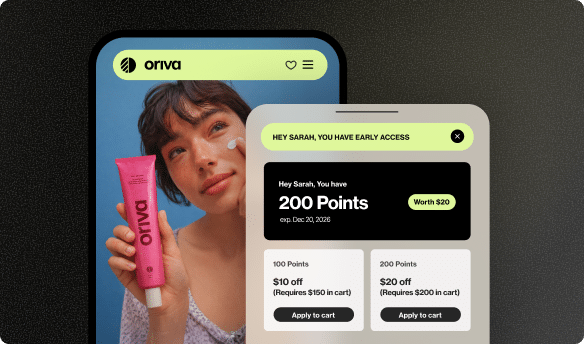







For modern eCommerce brands, data is abundant. The challenge lies in converting that data into actionable insights. When it comes to customer retention, your most powerful tool isn’t just a loyalty program; it’s the loyalty dashboard that powers it. This is your command center. It’s the central hub for monitoring performance, identifying opportunities, and directing your strategy to foster brand growth. This article explores why a robust dashboard is essential and how you can leverage it to make smarter, data-driven decisions.
Key Takeaways
- A loyalty dashboard is an actionable command center for managing, analyzing, and optimizing your entire customer retention strategy.
- The most important metrics to track are member growth, redemption rate, repeat purchase rate, and the average order value (AOV) of loyalty members compared to non-members.
- Look for a dashboard that provides deep analytics, powerful segmentation, and flexible program management so you can easily test and iterate on your rewards structure.
- Yotpo Loyalty offers a best-in-class dashboard focused on robust, conservative reporting and action-oriented insights, helping you understand the true impact of your program.
- When choosing a solution, the key is to find a dashboard that guides decision-making to increase customer lifetime value.
As eCommerce expert Ben Salomon often says, “A loyalty program is your promise to the customer. Your loyalty dashboard is how you prove you’re keeping it. It’s the single source of truth for understanding if your retention efforts are actually building loyalty or just giving away margin.”
What is a Loyalty Dashboard, and Why is it Your Brand’s Command Center?
A loyalty dashboard is the cockpit of your customer retention strategy. It’s a single, visual interface within your loyalty solution that unifies all your program’s data. Far more than a static report, it provides an interactive, real-time view of your customers’ behavior.
A well-designed loyalty dashboard replaces speculation with certainty.
- Instead of guessing if your rewards are popular, you know your exact redemption rate.
- Instead of guessing if members are more valuable, you see the side-by-side AOV of members vs. non-members.
- Instead of guessing who your best customers are, you can identify and segment them with a few clicks.
For a growing eCommerce brand, this is an essential component of your tech stack. With rising customer acquisition costs, sustainable growth depends on retaining existing customers. Your loyalty dashboard is the tool that provides the exact insights needed for that process.
A loyalty dashboard is the central hub for your retention strategy. It swaps guesswork for data-backed certainty, giving you a real-time view of customer behavior and program performance.
The Anatomy of a High-Impact Loyalty Dashboard: Key Features
Not all loyalty dashboards offer the same strategic value. Some just show a list of members and their point balances. A truly high-impact dashboard gives you the power to analyze, manage, and act.
What should you look for? Let’s break down the key components.
1. At-a-Glance Performance (The “Health Check”)
When you first log in, you need a quick “health check.” This dashboard element provides a high-level overview of key performance indicators (KPIs) through clear visualizations like graphs, charts, and scorecards.
Key metrics you must have:
- Total Members & Member Growth: Are you adding new members? At what rate?
- Loyalty Program ROI: This is the big one. How much revenue is your program generating compared to its cost?
- Redemption Rate: What percentage of points being earned are actually being used? This shows how engaged members are with your rewards.
- Repeat Purchase Rate (Members vs. Non-Members): This proves the value of your program. Are members really coming back to shop more often?
- Average Order Value (AOV) (Members vs. Non-Members): Are loyalty members spending more per order?
2. Program Management & Configuration
This is the operational hub for building and modifying your program. A flexible dashboard streamlines this process, empowering your team to manage the program without developer dependency for every promotion.
You should be able to:
- Create & Edit Earning Rules: Easily set how many points customers get for purchases, writing reviews, or following on social media.
- Manage Rewards: Set up different reward types, like dollar-off coupons, free shipping, or exclusive products.
- Build & Manage VIP Tiers: Create tiers (e.g., Bronze, Silver, Gold) and define the perks for each. The dashboard should clearly show how many members are in each tier.
- Set Up Referral Programs: Configure the rewards for both the person referring and their friend.
3. Deep-Dive Analytics & Reporting
This is where you move from what is happening to why it’s happening. A best-in-class dashboard provides robust reports that let you dig deeper.
As eCommerce expert Ben Salomon notes, “A simple report tells you what happened. A great report tells you why it happened, who it happened to, and what you should do about it next.”
Look for reports on:
- Customer Lifetime Value (LTV): How does LTV change after a customer joins the loyalty program?
- At-Risk Customers: The dashboard should help you identify members who haven’t shopped in a while so you can run a campaign to win them back.
- Reward Popularity: Which rewards are being redeemed most? Which ones are being ignored? This helps you optimize your offerings.
- Referral Program Performance: How many new customers are your referrals actually driving?
4. Powerful Customer Segmentation
This feature is a strategic differentiator. A great dashboard allows you to filter your entire member list into precise segments, enabling a move away from mass marketing toward targeted, personalized communication.
For example, you could create segments for:
- “VIPs”: Your top 5% of spenders.
- “New Members”: Joined in the last 30 days but haven’t made a second purchase.
- “At-Risk Members”: Haven’t purchased in 90 days but are in your top VIP tier.
- “Points Hoarders”: Members with a high point balance who haven’t redeemed.
Once you have these segments, you can run targeted campaigns. Send your VIPs an exclusive offer. Nudge new members toward their second purchase. Remind your “at-risk” members of their points.
5. Individual Member Management
This feature is essential for customer service. Your support team needs a way to quickly look up any member and see their entire loyalty history to resolve individual issues effectively.
This includes:
- Viewing their current point balance.
- Seeing a full history of points earned and spent.
- Manually adjusting points (e.g., adding 500 points as a “sorry” for a late shipment).
- Seeing their current VIP tier and referral link.
A powerful loyalty dashboard is built on five pillars: a clear at-a-glance health check, flexible program management, deep analytics, powerful customer segmentation, and easy individual member management. These features work together to give you full control over your retention strategy.
Building Your Loyalty Strategy from the Dashboard Up
A dashboard is just a tool. It’s your strategy that delivers results. The best way to use your dashboard is to let your goals define what you measure.
Step 1: Define Your Loyalty Goals
First, ask “What am I trying to achieve?” Your dashboard is the tool to measure your progress toward that goal.
Here are some common goals:
- Goal A: Increase repeat purchase rate.
- Goal B: Increase average order value (AOV).
- Goal C: Acquire new customers at a lower cost.
- Goal D: Re-engage “lapsing” customers.
Step 2: Choose the Right KPIs for Your Dashboard
Now, connect those goals to specific metrics on your dashboard. This is what you’ll focus on. Here is how you can connect your goals to specific dashboard KPIs:
- To increase repeat purchase rate: Focus on the ‘Repeat Purchase Rate (Members vs. Non-Members)’ metric.
- To increase AOV: Monitor the ‘Average Order Value (Members vs. Non-Members)’.
- To acquire new customers: Track your ‘Referral Program Conversion Rate’.
- To re-engage lapsing customers: Analyze the ‘Redemption Rate of ‘At-Risk’ segments’.
Bold these 1-3 metrics on your dashboard (or in your mind). This is your “North Star.” Everything else is just context.
Step 3: Turn Your Data into Action (A Tutorial)
Let’s walk through a common scenario. You log into your dashboard and notice a low redemption rate. Customers are earning points, but not spending them. This is a problem. Unspent points are a liability on your books, and it means customers aren’t engaged.
Here’s how you use your dashboard to fix it:
- Analyze the Problem:
- Check Reward Popularity: Go to your analytics report. Are members only redeeming the “$5 off” coupon? Is that “Free Tote Bag” reward (that you thought was great) completely untouched? Maybe your rewards just aren’t very exciting.
- Check Point Expiration: Does your dashboard show that points don’t expire? This removes urgency. Customers think, “I’ll just save them forever.”
- Check Earning Velocity: How long does it take an average customer to earn enough points for a reward? If it takes 10 purchases to get $5 off, most people will give up.
- Form a Hypothesis:
- Your data shows the “$5 off” reward is popular, but it takes an average of $200 in spending to earn it. Your hypothesis is: The reward threshold is too high.
- Take Action & Test:
- The Test: Go to your Program Management section. Create a new, temporary reward: “Get a $5 off coupon for only 250 points” (instead of the usual 500).
- The Campaign: Go to your Segmentation tool. Create a segment of all members who have over 250 points but haven’t redeemed in 90 days.
- The Nudge: Send this segment a targeted email: “You have enough points for a $5 reward! Claim it now before this special offer ends.”
- Measure the Result:
- Go back to your dashboard. Watch your redemption rate for that segment. See if those customers come back and use the coupon. Did it work? If yes, you might want to permanently lower the point cost of your most popular reward.
You have just successfully used your loyalty dashboard to identify a problem, diagnose the cause, run a targeted fix, and measure the result. That is the power of moving from passive data review to active strategy.
Leveraging a Best-in-Class Loyalty Dashboard: The Yotpo Loyalty Example

When you’re looking for a loyalty solution, the dashboard is a critical part of the package. A best-in-class product like Yotpo Loyalty is built around the idea that data should be both powerful and easy to understand.
Yotpo Loyalty is a top-tier loyalty and referrals solution. Its dashboard is designed to give eCommerce brands the strategic tools they need to build lasting customer relationships.
Robust Analytics and Actionable Insights
The Yotpo Loyalty dashboard provides action-oriented insights—not just vanity metrics. It provides conservative reporting that gives you the true picture of your program’s performance.
This includes:
- Dedicated Dashboards: You get robust, dedicated reports for every part of your program: Rewards, VIP Tiers, Referrals, and Revenue. This means you are not sorting through a single, overly complex report.
- Clear ROI: The dashboard clearly separates revenue from loyalty members versus non-members, so you can see the direct impact of your program.
- Customizable Filters: You can filter data by date range, customer tags, and more, letting you drill down into the specific trends that matter to you.
Flexibility and Easy Iteration
A great loyalty program requires ongoing optimization, not a “set it and forget it” approach. The Yotpo dashboard is built for agility. It makes it easy to build, launch, and iterate on your program.
From the dashboard, you can easily manage all your on-site elements. Want to change the rewards in your loyalty “explainer” page? You can do that in minutes. Want to A/B test a new reward? The dashboard gives you the controls to do it. This flexibility empowers you to create unique, branded loyalty experiences that feel like a natural part of your store.
Powerful Segmentation Capabilities
The dashboard is your hub for segmentation. It allows you to create truly customized customer journeys based on a customer’s loyalty status, spending habits, or point balance.
For example, you can use the dashboard to find all your “Gold Tier” members and see their activity. This data is then easily used to send targeted campaigns that make them feel recognized, strengthening their bond with your brand.
A Quick Note on Synergy
While Yotpo Loyalty is a powerful standalone product, its dashboard can also be a hub for tracking customer engagement across different channels. For instance, you can use the dashboard to set up and track loyalty points for actions like leaving feedback with Yotpo Reviews. This is a smart synergy—rewarding customers for providing valuable social proof—and you can manage it all from one place.

A best-in-class dashboard, like the one offered by Yotpo Loyalty, gives you more than just data. It provides action-oriented insights, flexible program management, and powerful segmentation tools, all backed by a team of experts to help you build a strategy that works.
Common Challenges (and How to Overcome Them)
A dashboard is exciting, but it’s easy to hit a few common roadblocks. Here’s how to navigate them.
Challenge 1: Data Overload
You log in and see 50 different charts. This feeling of being overwhelmed can lead to inaction.
- How to Overcome It: Go back to your goals. Pick just 1-3 “North Star” metrics (like “Repeat Purchase Rate” and “AOV – Members”) to focus on. Put those at the top of your dashboard if you can. Look at those every day. Look at everything else once a month.
Challenge 2: The Data Isn’t Actionable
You see a report that says “15% of members are at-risk,” but it’s unclear what to do.
- How to Overcome It: Always ask the “so what?” question to bridge data and action.
- What: 15% of members are at-risk.
- So What? I need to run a win-back campaign.
- Now What? I will use the segmentation tool to build a list of these “at-risk” members and send them an exclusive “We miss you!” point bonus.
Challenge 3: Poor User Experience (For You!)
The dashboard is slow, clunky, and you can’t find anything.
- How to Overcome It: This can be a significant obstacle. When you are demoing loyalty solutions, interact with the dashboard directly. Don’t just watch a salesperson click through it. Can you create a new reward? Can you find the ROI report? If the dashboard is difficult to navigate, your team will not use it to its full potential.
The Future: What’s Next for Loyalty Dashboards?
Loyalty dashboards are not static; they are evolving, and the future of this technology is exciting.
- AI-Driven Insights: Instead of you having to find the problem, the dashboard will tell you. Expect to see proactive alerts like, “Your redemption rate for Gold Tier members has dropped 20%. We suggest running a ‘Double Points Weekend’ for this segment.”
- Deeper Personalization: The dashboard will become the hub for 1-to-1 personalization, allowing you to automatically offer unique rewards to individual customers based on their past purchase history.
- True Omnichannel View: Future dashboards will more seamlessly integrate data from your physical stores, your mobile app, and your website, giving you one single view of your customer’s loyalty, no matter where they shop.
Conclusion: Your Dashboard is Your Roadmap
Your loyalty dashboard is far more than a report card; it’s your roadmap. It’s the tool that helps you navigate the complex world of customer retention.
A-best-in-class dashboard, like the one powering Yotpo Loyalty, gives you the clear, actionable insights you need. It helps you understand your customers, test new ideas with confidence, and make smart decisions that turn one-time buyers into lifelong fans.
Don’t settle for a dashboard that just shows you data. Choose one that empowers you to act.
Frequently Asked Questions
1. What is the single most important metric on a loyalty dashboard?
While it depends on your specific goals, many experts would point to Repeat Purchase Rate (Members vs. Non-Members). This metric directly proves that your loyalty program is successfully changing customer behavior and driving retention.
2. How often should I check my loyalty dashboard?
You should do a quick 2-minute “health check” of your main KPIs (like revenue, member growth) daily. You should plan on doing a “deep dive” into your analytics reports weekly or bi-weekly to look for new trends and opportunities.
3. What’s a good loyalty program redemption rate to aim for?
Industry benchmarks can vary, but most experts suggest a healthy redemption rate is somewhere between 15% and 25%. If it’s much lower, your rewards may not be valuable or easy enough to get. If it’s too high (e.g., 50%+), you might be giving away too much value and cutting into your margins.
4. My dashboard shows low engagement. What’s the first thing I should do?
Check your reward value. Go to your Program Management and Analytics sections. Are your rewards exciting? And more importantly, are they achievable? If it takes $1,000 of spending to get a $5 coupon, most customers won’t even try. Try launching a more attainable, low-threshold reward and see if engagement picks up.
5. How does a loyalty dashboard help with customer service?
It’s a critical tool. When a customer calls, your support team can use the Individual Member Management feature to instantly see their point balance, reward history, and VIP status. This allows them to quickly solve problems (e.g., “I see your points didn’t apply, let me add those for you manually”) and make the customer feel seen and valued.
6. Can I track my referral program from the same dashboard?
Yes. A good loyalty solution, like Yotpo Loyalty, will have a dedicated Referrals Dashboard. This lets you track key referral metrics like invites sent, new customer conversions, and total revenue driven by referrals, all in one place.
7. What’s the difference between a simple dashboard and a robust one?
A simple dashboard just shows you data (e.g., “You have 5,000 members”). A robust dashboard lets you act on that data (e.g., “Let’s build a segment of the 500 members who joined last month and send them a special offer”).
8. My dashboard has a segmentation tool. What’s a good first segment to build?
A great first segment is “New Members – No Second Purchase.” Create a segment of customers who joined the loyalty program in the last 30-45 days but haven’t come back to shop. Send them a “Welcome!” email with a small point bonus to nudge them toward that all-important second purchase.
9. Why does Yotpo Loyalty talk about “conservative reporting”?
This means the dashboard is designed to provide a transparent, accurate view of your program’s ROI, without inflating numbers. It focuses on tracking actual lift and revenue, so you can make budget and strategy decisions with confidence, knowing the data is reliable.
10. Can I manage my VIP Tiers from the dashboard?
Absolutely. A key feature of any modern loyalty dashboard is the VIP Tier Management section. This is where you set the spending (or points) thresholds to enter each tier, define the exclusive perks for each, and track how many members are moving up (or down) between tiers.





 Join a free demo, personalized to fit your needs