








The prospect of building a successful business, leading your strategy, and sharing your passion with the world is more accessible than ever.
In 2026, the undisputed frontier for this entrepreneurial spirit is eCommerce. The global e-commerce market is projected to reach a staggering $24.90 trillion in [yotpo year], showcasing a landscape ripe with opportunities.
However, while the barriers to entry have been lowered, launching and scaling a successful online business remains a significant undertaking. Many aspiring entrepreneurs possess brilliant ideas but become entangled in the operational and strategic complexities of the “how.”
This comprehensive guide breaks down the entire journey of starting an e-commerce business in 2026 into manageable and actionable steps. From crystallizing your core idea and navigating legal requirements to selecting your platform, launching your store, and, crucially, building lasting customer relationships that fuel sustainable growth.
Step 1: Finding Your Niche & Crafting Your Business Plan
Every successful ecommerce venture begins with two foundational elements: a compelling niche and a solid business plan. Don’t underestimate the power of this initial strategic work; it will guide every decision you make.
Passion Meets Profitability: Identifying Your Niche
Your niche is the specific segment of the market you aim to serve. The ideal niche sits at the intersection of your passion, your expertise, and genuine market demand.
- Brainstorm Your Ideas: What are you passionate about? What problems do you see in the market that you could solve? What unique skills or products can you offer?
- Conduct Thorough Market Research:
- Demand: Are people actively searching for products in this niche? Utilize tools like Google Trends, keyword research tools (e.g., SEMrush, Ahrefs – although these are paid tools, free versions or Google Keyword Planner can also offer valuable insights), and social media listening to gauge interest.
- Competition: Who are your potential competitors? Analyze their strengths, weaknesses, pricing, and marketing strategies. Can you offer something different or better?
- Target Audience: Define your ideal customer. What are their demographics, psychographics, pain points, and buying habits? Businesses that utilize market segmentation can experience a 760% increase in revenue.
- Profitability: Evaluate the potential profit margins. Consider sourcing costs, shipping, and potential pricing strategies.
Defining Your Business Model
How will you source and sell your products? Standard ecommerce business models include:
- Direct-to-Consumer (D2C): You create and sell your own branded products directly to customers, eliminating the need for middlemen. This model offers high margins and brand control, but requires investment in product development and inventory management.
- Private Labeling: You find a manufacturer to produce existing products, which you then brand and sell under your label.
- Dropshipping: You partner with a supplier who holds the inventory and ships products directly to your customers. This model has low startup costs but also lower margins and less control over the customer experience.
- Wholesaling/Warehousing: You purchase products in bulk from manufacturers and store them in your warehouse (or utilize a third-party logistics provider, or 3PL) before selling them.
The Blueprint: Your Ecommerce Business Plan
A formal business plan is your roadmap. It forces you to think through every aspect of your venture and will be essential if you seek funding. Key sections include:
- Executive Summary: A concise overview of your business.
- Company Description: Your mission, vision, and legal structure.
- Market Analysis: Details about your niche, target audience, and competitors.
- Products & Services: What you will sell and your unique selling proposition.
- Marketing & Sales Strategy: How you will reach and attract customers.
- Operations Plan: Sourcing, inventory, shipping, and customer service.
- Management Team: Who is involved, and what are their areas of expertise.
- Financial Projections: Startup costs, revenue forecasts, profit and loss statements.
Step 2: Branding and Legal Foundations
With a solid plan, it’s time to give your business a distinct identity and ensure it’s properly established from a legal standpoint.
Creating a Memorable Brand Identity
Your brand is more than just a logo; it’s the entire perception customers have of your business. A strong brand builds trust and differentiates you from the competition.
- Brand Name: Choose something memorable, relevant, and available (check domain names and social media handles).
- Logo & Visuals: Develop a professional logo, color palette, and typography that reflect your brand’s personality.
- Brand Voice & Messaging: Define how your brand will communicate. Is it playful, sophisticated, and eco-conscious? Ensure consistency across your website, emails, and social media.
Navigating the Legal Maze
Getting your legal ducks in a row from the start will save you headaches down the line.
- Business Structure: Determine your legal structure (e.g., sole proprietorship, LLC, S Corporation, C Corporation). Consult with a legal professional to determine the best fit.
- Licenses & Permits: Research the business licenses and permits required in your city, county, and state.
- Employer Identification Number (EIN): If you plan to hire employees or operate as a corporation or partnership, you’ll need an EIN from the IRS.
- Sales Tax: Understand your sales tax obligations. Most ecommerce platforms can help you configure sales tax collection.
- Banking: Open a separate business bank account.
Step 3: Choosing Your Ecommerce Platform (Your Digital Storefront)
Your ecommerce platform is the software that will power your online store. This is one of the most critical technology decisions you’ll make, as it impacts everything from your site’s design and functionality to your ability to scale.
Understanding Platform Types
- SaaS (Software as a Service) Platforms: These are hosted solutions where you pay a monthly fee to use the software, and the provider handles all the technical aspects, including hosting, security, and updates.
- Pros: Ease of use, predictable costs, security and hosting included, often excellent customer support.
- Cons: Less customization flexibility compared to open-source solutions, and transaction fees may apply to some plans.
- Open-Source Platforms: This software is free to download, but you are responsible for your own hosting, security, maintenance, and development.
- Pros: Complete control and customization, with no monthly platform fees (although other costs may apply).
- Cons: Requires technical expertise (or a budget for developers), as you manage all hosting, security, and updates, which can result in a higher total cost of ownership.
Key Platforms to Consider
- Shopify: A subscription-based SaaS platform that allows users to set up an online store and sell products. It provides themes for design, integrated payment processing, and access to a large app store for extending functionality. It’s known for its ease of use and scalability, powering millions of businesses.
- BigCommerce: A SaaS ecommerce platform offering tools for businesses to create and manage their online stores. Its features include design customization, product and inventory management, and marketing tools. It caters to a range of business sizes.
- WooCommerce: An open-source ecommerce plugin designed for WordPress websites. It allows users to add ecommerce functionality (product listings, shopping cart, checkout) to a WordPress site. It requires users to manage their hosting and WordPress installation.
- Squarespace Commerce: A website builder and SaaS platform that includes ecommerce functionality. It is known for its design-focused templates and ease of use for creating visually appealing online stores.
- Wix Ecommerce: Another website builder platform that offers ecommerce plans. It provides a drag-and-drop interface for store design, along with features for product management, payments, and shipping.
Factors to Consider When Choosing Your Platform
- Budget (Total Cost of Ownership): Don’t just look at the monthly fee. Consider transaction fees, app costs, theme costs, and potential developer fees when choosing an open-source option.
- Ease of Use: How comfortable are you with technology? Do you want a platform you can manage yourself, or do you have a technical team?
- Scalability: Will the platform be able to handle your growth in terms of traffic, products, and orders?
- App Ecosystem & Integrations: Does the platform have a robust app store with the necessary tools for marketing, shipping, accounting, and other essential functions?
- Payment Gateway Options: Does it support the payment gateways you want to use?
- Design Flexibility: How much control will you have over the look and feel of your store?
- Support: What kind of customer support does the platform offer?
Step 4: Setting Up Your Online Store
Once you’ve chosen your platform, it’s time to build your digital storefront.
Designing Your User Experience (UX) & User Interface (UI)
First impressions matter. Your website needs to be visually appealing, easy to navigate, and trustworthy. Roughly 38% of people will stop engaging with a website if the content or layout is unattractive.
- Theme Selection: Choose a professional theme that aligns with your brand and is mobile-responsive. Mobile commerce accounts for over 75% of all ecommerce sales, so a flawless mobile experience is non-negotiable.
- Navigation: Create a clear and intuitive site navigation structure. Customers should be able to easily find what they’re looking for.
- Branding: Implement your logo, color palette, and typography consistently.
Product Listings That Convert
Your product pages are your digital salespeople. They need to be compelling and informative.
- High-Quality Product Photography & Videography: Invest in professional, high-resolution images and videos that showcase your products from multiple angles and in use. Good visuals can increase conversion rates by 30% or more.
- Compelling Product Descriptions: Go beyond just listing features. Focus on the benefits and tell a story. Use persuasive language and incorporate keywords for SEO.
- Clear Pricing and Calls-to-Action (CTAs): Ensure your pricing is transparent and that your “Add to Cart” button is prominent and easily accessible.
Payment Gateway Integration & Shipping Logistics
- Payment Gateways: Set up your chosen payment gateways (e.g., Shopify Payments, PayPal, Stripe) to securely accept payments.
- Shipping Strategy: Define your shipping rates and zones to optimize your shipping costs and ensure efficient delivery. Will you offer free shipping, flat-rate shipping, or real-time carrier rates? Configure these options in your platform. Consider offering multiple shipping options.
Step 5: Planning for Post-Launch Success: Building Trust & Driving Retention from Day One
Launching your ecommerce store is a monumental achievement, but it’s just the beginning.
The most successful online businesses in 2026 are those that build robust systems for customer trust and retention from the very first interaction. This isn’t something you bolt on later; it’s a foundational part of your launch strategy.
Your goal is to turn those hard-won first-time buyers into loyal, repeat customers.
The Power of Social Proof: Why Reviews are Non-Negotiable from Launch
In an online world where customers can’t physically touch or try your products, they rely heavily on the experiences of others. This is where product reviews become invaluable. Consider these statistics:
- An overwhelming 98% of consumers report that they read online reviews before making a purchase decision.
- Displaying reviews can increase conversion rates by up to 270%. Products with even just five reviews have a significantly higher purchase probability than those with none.
You need a plan to collect and showcase reviews from your very first orders actively. This builds immediate trust and provides crucial social proof for new visitors.
This is where a dedicated solution like Yotpo Reviews becomes an essential part of your launch toolkit. Integrated directly with your ecommerce platform (like Shopify), Yotpo helps you automate the process of soliciting reviews from new customers via email or SMS.

Its AI-powered Smart Prompts can guide customers to leave more detailed and helpful feedback, even encouraging them to upload photos and videos of your products in action. This user-generated content (UGC) is absolute gold for building credibility and helping future shoppers make confident purchase decisions from the moment your store goes live.
Building Bridges, Not Just Transactions: The Role of Customer Loyalty
Acquiring a new customer is expensive. In fact, it can cost five times more than retaining an existing one. Furthermore, loyal customers tend to spend 67% more on average than new customers. This makes a compelling case for focusing on building customer loyalty from the very beginning. How will you turn that first-time buyer into a passionate, lifelong fan?
Implementing a strategic loyalty program from the outset can dramatically impact your customer retention and lifetime value. A well-designed program gives customers compelling reasons to choose your brand again and again.

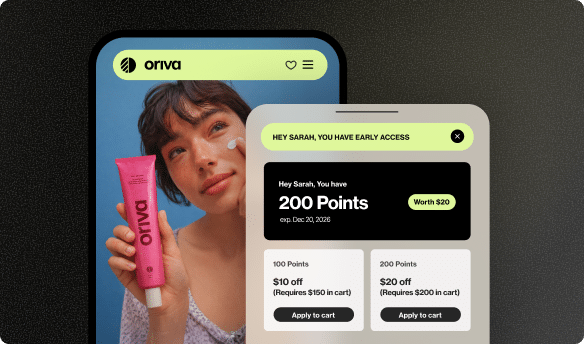
This is where Yotpo Loyalty offers a decisive advantage for new ecommerce businesses. It allows you to quickly design and launch a branded rewards program that truly resonates with your customers. You can offer points for purchases, create engaging VIP tiers with exclusive perks (such as early access to sales or free shipping), and even reward customers for valuable actions, like referrals or social media engagement.
Planning for this before you’re swamped with orders means you’re building retention into the very DNA of your business.
Establishing Direct Lines of Communication: Email & SMS Marketing
Even with a brand new store, you need to start building your marketing lists immediately.
Email and SMS are your direct, owned channels to communicate with interested shoppers and customers. The ROI here is undeniable: email marketing still boasts an ROI of up to $42 for every $1 spent, and SMS open rates often exceed 90%.
You need to capture email addresses and SMS opt-ins from day one, in a compliant manner. This can be achieved through well-placed sign-up forms, pop-ups offering an incentive (such as a discount on their first order), or at checkout. Then, you need the tools to engage these subscribers effectively.
Step 6: Pre-Launch Checklist & Going Live!
You’re almost there! Before you officially “flip the switch,” run through this final checklist:
- Final Testing:
- Place test orders with every payment method.
- Test your abandoned cart flow.
- Check all shipping configurations.
- Verify that all contact forms and email/SMS sign-up forms are functioning properly.
- Ensure all website links are correct.
- Test site speed on both desktop and mobile devices (aim for a load time of under 3 seconds).
- Install Google Analytics 4 (GA4): Ensure tracking is set up correctly.
- Set Up Google Search Console: Submit your sitemap.
- Review Legal Pages: Ensure your Privacy Policy, Terms of Service, Shipping, and Return policies are visible and accurate.
- Backup Your Site: Perform one final backup before going live.
Going Live: This typically involves updating your domain name’s DNS records to point to your new e-commerce platform’s servers. This change can take a few hours to propagate.
Step 7: Post-Launch: Marketing, Analyzing, and Scaling
Congratulations, your store is live! But the journey doesn’t end here.
Your First Marketing Campaigns
Now it’s time to drive traffic. Consider:
- Paid Advertising (PPC): Google Ads, Facebook/Instagram Ads to get initial visibility.
- Social Media Marketing: Build your presence on relevant platforms.
- Content Marketing: Start a blog, create valuable content related to your niche.
- Influencer Marketing: Partner with relevant influencers.
Monitoring Key Ecommerce Metrics
Track your performance closely:
- Conversion Rate: What percentage of visitors are making a purchase?
- Average Order Value (AOV): How much are customers spending per order?
- Traffic Sources: Where are your visitors coming from?
- Customer Acquisition Cost (CAC): How much does it cost to acquire a new customer?
- Customer Lifetime Value (CLTV): The total value of a customer over their relationship with your brand.
Optimizing and Iterating
Use the data you collect to improve continuously.
A/B test your product pages, your email campaigns, and your ads. Listen to customer feedback. Ecommerce is an ongoing process of learning and optimization.
Conclusion: Your Ecommerce Journey Starts Now
Starting an ecommerce business in 2026 is an exciting venture, filled with opportunity.
By following a structured approach—from identifying your niche and crafting a solid business plan to selecting the right platform and, crucially, planning your customer retention strategy from the outset—you set yourself up for success.
Remember, launching your store is just the first step.
The real work and reward come from building lasting relationships with your customers. In today’s competitive landscape, this means leveraging powerful tools to establish trust through authentic reviews, foster loyalty with engaging rewards programs, and communicate effectively through personalized email and SMS messaging.
For ambitious brands looking to build not just a store but a thriving community of repeat customers and advocates, integrating these critical functions onto a unified platform like Yotpo provides a powerful advantage. It ensures that from your very first sale, you have the infrastructure in place to maximize customer lifetime value and build a resilient, profitable ecommerce business for the years to come. Your journey is just beginning.











 Join a free demo, personalized to fit your needs