









Let’s face it: the old “growth at all costs” playbook is officially retired. If your strategy still leans on brute-force acquisition and manual workflows, you’re fighting a losing battle against your own P&L. The data from late 2025 is clear—cheap digital ads are history, and the “mobile gap” is quietly siphoning billions from the industry’s bottom line.
We are now in an era of “steady but selective” growth, where top-line revenue is just vanity and profitable retention is sanity. The path forward isn’t about working harder; it’s about building a ruthlessly efficient, AI-first infrastructure that values long-term loyalty over the sugar high of a one-time sale.
Manual data entry, support queues, and “gut-feeling” decisions are no longer just outdated—they are dangerous capital drains. Welcome to the age of Agentic Commerce.
Key Takeaways: Retail Industry Benchmarks 2026
- The Mobile Crisis: Mobile drives traffic but fails to convert. The 140-basis-point spread between e-commerce growth and total retail sales growth masks a critical failure: mobile conversion lags desktop by nearly half.
- Loyalty is Economics, Not Emotion: With a retention rate of just 63%, retail has the “leakiest bucket” of any major industry. Increasing retention by 5% can boost profitability by 25% to 95%.
- AI is the New Traffic Engine: Traffic from generative AI sources has exploded, showing a 1,200% year-over-year increase. If your brand is not optimized for Large Language Models (LLMs), you are invisible.
- The Returns Tax: The industry surrendered $890 billion to returns in 2024. Preventing this through AI sizing and fit-tech is now a margin requirement, not a feature.
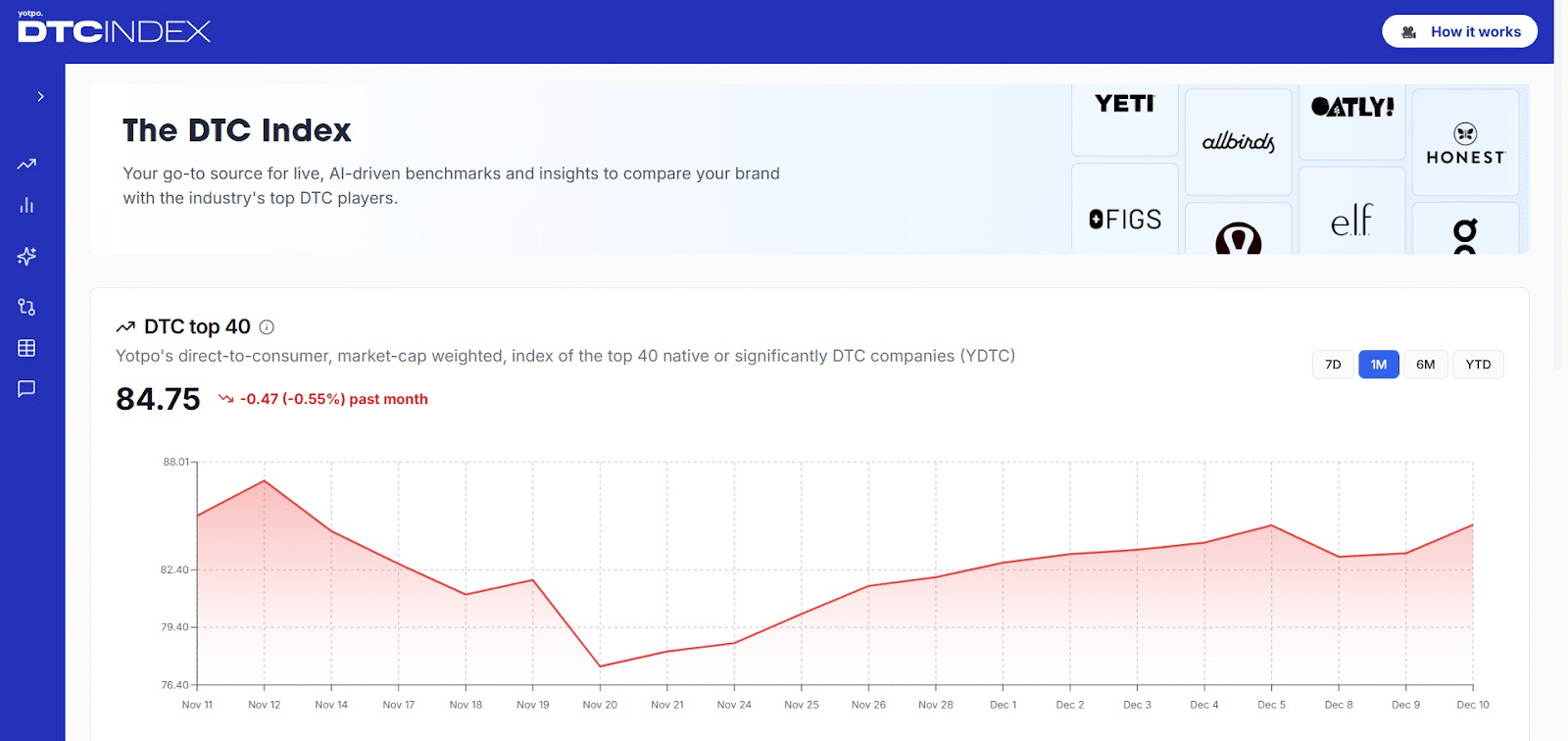
- Profitable DTC is the Only DTC: As evidenced by the Yotpo DTC Index, markets are punishing “growth-only” brands while rewarding the operational discipline of profitable players like Warby Parker.
The New Economic Reality: Stabilization and Scars
The macroeconomic volatility that defined the early 2020s has settled into a “soft landing,” but the consumer psyche has been permanently altered. While Real GDP is projected to rise by 2.4% in 2025, and inflation has cooled to 2.3%, the “cost of living” crisis has left a scar. Price levels remain elevated, forcing a structural adjustment in household budgeting.
This environment has birthed the “Lipstick Effect” on a massive scale. Consumers are bypassing big-ticket items in favor of affordable luxuries—a trend clearly visible in the Yotpo DTC Index, where brands like e.l.f. Beauty is posting 28% net sales increases. Conversely, the “Experience Economy” is cannibalizing retail share-of-wallet, with 80% of executives expecting consumers to prioritize doing over buying.
The Tariff Shock
We cannot ignore the geopolitical friction. The mere rumor of sweeping tariffs in April 2025—dubbed “Liberation Day” by cynics—sparked a market selloff. In response, 87% of online merchants have raised prices to shield margins. The winners in 2026 will be those with the pricing power to pass these costs on without breaking the bond of loyalty.
The Physics of the Funnel: Why You Are Losing Revenue
The aggregate numbers are deceiving. While global e-commerce sales are projected to hit $6.86 trillion, the efficiency of the funnel is degrading. You are paying more to get people to your site, only to lose them at the goal line due to friction that should have been eliminated years ago.
The Conversion Crisis
The global e-commerce conversion rate is benchmarking at 3.13%. However, this average hides a catastrophic divide:
- Desktop Conversion: ~4.8%
- Mobile Conversion: ~2.9% to 1.8%
This “Mobile Gap” is the single largest operational failure in modern retail. Your customers are on their phones, but they are buying on their desktops because your mobile experience is fraught with friction. We are seeing a “mobile penalty” where mobile cart abandonment spikes to 78.26% – 86%.
Traffic Sources: The Trust Deficit
Not all traffic converts equally. The data proves that trust drives revenue:
- Email Marketing: 10.3% Conversion. This is your loyal base.
- Social Media: 1.5% Conversion. Despite the hype of social commerce, “cold” social traffic is inefficient. It is a discovery channel, not a conversion channel.
Strategic Implication: Stop treating social media as a direct response ATM. Use it to build the brand halo, then move users to owned channels (Email/SMS) where conversion is 6x higher.
The Loyalty Imperative: Retention is the New Acquisition
In a world of signal loss and rising CAC, acquisition is vanity, retention is profit. The retail industry currently suffers from a concerning 63% customer retention rate. Compare this to the banking sector (75%) or media (84%). This gap reflects structural inefficiencies in how brands invest in long-term customer relationships.
The Mathematics of Loyalty
The economics are indisputable:
- Probability of Sale: You have a 60-70% chance of selling to an existing customer, versus 5-20% for a new one.
- Spend Multiplier: Repeat customers spend 67% more than new buyers.
Reviews as Trust Infrastructure
This is where the role of reviews and user-generated content (UGC) shifts. Reviews are not just conversion boosters for a product page; they are the bedrock of long-term trust. In the “Lipstick Effect” economy, where consumers are scrutiny-heavy and value-conscious, social proof is the only currency that matters. A manual approach to collecting this data—emailing customers one by one—is a waste of human capital. AI must be deployed to solicit, analyze, and syndicate this social proof automatically.
Agentic Commerce: The AI Revolution
2025 is the year AI graduated from “backend optimization” to “frontend buyer.” We are witnessing the rise of Agentic Commerce, where consumers use AI agents to shop for them.
The Explosion of AI Traffic
The data is staggering: traffic from generative AI sources to retail sites increased by 1,200% year-over-year in October 2025.
- Higher Intent: Consumers arriving via AI are 16% more likely to convert.
- Better Engagement: These visitors spend 44% more time on site and have a 31% lower bounce rate.
This changes the SEO game entirely. You are no longer optimizing for keywords; you are optimizing for LLM visibility. Your product data must be structured so that an AI agent can read it, understand it, and recommend it. If your data is messy, you do not exist to the AI agent.
Operational Automation is Non-Negotiable
Manual operations are increasingly inefficient. 92% of businesses are already leveraging AI-driven personalization tactics, with many seeing an ROI of $20 for every $1 spent.
- Customer Support: Human agents answering “where is my order” (WISMO) tickets is a misuse of funds. AI agents must handle 80% of routine inquiries.
- Theft Prevention: Biometric-powered AI solutions are now critical to curb internal theft.
The Returns Crisis: The $890 Billion Leak
We have allowed a culture of “buy bracket” (buying multiple sizes to return the rest) to rot our margins. The total cost of returns hit $890 billion in 2024. During the holiday season alone, 28% more merchandise came back than the previous year.
The Fix: You cannot purely policy your way out of this (though tightening return windows helps). You must solve the root cause—uncertainty.
- High-Fidelity Visualization: 3D and AR must be standard.
- AI Sizing: Algorithms that predict fit based on purchase history are mandatory.
- Preventative Logistics: Using AI to flag “high risk” serial returners before the purchase is approved.
The DTC Benchmark: Profitability or Death
The Yotpo DTC Index reveals a clear bifurcation in the market. Brands that prioritized rapid top-line growth without profitability are now under pressure, while those focused on operational discipline and sustainable economics are outperforming.
Diversification Wins
The Index also shows that pure-play DTC is risky. The winners are diversifying. Warby Parker partnering with Target and expanding physical stores (over 300 locations) proves that Unified Commerce is the benchmark. Even Lululemon is seeing its growth driven by international expansion (China +25%) rather than domestic saturation.
Emerging Channels: Retail Media & Social
Retail Media Networks (RMNs)
If you are a retailer and you are not selling ads, you are leaving high-margin revenue on the table. Global retail media spend is projected to exceed $300 billion by 2030, outpacing linear TV. This is the new margin shield against rising COGS.
TikTok & Social Commerce
While conversion is lower, the volume is undeniable. TikTok’s U.S. sales hit $15.8 billion, capturing nearly 20% of the social commerce market. It is the new “mall”—a place for hanging out and discovery.
Conclusion: Automate or Abdicate
The benchmarks for 2026 are not suggestions; they are the survival threshold. A 3% conversion rate is no longer “good enough”—it is a sign of friction. A 63% retention rate is a crisis. The era of throwing bodies at problems—manual reviews collection, manual data entry, manual support—is over. It is too slow and too expensive.
You must pivot your capital allocation immediately:
- Defund acquisition that doesn’t have a clear LTV payback.
- Reallocate budget to AI infrastructure that automates the loyalty loop.
- Treat mobile as your primary storefront, not a responsive afterthought.
The future belongs to the “Agentic Retailer”—lean, automated, and obsessively focused on the lifetime value of the customer. Everyone else is just renting traffic.
Frequently Asked Questions
1. Why is the “Mobile Gap” considered the biggest immediate opportunity for retailers?
Mobile devices drive the majority of traffic but suffer from a conversion rate of just 1.8% to 2.9%, compared to ~4.8% for desktop. Closing this gap by even a fraction—through one-click wallets like Apple Pay and “thumb-first” design—can unlock billions in revenue without spending a dime more on ads.
2. How significantly does AI traffic perform better than traditional traffic?
The difference is transformative. Shoppers arriving via generative AI sources are 16% more likely to convert and spend 44% more time on site. They arrive pre-qualified by the AI agent, meaning they are lower in the funnel and ready to buy.
3. Is the “growth at all costs” DTC model officially dead?
Yes. The Yotpo DTC Index shows clearly that markets are punishing revenue growth that comes with high burn and rewarding profitable efficiency. Investors now demand EBITDA expansion, not just top-line vanity metrics.
4. What is a “good” retention rate for a retail brand in 2026?
The industry average is 63%, which is poor compared to other sectors. A “good” benchmark to aim for is 70%+. Brands achieving this are utilizing emotional loyalty programs rather than just transactional points.
5. How much is the returns crisis actually costing the industry?
It is an $890 billion annual tax on the industry. With return rates rising 28% year-over-year, retailers must invest in fit-tech and AI prediction to stop returns before they happen.
6. Should we still be investing in organic social media given the low conversion rates?
Yes, but change the KPI. Social media converts at a low 1.5%, but it accounts for a massive share of discovery. Use social to drive awareness and capture first-party data (emails), then convert them via high-performing channels like email (10.3% conversion).
7. What is the “Lipstick Effect” and how does it impact 2026 strategy?
The “Lipstick Effect” is the consumer shift toward affordable luxuries during economic tightness. Brands like e.l.f. Beauty are thriving (+28% sales) by offering high-quality, low-price “treats.” If you sell high-ticket items, consider introducing lower-priced entry points to capture this spend.
8. How are tariffs impacting pricing strategies?
The threat of tariffs has forced 87% of merchants to raise prices. The benchmark strategy is to protect margins by passing costs on, but mitigating the sting through improved loyalty perks and product value.
9. What is “Agentic Commerce”?
It is the phase of retail where AI agents act as shoppers. Instead of a human searching Google, they ask an LLM to find the best product. Retailers must optimize their technical schema to ensure these AI agents can “read” their catalog and recommend their products.
10. Why are reviews critical for loyalty, not just conversion?
Reviews build the trust required for retention. In an era where consumers are skeptical of marketing claims, authentic User Generated Content (UGC) validates the quality that leads to a second purchase. Collecting this manually is obsolete; AI must automate the solicitation and display of this social proof.











 Join a free demo, personalized to fit your needs