



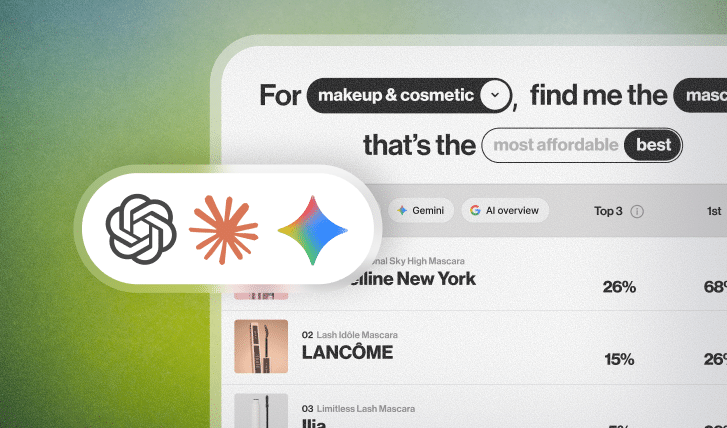






Generative AI boosts ecommerce sales by pulling in a growing pool of shoppers. These shoppers convert at a premium once they land on a retail site. AI traffic to US retail sites rose 393% year over year in Q1 2026, per Adobe Analytics data reported by TechCrunch.
That changes what AI for retail means, beyond writing product copy faster. It also covers personalization, merchandising, and a growing AI-search channel. That channel shapes whether a brand shows up, and sells. It happens when a shopper turns to an AI engine instead of a search bar.
Key takeaways
- AI affects retail revenue through several distinct levers. These include content production, personalization, merchandising and product data, and a growing AI-search channel.
- AI-referred shoppers don’t act like typical site visitors. They convert better and spend more once they arrive, per Adobe Analytics.
- Reviews and other genuine customer content appear to carry real weight when AI engines make a pick. Review programs and AI-presence work can reinforce each other.
- A strong program rests on three coordinated pieces: tech readiness on a brand’s own site, content worth citing, and a presence in the third-party places AI tools often look.
- The sales impact tends to show up earlier in the shopping journey. It happens during research and comparison, well before checkout. Treating AI presence as a bottom-funnel tactic misses where it pays off.
What “Boosting Ecommerce Sales With Generative AI” Actually Means
The phrase gets used to describe two different things. Mixing them up leads to wasted effort. The first is AI as a production tool. It writes product descriptions, makes personalized recommendations, and drafts marketing copy. It also summarizes reviews faster than a human team could alone.
The second is AI as a search channel. More shoppers now ask ChatGPT, Gemini, or Google’s AI Mode to recommend a product. They then buy from whichever brand shows up in that answer.
Both affect revenue, but through distinct paths. A team that only invests in the first one leaves the growing edge on the table. Writing better product copy with AI tools can improve on-site conversion. Showing up well when an AI engine does the recommending brings in a stream of warm-intent traffic. That traffic arrives before a shopper ever reaches the product page. It is the same pattern behind the traffic and conversion numbers above.
Why This Matters Now
Shopper behavior has already shifted. About 49% of US adults say they have used an AI chatbot such as ChatGPT or Gemini. That finding comes from Pew Research Center’s 2026 study. That’s not a niche behavior anymore. It’s nearing half the adult population.
Retailers are moving too. The pace varies depending on how deep the AI work goes. 91% of retail and CPG companies say they are either actively using or assessing AI. That’s per NVIDIA’s third annual State of AI in Retail and CPG survey. That figure covers broad AI adoption across use cases like supply chain planning, forecasting, and pricing. It’s not AI-visibility work specifically.
What ties consumer adoption to a sales line is the money moving through the channel. During Cyber Week 2025, AI influenced about 20% of orders and roughly $67 billion in global online sales. That’s per Salesforce. That was out of $336.6 billion in total Cyber Week sales. It was up 7% year over year, per the same source. That’s real spending during one of retail’s biggest weeks, not a small pilot program.
Where Generative AI Moves Ecommerce Sales
The sales impact of AI in retail breaks down into four areas. Each one contributes on its own. They compound further when a team invests in more than one at a time.
Content at Scale
AI can draft product descriptions, category page copy, size guides, and blog content. It works far faster than a manual process allows. Used well, this closes a gap that costs sales quietly. It fixes thin or missing product content that leaves a shopper unsure enough to abandon the page.
Used carelessly, though, AI produces bland copy. That copy reads the same across a hundred SKUs and does little to build trust. The gap between the two outcomes comes down to one thing. It’s how much real product and review detail feeds the process.
The content that performs best draws on real product detail and real shopper language. It skips generic marketing words. AI systems can draw on structured data, page content, and other signals, and often use that mix when forming an answer for a shopper. Content grounded in specifics, materials, sizing, and real use cases tends to work well for both audiences. It serves the human reader and any AI system summarizing the page.
Personalization Shoppers Actually Notice
AI shapes what a shopper sees: product picks, custom email, on-site content tuned to browsing history. A shopper might notice a pick that felt oddly on target, like an email that knew they wanted running shoes. Adobe‘s numbers suggest that shift changes how a purchase feels. Among consumers who use AI for online shopping, 79% feel more confident in a purchase after using an AI assistant. Returns follow suit: 69% of that same group say they’re less likely to return an item AI helped them buy.
Fewer returns and higher purchase confidence both flow straight to the bottom line. Returns are one of the quieter costs in retail. Confident shoppers, in turn, tend to complete the checkout they started.
Merchandising and Product Data
AI also supports the less visible merchandising work. It generates and cleans up structured data, and flags uneven product attributes across a catalog. It also helps a team decide which pages need care first. None of this is customer-facing. But a catalog that’s accurate and consistent is easier for both shoppers and AI systems to navigate. That, in turn, cuts the confusion that drives returns and abandoned carts.
AI-Search Visibility: The Fastest-Growing Lever
The newest and fastest-growing piece is showing up inside AI tools themselves. Shoppers use AI tools to research, compare, and shortlist products well before they buy. A shopper comparing running shoes might ask an AI assistant to shortlist the best picks for flat feet. That happens long before visiting any retailer’s site.
Among US adults who use AI chatbots, 42% say they use them to search for information. That’s per Pew Research Center. Product research is one of the most common reasons people give for that.
That’s an important distinction for how a team should think about this channel. AI mainly shapes the research, comparison, and shortlisting stage of the journey. It doesn’t shape the instant a shopper checks out. A brand that shows up clearly while a shopper is still comparing options gains a real advantage. That edge lasts until the shopper narrows down to a final choice. It holds true even when the purchase happens through a different channel.
How AI-Referred Shoppers Behave Once They Arrive
Traffic quality matters as much as traffic volume, and AI-referred visitors are worth extra care. Visitors who arrive from AI sources spend about 48% more time on site than other visitors. That’s per Adobe Analytics reported by TechCrunch. They also view roughly 13% more pages per visit, per the same source.
That engagement translates into revenue. By March 2026, AI traffic was converting 42% better than non-AI traffic. That’s per Adobe Analytics data reported by TechCrunch. Revenue per visit was also running 37% higher, per the same report.
Deeper engagement is a useful signal. But it also raises the stakes for what a brand shows that traffic once it lands. A shopper who arrived because an AI engine suggested a specific product often browses several more pages once there. That shopper is judging the brand more closely than a typical visitor. Thin product pages or spotty information costs more with this audience, not less, because they’re paying closer attention.
The Role of Reviews and Authentic Content
Reviews sit at an interesting crossroads in all of this. Shoppers still lean on them heavily. 84% of Americans say they trust online product reviews. That’s according to a January 2026 survey reported by Digital Commerce 360. AI tools are now part of how shoppers process that review content, rather than replacing it. 33% of consumers who use AI while shopping turn to it to help interpret reviews. That’s per an IBM and NRF study.
Real shopper voices carry a kind of detail that’s hard to fake. AI systems trained on how people talk about products online may weigh that same content more heavily when forming a pick. That’s a hedge worth taking seriously, though, not a settled fact. The exact internals of how any AI engine ranks or trusts a source aren’t public.
The pattern that’s measurable sits on the human side. Shoppers read several reviews before buying, and keeping a review program active keeps that content fresh for shoppers, and potentially useful to any AI system drawing on it.
A Practical Program: Three Coordinated Levers
A practical program approaches this as three coordinated pieces rather than a single project. Each piece addresses a distinct point of failure.
- Onsite readiness. This covers structured data and schema markup that make products machine-readable. It also means clean internal linking. And it means product pages written clearly enough for a model to extract exact specifics without guessing.
- Content. Review-backed material on the brand’s own blog and product pages answers the real questions shoppers are asking. It comes from real shopper input, not bland copy.
- Activation. A brand builds a presence in forums, marketplaces, and groups. AI tools often reference these for a given niche. That presence should rest on genuine reviewer and shopper voices, not fake content.
Our framework treats these as partners, not a sequence. A brand that invests a modest amount in all three areas sees more consistent results. That beats perfecting a single piece while neglecting the other two.
Common Mistakes That Cost Ecommerce Sales
A few recurring mistakes show up often enough to call out.
- Publishing AI-generated content that isn’t grounded in real product detail or shopper language tends to read as generic. It can hurt trust rather than build it.
- Some teams skip the tech foundation: structured data, clean product pages, working schema. They expect content or ads alone to fix presence gaps.
- Treating AI presence as something that only matters at checkout misses the point. The evidence points to research and comparison as where it influences a decision.
- Not measuring the channel at all leaves a brand unable to tell how it’s trending. That includes whether AI traffic is growing, shrinking, or converting differently from the rest of the site.
- Letting review programs go stale costs a brand, too. AI systems and human shoppers alike seem to lean on recent, specific, and varied reviews. Both tend to trust these more than an old, thin set.
A Simple Starting Checklist
Most retail teams don’t need to overhaul their entire stack to start capturing this revenue. A simple starting sequence looks like this:
- Audit product pages and schema markup for tech gaps. These gaps can keep AI systems from reading a catalog well.
- Identify which AI engines and third-party sources already mention the brand’s niche. Note where competitors are showing up instead.
- Use AI to close real content gaps, such as thin descriptions, missing size guides, and unanswered common questions. Ground the content in real product and review data.
- Strengthen the review program itself. Real shopper voices can be among the strongest inputs for both human trust and AI-engine picks.
- Track results steadily, using a consistent way to measure AI search visibility. Look at whether presence improves, and whether it’s translating into qualified traffic and revenue.
That last step is where a lot of teams get stuck. Tracking AI presence well takes the right tooling, not a spreadsheet of manual prompts. This is the gap Yotpo Discover was built to close.
Where Yotpo Discover Fits
Discover is Yotpo’s purpose-built AI-visibility platform for ecommerce. It is built on Yotpo’s existing base of real reviews, verified purchase data, and loyalty signals. That base includes native review, loyalty, and order data. Discover tracks how a brand’s products appear across ChatGPT, Gemini, and Google’s AI Mode. It then deploys three coordinated agents, Onsite, Content, and Activation, to close the gaps it finds.
Beekman 1802 and David Protein both work with Yotpo Discover. Clear, specific product pages are the kind of content an AI assistant can often find and cite when it forms an answer.
Teams ready to turn AI-search traffic into real ecommerce sales can learn more and request a demo at yotpo.com/discover. Or they can start with a free AI visibility score from Yotpo. It gives a concrete read on where they stand before they decide where to focus first.
Frequently asked questions
What does it actually mean to boost ecommerce sales with generative AI?
It covers a few related but distinct parts. One is using AI to produce content and personalize faster. The other is improving how a brand’s products appear when shoppers ask AI tools like ChatGPT or Gemini for recommendations. Both affect revenue. But the AI-search visibility piece is newer. Based on current traffic and conversion data, it’s growing faster than most teams have budgeted for.
Do I need to choose between using AI to write content and optimizing for AI-search visibility?
No, and treating them as separate budgets tends to slow both down. Content built from real product and review detail tends to perform well for shoppers reading it. It also helps AI systems drawing on it to form an answer. The two efforts reinforce each other rather than compete for resources.
Which AI engines should ecommerce brands pay attention to?
ChatGPT and Gemini are among the most widely used chat assistants, alongside Google’s AI Mode. Other AI tools are part of the broader AI-search landscape and worth watching. But they’re not yet where most retail AI programs focus their effort.
Can a brand pay to get recommended inside an AI answer?
A brand cannot pay for a spot inside an AI answer. OpenAI began testing ads inside ChatGPT in 2026. Those ads appear as clearly labeled, separate placements. They don’t influence which products the AI engine naturally picks, per TechCrunch. Earning a citation inside the answer itself still comes down to the signals this article covers. Those signals are tech readiness, credible content, and real reviews.
How soon can a brand expect to see a sales impact from this kind of work?
Timelines vary by category and starting point. Results tend to compound rather than deliver an overnight jump. AI engines tend to re-crawl and re-weigh a brand’s signals, not all at once. Brands that address tech readiness, content, and review quality together see visibility improve faster. The traffic that follows tends to improve too, more than for brands working on just one piece.











 Join a free demo, personalized to fit your needs