



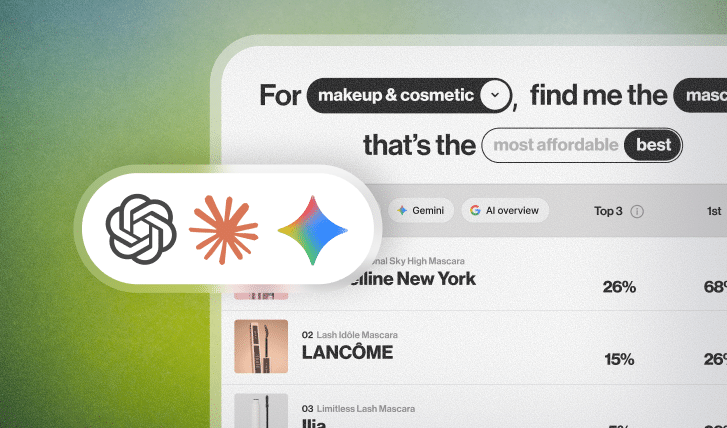






33% of shoppers who use AI while shopping turn to it specifically to help interpret product reviews before they buy, according to an IBM Institute for Business Value and NRF study of more than 18,000 consumers across 23 countries.
That single number points to something larger. Large language models don’t just answer general questions anymore. They now sit between a shopper and a purchase decision. Often they read reviews, compare options, and sometimes name a brand outright. For ecommerce teams, the question is how to show up well when that happens. That’s what ecommerce LLM optimization is about.
Key takeaways
- Ecommerce LLM optimization is the work of helping a brand’s products get named, cited, or recommended. It happens when a shopper asks an AI engine, like ChatGPT or Gemini, for help. They want to know what to buy.
- It differs from classic SEO in scope. Instead of tuning a handful of pages for ranking, brands need product-level data. That data must stay accurate and consistent across thousands of SKUs.
- Reviews, order history, and loyalty data can carry real weight with AI engines. They’re harder to fake than brand copy, and shoppers lean on them the same way.
- Ranking well in classic search results doesn’t guarantee an AI citation. The overlap between the two is still small, though it’s growing.
- A practical program covers three areas. It fixes technical readiness on the brand’s own site. It also produces content AI engines can cite, and it helps the brand show up in the third-party places they may draw on.
What LLM Optimization Means for Ecommerce
Large language model optimization is sometimes shortened to LLM optimization. It’s also grouped under the broader terms generative engine optimization (GEO) and answer engine optimization (AEO). All three describe the practice of helping AI systems find, understand, and recommend a brand’s products.
For an ecommerce brand, that means the AI engine can describe what’s for sale right. It also means explaining who it’s for and why it’s worth buying. It may then choose to name that brand over a rival.
The mechanics differ from a standard marketing channel. There’s no bid to place and no keyword to rank for in the old sense. Instead, an AI engine often draws on a mix of sources. Those include a brand’s own site, its reviews, and third-party pages that cover the topic.
Together, those sources shape the answer it gives a shopper. This work is a set of practices. Each one helps a brand show up more in that answer.
How This Differs from Traditional SEO for Online Stores
Classic ecommerce SEO targets a ranking system that returns a list of links a shopper chooses among. A product page competes on title tags, backlinks, and page speed. Success looks like a top-10 spot for a given search term.
Ecommerce LLM optimization aims at a new outcome. The goal is getting named inside the answer it gives, not ranked on a results page. That shifts which signals matter. Structured data and a clean rollout still count. So does something a ranking system rarely weighed: whether a product reads the same way everywhere online. And whether real customers back up what the brand claims matters too.
Why Ecommerce Needs Its Own Playbook, Not Just Generic GEO
Most writing about GEO is aimed at a brand or publisher trying to get one page cited. Ecommerce is a different problem at scale. A mid-sized online store might carry thousands of SKUs. Each one has its own size, material, price, and use case.
Picture an AI engine forming an answer. Maybe it’s about the best running shoes for flat feet, or a durable kids’ backpack. It tends to need product-level data, not just a polished homepage.
That means this work has to happen at the catalog level. It needs matching product details across each listing and structured markup on each product detail page. It also needs content that answers real shopping questions by category. A generic GEO checklist built for a single company blog won’t cover any of that.
Why LLM Optimization Matters for Ecommerce Right Now
The shift is already showing up in ecommerce traffic data. AI-referred traffic to US retail sites rose 393% year over year in the first quarter of 2026. By March 2026, that traffic was converting 42% better than non-AI traffic. That’s a reversal from a year earlier when it converted worse. That’s according to Adobe Analytics data reported by TechCrunch.
Retail and CPG businesses are paying attention too. 91% of retail and CPG companies said they are either actively using or assessing AI. That’s per NVIDIA’s third annual State of AI in Retail and CPG survey. That figure covers AI adoption broadly, across use cases like supply chain and pricing. It isn’t about AI-visibility work on its own.
None of this means AI closes the sale at checkout. Shoppers mostly use AI engines earlier. They research options, compare products, and narrow a shortlist well before they buy. A brand that shows up during that research phase has a real advantage. That edge carries through to when a shopper compares final options. It holds even when the purchase itself happens through a regular channel.
What Influences Which Brands Large Language Models Name
AI engines often don’t rank pages the way a search engine does. They can draw on a mix of crawled content and structured product data. A growing pool of third-party signals, like reviews and forum discussion, feeds the answer too. A brand’s own site is only part of what goes into it.
The Data Signals Models Appear to Draw On
AI engines can draw on structured data, page content, reviews, and other public signals when giving an answer. No AI company has published which signals matter most for a given question. So any claim about the exact mechanism is a general description, not a guarantee.
From the outside, what shows is which content tends to get cited. Pages with clear product details tend to show up more often than plain marketing copy. So do pages that reflect what real customers say. That tracks with how these models appear to weigh first-person detail as more credible than a brand’s own claims.
The Citation Gap in Ecommerce Specifically
One of the clearest signs that ecommerce needs its own approach is the citation gap. Only 16.7% of the sources Google cites inside AI Overviews also rank in the classic organic top 10 for that same query. That’s according to BrightEdge’s 16-month study of AI Overview citations.
Google AI Overviews is a distinct surface. Most LLM programs are built around the chat-based AI engines instead. Still, the pattern holds up broadly: ranking well and getting cited aren’t the same thing.
The gap is closing in ecommerce, though slowly. Citation overlap between AI Overview sources and the organic top 10 in the ecommerce vertical grew from roughly 3% to 13% year over year. That’s according to the same BrightEdge analysis. That’s real progress, but it’s still evidence that a strong organic ranking alone isn’t enough to guarantee an ecommerce brand gets named.
The Review and Data Signals That Carry the Most Weight
Structured data can help an AI engine read a product right. Reviews and purchase behavior tend to be what carries the most weight beyond that. They also give the shopper a reason to believe the product is worth naming.
Review Depth and Authenticity
84% of Americans say they trust online product reviews, according to a January 2026 Omnisend-commissioned survey reported by Digital Commerce 360. That trust doesn’t disappear when a shopper moves from a review section into an AI chat. If anything, it helps explain why 33% of shoppers who use AI while shopping now turn to it. They want help interpreting reviews, rather than just skimming them on their own.
That figure sits behind AI-assisted product research at 41% and ahead of AI deal-hunting at 31%. That’s per the same IBM Institute for Business Value and NRF study of more than 18,000 consumers across 23 countries cited earlier.
Authenticity matters as much as volume. Among shoppers rating the most trustworthy content types, user-generated reviews came in at 63%, just behind organic search and well ahead of brand-produced content. That’s per Emplifi’s 2026 Digital Authenticity in the Age of AI report. A thin review section gives an AI engine less to work with. So does one padded with plain five-star comments. A smaller set of detailed reviews works better.
Order History and Loyalty Data as a Trust Signal
Reviews aren’t the only shopper signal in play. Verified purchase data and loyalty activity can add another layer of trust. They reflect what people bought and kept buying, not just what they said. In our experience, brands with a loyalty program tend to build a richer record. A steady flow of verified reviews helps too, and it reflects real customer behavior. That record also tends to be more consistent, with more to draw on.
That’s a directional point, not a settled mechanism. No AI company has published exactly how it weighs order or loyalty data inside an answer. In short, this kind of first-party signal can help a brand show up more, without guaranteeing a citation.
Consistent Product Data Across the Web
The third signal is consistency. A product’s name, materials, sizing, and price should match everywhere. When they do, an AI engine tends to give a confident answer. That means matching across a brand’s own site, its retailer listings, and the places shoppers discuss it. When details conflict, the model has less to go on. It may then lean toward a rival whose data reads as more reliable.
Inconsistent data may reduce a model’s confidence in a source, though the exact effect isn’t published anywhere. Either way, keeping product data accurate and matching across each channel is a simple habit. It pays off in both classic search and AI-generated answers.
Building a Practical Ecommerce LLM Optimization Program
A working program isn’t a single tactic. We recommend treating it as joint work across three areas that reinforce each other. Fixing one without the others tends to leave real results on the table.
Onsite Readiness
Start with the brand’s own site. Add schema markup that makes products machine-readable. Keep internal linking clean so a crawler can move between related products. Write product detail pages clearly enough for a model to pull out clear facts.
That includes size, material, and use case, without guessing. A catalog locked behind heavy JavaScript rendering, or thin, templated copy, is hard to read right. That’s true for any system, human or AI.
Content Large Language Models Can Cite
Next comes content. Build review-backed material on the brand’s own blog. Answer the exact questions shoppers are asking AI engines. Pursue outreach that earns placement on third-party sites AI engines already trust for the topic. Content built from real customer experience tends to outperform plain marketing copy. That’s because it mirrors the kind of detail a model appears to value most in its answer.
Activation Beyond the Brand’s Own Site
The third area is activation. It starts with finding the forums, marketplaces, and groups AI engines cite most often. Target those for a given topic. From there, brands can mobilize verified reviewers and loyalty members to share real experiences in those spaces.
This is the piece most brands spend too little on. It happens off their own domain and is harder to control. Yet AI engines tend to pull from these outside spaces.
What to Measure
We recommend tracking a few things steadily. Track how often the brand gets named across ChatGPT, Gemini, and Google’s AI Mode. Focus on real shopping prompts. Watch which rivals show up instead and why.
Check whether improved visibility leads to qualified traffic and revenue, not just impressions. Tracking AI visibility takes purpose-built tooling rather than a spreadsheet of manual prompts. The same question can return a different answer from one week to the next.
How Ecommerce LLM Optimization Works Alongside SEO
It’s tempting to treat LLM work and SEO as competing budgets now that AI answers are reshaping how people search. But that framing misreads how the two interact. AI engines still tend to rely on crawled, indexed, well-structured content as raw input for their answers.
SEO teams have spent years building a foundation: clean site architecture, correct metadata, fast page loads. That same foundation can also make a brand more readable to an AI model. Treating LLM work and SEO as separate line items is a mistake. It’s one of the costliest mistakes a team can make. The two work best as connected layers of one shared strategy.
Where Yotpo Discover Fits
Most ecommerce teams don’t need to redo their whole marketing stack to start on LLM work. They need a clear-eyed read on where they stand now, and a ranked plan from there. That’s the gap Yotpo Discover was built to close.
Discover is a purpose-built AI-visibility platform for ecommerce. It’s built on Yotpo’s base of authentic reviews, verified purchase data, and loyalty signals. It tracks how a brand’s products appear across ChatGPT, Gemini, and Google’s AI Mode. Then it puts three agents to work: Onsite, Content, and Activation. Each agent helps close the gaps it finds.
Beekman 1802 and David Protein both work with Yotpo Discover to strengthen how their products show up in AI answers. Each keeps its product content clear, specific, and consistent across channels, with ongoing customer reviews adding to that foundation. That combination is the kind of content an AI assistant can find and cite.
Teams ready to start their own ecommerce LLM optimization program can learn more and request a demo at yotpo.com/discover, or get a free AI visibility score from Yotpo to see where they currently stand before deciding where to focus first.
Frequently asked questions
What is LLM optimization for ecommerce?
LLM optimization for ecommerce means helping large language models, such as ChatGPT and Gemini, find, understand, and recommend a brand’s products. It comes into play when a shopper asks for help deciding what to buy. The work covers three things.
It includes technical readiness on a brand’s own site. It also includes content built from real customer experience. Presence in the third-party places AI engines often look matters too.
How is ecommerce LLM optimization different from SEO?
Classic SEO optimizes for a ranking spot on a results page. Ecommerce LLM optimization instead aims at getting the brand named inside the AI-generated answer. That tends to depend more on other signals. Review depth, data consistency across a catalog, and third-party mentions all matter. The two aren’t really competing. AI engines still often rely on the same crawlable, well-structured content that SEO work produces.
Which AI engines matter most for ecommerce brands right now?
Yotpo Discover tracks how a brand’s products appear across ChatGPT, Gemini, and Google’s AI Mode. Rather than trying to rank one engine above another, a brand is better served by keeping product data clear and consistent. That way, any of them can represent it well. Other tools, like Perplexity and Claude, are part of the AI-search landscape and worth watching. Still, most ecommerce LLM programs focus their effort on those first three.
Do reviews really influence what an AI engine recommends?
Reviews appear to carry real weight. That’s largely because they’re harder to fabricate than brand copy. They also carry the specific, first-person detail these models tend to weigh as credible. This lines up with how shoppers themselves behave. 84% of Americans say they trust online product reviews, and a third now use AI tools to help interpret them.
How long does it take to see results from LLM optimization?
Timelines vary by type and starting point, and progress tends to compound rather than deliver an overnight jump. AI engines tend to re-crawl and re-weigh a brand’s signals over time. Brands that address technical readiness, content, and review quality often see results improve faster, compared with brands working on a single lever alone.











 Join a free demo, personalized to fit your needs