










For decades, the gleaming row of five stars has been the universal symbol of online product excellence. A perfect score, a quick glance, and a decision made – that was the old paradigm. But in 2026, online shoppers are far savvier, their expectations significantly more nuanced. The simplistic allure of a flawless rating is giving way to a deeper demand for authenticity, making genuine reviews, even those with constructive criticism, a brand’s most powerful sales asset.
This profound evolution in consumer behavior is a core finding from Yotpo’s comprehensive 2026 AI Shopper Behavior Report, “To Buy or Not to Buy.” This pivotal report delves into how modern shoppers are making confident purchase decisions in an increasingly complex digital world, where trust is earned not just by what you say, but by what your customers reveal. Dive into the full data-driven insights here: Yotpo 2025 AI Shopper Behavior Report
The Evolution of Trust: From Quantity to Quality (and Authenticity)
Since their inception in the 1990s, online reviews have been a cornerstone of consumer decision-making. Yet, for many years, this meant tedious sifting through pages of often conflicting opinions, scattered details, and endless scrolling. Shoppers were left to piece together the truth. Now, AI is a game-changer, but its power is magnified by the quality of the reviews it processes.
AI can instantly analyze and summarize thousands of real customer voices, transforming raw feedback into razor-sharp insights. It pulls out patterns, highlights pros and cons, and delivers the precise context shoppers need, fast. No more digging. No more guesswork. What was once buried is now front and center, making reviews not just post-purchase reflections but fast, trusted, and decision-driving assets from the very first click. AI is not replacing human feedback; it is amplifying its impact, allowing shoppers to feel smarter and more confident in seconds.
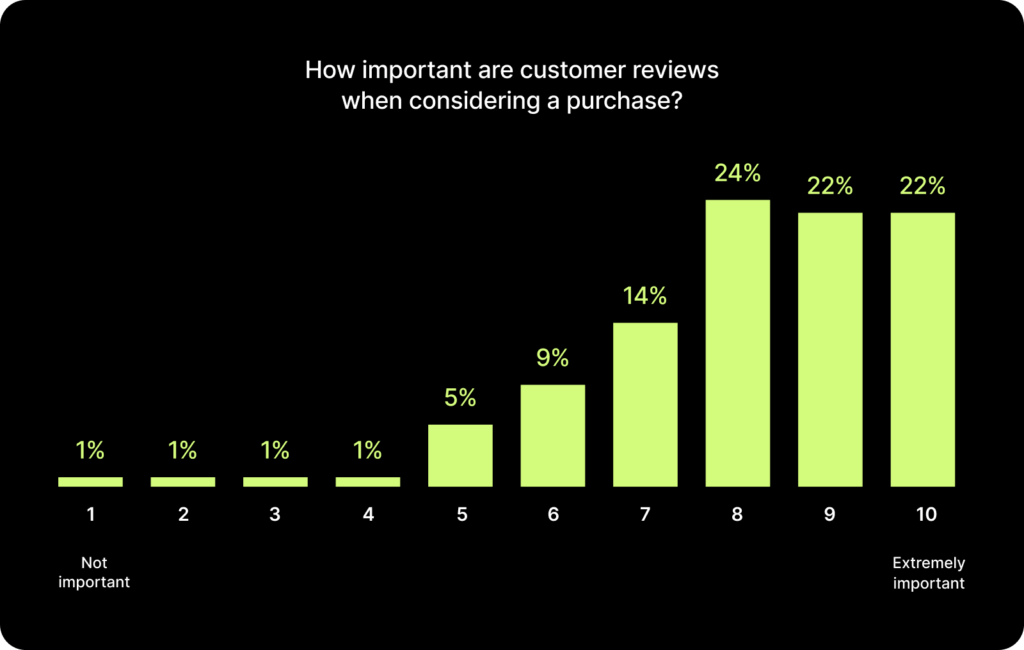
The data unequivocally supports this: 82% of shoppers rate reviews 7 or higher on a 1–10 scale of importance when deciding what to buy. This is not casual Browse; it is active reliance. Reviews are no longer just supporting content; they are as essential as price, product specifications, or brand reputation. They are critical decision-making tools.
The Competitive Edge: Social Proof That Actually Sells
In today’s crowded digital marketplaces, simply listing product specifications is not enough to stand out. Customer reviews have become the ultimate differentiator. They are the lens through which your product’s unique selling points are revealed via real-world use. They uncover unexpected benefits, clarify common concerns, and tell a product story that your carefully crafted marketing copy simply cannot.
Consider the stark reality: 66% of shoppers are hesitant to buy a product with fewer than five reviews. What happens if there are no reviews at all? That is not just a red flag; it is often a signal for shoppers to immediately abandon their carts or leave your site. As Alex, a 38-year-old shopper from Cleveland, US, stated, “If a product doesn’t have any customer reviews, that’s a big red flag for me.” Simone, 29, from Brighton, UK, echoed this sentiment, adding, “If a product only has 2 or 3 reviews, it’s hard to put much credibility behind those.”
This crucial insight underscores why review content must be treated as a performance asset. A robust, transparent review ecosystem does not just provide reassurance; it actively differentiates your brand. In highly competitive sectors like fashion, beauty, and electronics, this distinction is everything.
The report highlights which categories are most reliant on reviews:
- Electronics and tech gadgets lead the pack, with an astounding 85.5% of frequent review readers stating they always check reviews before purchasing. The complexity and financial investment in these items necessitate external validation.
- Clothing and beauty products follow closely, with nearly 7 in 10 shoppers frequently checking reviews before making a purchase. Fit, feel, and personal results are difficult to convey without user experiences.
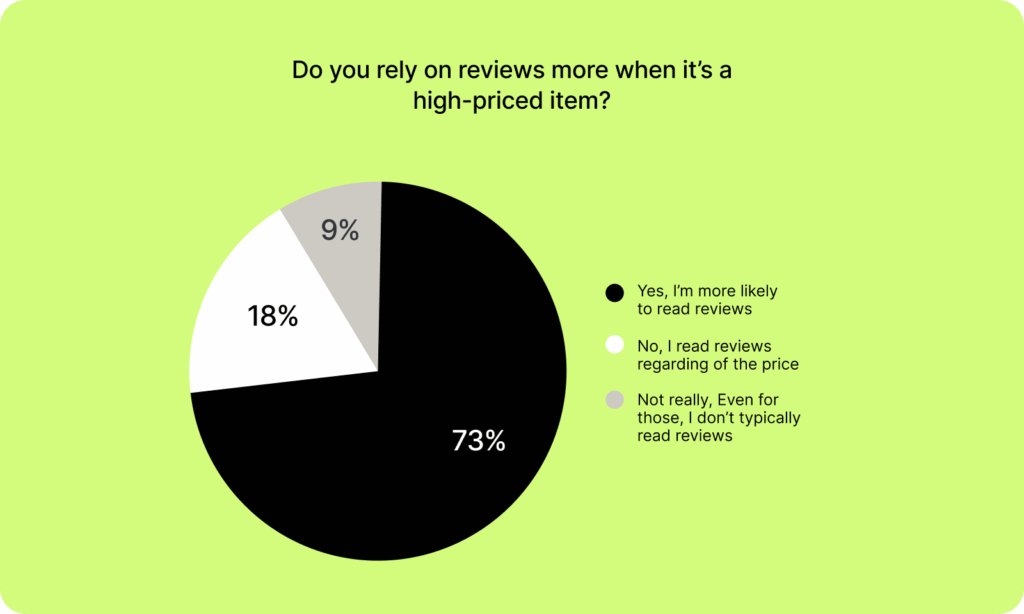
Another area where reviews are absolutely crucial is for high-ticket items. A significant 73% of shoppers said they are more likely to read reviews when making a high-ticket purchase. High prices inherently trigger elevated expectations, not only for product quality but also for review transparency. Shoppers want to know: “Is this really worth the investment?” This drives them to dig deeper, scroll longer, and investigate with a heightened sense of intent. “I’m going to spend that much, I need to be sure,” explained Jacob, 40, from San Francisco, US. Matthew, 25, from Sydney, Australia, added, “I check reviews carefully when it’s a bigger investment, even looking at how recent the reviews are.”
But simply accumulating reviews is not enough to gain a true competitive edge. What truly resonates with shoppers today is the feeling of realness. Shoppers are not just seeking proof that others have bought; they are seeking proof they can trust.
Truth Over Perfection: Why Negative Reviews Are Your Allies, Not Your Enemies
The modern shopper is not just passively browsing reviews; they are actively investigating them. They are scanning for patterns, seeking nuance, and assessing credibility based on authenticity, not just overwhelming positivity. Today’s consumers have a built-in filter, a keen radar for anything that feels overly polished, staged, or too good to be true. What they genuinely seek is not perfection; it is honesty.
This means that a complete absence of negative reviews does not inspire confidence; it actually triggers suspicion and raises significant red flags. Negative reviews, once feared by brands, are now increasingly viewed by consumers as crucial signs of legitimacy. Shoppers expect to see some critique; it is how they discern that a brand is not attempting to hide anything. Emily, 22, from Houston, US, articulated this perfectly: “How come there are no medium or low reviews? That seems like the company is hiding something.”
Brands must fundamentally shift their perspective away from the outdated notion that only positive reviews are good reviews. Genuine trust is forged in the grey areas: when brands demonstrate a willingness to allow imperfection to show, and crucially, when they respond with transparency, empathy, and decisive action.
Consider this powerful statistic: More than half of shoppers (53%) say a negative review about product quality or performance has made them reconsider a purchase. This highlights the potential impact of critical feedback. However, here’s the crucial pivot: of these shoppers, over half (56%) state that their ultimate decision depends on how the brand responds.
This means the brand’s response is the critical variable that can completely change the narrative. Kim, 28, from Los Angeles, US, explained, “The response and how quickly they respond are important. If I see a few bad reviews and no response from the brand at all, I think this product is bad.” Daniel, 36, from Seattle, US, added, “Show that you are genuinely replying to them and are taking steps to improve rather than just doing generic copy and paste responses.”
Therefore, it is not enough for brands to merely respond to negative reviews; they must do so with intention and authenticity. Avoid templated replies and generic, canned apologies. Instead, acknowledge the specific issue, offer a clear solution or a concrete next step, and demonstrate unequivocally that customer feedback leads to real, measurable improvements. A thoughtful, human response to a negative review can transform a poor experience into a powerful moment of brand credibility and trust.
Actionable Strategies for Building a Trustworthy Review Ecosystem
To meet this new standard of shopper expectation, brands must strategically collect, present, and leverage their reviews. It’s about building a review ecosystem that feels honest, accessible, and tailored to the buyer’s mindset.
Here’s how to elevate your review strategy:
- Comprehensive Product Comparison (Most Popular):
Embrace and Encourage Authentic Reviews; Don’t Fear Imperfection: A healthy mix of positive and negative feedback is the most effective way to build genuine trust and make your reviews feel real. This balance signals transparency and builds consumer confidence. Yotpo’s Reviews Atlas can be an invaluable tool here. It helps brands assess their authenticity score and pinpoint any gaps, such as a suspiciously low number of critical reviews, that might inadvertently erode shopper trust. A perfectly polished facade often looks less trustworthy than a genuine, albeit imperfect, one.
- Respond Thoughtfully and Strategically to Negative Reviews: Generic, copy-pasted responses are detrimental. Instead, craft constructive, human responses that clearly show you are listening, you understand the issue, and you are taking steps to address it. This approach can turn a potentially poor customer experience into a powerful moment of brand credibility. Leveraging tools like Yotpo’s AI-assisted comment tools can be highly beneficial here, offering smart suggestions for responding to all types of feedback quickly and effectively, while maintaining a human touch.
- Highlight the Most Relevant Content and Make it Easily Accessible: Shoppers are looking for specific information. Reviews that address common doubts or concerns (e.g., fit, material feel, durability, product accuracy, customer service quality) should be prominently featured and easy to find. Yotpo’s smart sorting capabilities are designed precisely for this. They automatically surface the most helpful and relevant reviews, providing shoppers with faster, more direct paths to confidence and purchase decisions. This saves them time and validates their decision-making process.
Reviews Across the Funnel: ROI That Extends Far Beyond Clicks
The influence of customer reviews is not confined to boosting shopper confidence; they strategically impact hard business metrics across the entire sales funnel, delivering measurable return on investment (ROI).
- Top of the Funnel – Trust Accelerators and Acquisition Efficiency At the initial stages of the funnel, reviews act as powerful trust accelerators. When prospective shoppers encounter authentic voices vouching for a product, they are significantly more likely to consider that product, even if they were previously unfamiliar with the brand. This heightened consideration translates into greater efficiency for your paid media efforts, as your ads lead to more qualified leads. The ultimate result is a measurable reduction in your Customer Acquisition Cost (CAC), making every marketing dollar work harder.
- Middle of the Funnel – Hesitation Reduction and Conversion Optimization As shoppers move into the consideration phase, reviews play a crucial role in alleviating lingering doubts and hesitations. They provide answers to the silent questions that often plague online buyers: “Will this truly fit me as expected?”, “Is it genuinely worth the price?”, “How long will it actually last?”, “Is the color accurate to the image?” By directly addressing these points of friction, reviews significantly reduce customer uncertainty. This reduction in friction directly translates into measurable improvements in your conversion rate, turning hesitant browsers into confident buyers.
- Bottom of the Funnel and Beyond – Retention and Long-Term Loyalty The impact of reviews extends far beyond the initial purchase. When customers feel that their expectations were accurately set and met – or even better, exceeded – by the product and the brand experience, they are significantly more likely to become repeat customers. This positive post-purchase experience, often validated by the reviews they read beforehand, fosters genuine customer loyalty. Loyal customers do not just return; they become brand advocates, further contributing to your authentic review ecosystem.
In essence, reviews serve as the trust layer that seamlessly guides shoppers forward, the social proof that imbues brands with credibility, and the real-world insight that transforms tentative browsers into committed buyers. They are an indispensable asset in the modern e-commerce landscape.
The Star Rating Reimagined: A Starting Point, Not the Full Story
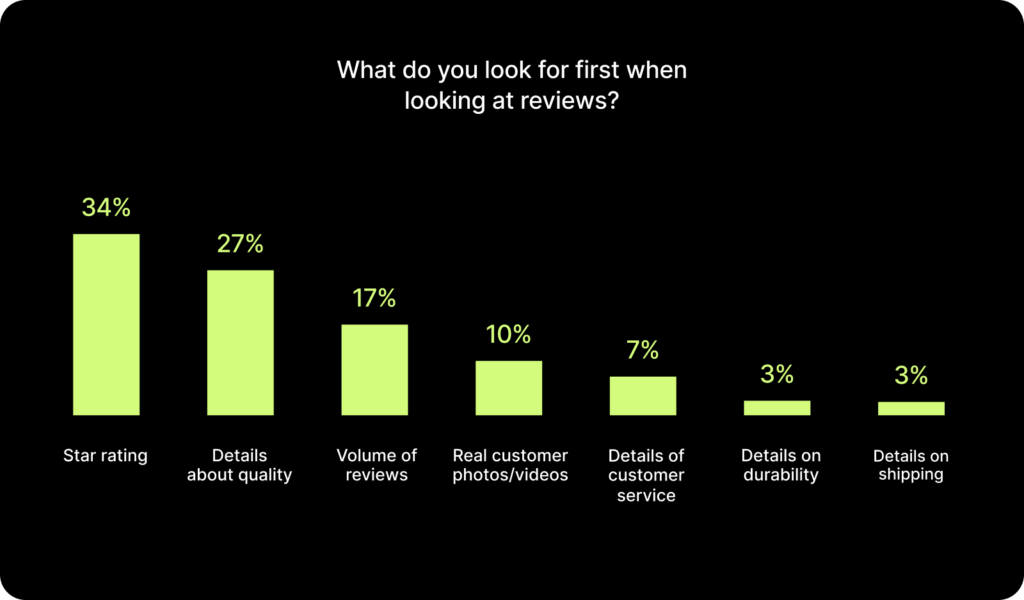
The familiar star rating—that compact row of yellow stars—remains a powerful first impression in the boundless digital aisle. It is fast, universally understood, and acts as an immediate credibility shortcut for 34% of shoppers who say it is the very first thing they look at when evaluating a product. It serves as an initial filter, quickly indicating whether a product is even worth their time. However, while stars might open the door, they rarely, if ever, seal the deal on their own.
Today’s consumers are far more sophisticated. They understand that a perfect 5.0-star rating, particularly when based on a small volume of reviews, can breed suspicion rather than trust. They know that the true value of a product is not merely found in an average score but lies in the narrative behind the stars: the sheer volume of reviews, the authenticity of the language used, the presence of user-generated visuals, and the freshness of the feedback. This nuanced approach is particularly evident among Millennials.
- 90% of Millennials told us they use star ratings as an initial filter but critically do not stop there. They instinctively move beyond the first impression to examine the broader narrative. For them, volume significantly enhances trust.
- A compelling 70% of Millennials reported trusting a high volume of reviews paired with a solid rating far more than the rating alone. As Noah, 38, from Manchester, UK, insightfully observed, “There’s a difference between if it is 4.4 and it’s 18 reviews, and it is 4.3, but there are 1,800 reviews.” The latter, despite a slightly lower numerical rating, conveys far greater social proof and reliability.
This trend is even more pronounced with Gen Z, who tend to be more inherently skeptical of isolated ratings:
- 90% of Gen Z shoppers report scanning the star rating first but then immediately shifting their attention to visuals, detailed review content, and recent posts to gain a better sense of real-world use.
- A significant 80% of Gen Z shoppers explicitly state that a high volume of reviews signals authenticity and safety, reinforcing the idea that social proof is most potent when it feels both genuine and abundant.
Interestingly, Gen X shoppers show a somewhat greater reliance on star ratings, with 34.5% saying they rely on them to inform purchase decisions, compared to just 26.4% of Gen Z. This generational difference suggests that brands should thoughtfully tailor how they present reviews to different audiences. Older generations might respond better to prominently displayed, high ratings, while younger consumers demand deeper transparency and richer detail to build trust.
The Psychology of “Good Enough”: Why Perfection Can Be a Red Flag
Our research also unveiled a counterintuitive but critical insight: the assumption that a higher rating is always better can be flawed. A perfect 5.0 rating, especially when supported by a small number of reviews, can actually spark suspicion rather than solidify trust. Shoppers today are acutely aware of the prevalence of fake reviews, curated feedback, and artificially inflated scores.
Kate, 32, from New York, US, voiced this common skepticism: “I think it’s pretty easy for companies to pay to get 5-star reviews or give incentives for 5-star reviews. So I like to look at more of the middle-of-the-road ones just to see what valid critiques of the products might be.”
James, 25, from Austin, US, added, “Brands should highlight real balanced reviews, not just the perfect five-star ones so we can trust what we’re seeing.”
This highlights that imperfection, particularly when contextualized with genuine feedback, can actually significantly enhance credibility. A few 3-star reviews that offer constructive criticism or detail specific user expectations help paint a more balanced and believable picture that shoppers are far more likely to accept. For the majority of shoppers, a rating between 4.3 and 4.4 stars hits the sweet spot – it is high enough to inspire confidence but just low enough to feel believable and authentic. As Jennifer, 40, from Chicago, US, affirmed, “For me, star ratings are very important… I would like to see at least 4.3 or 4.4.”
From Stars to Stories: The True Drivers of Trust
The modern shopper’s path to purchase is less about snap judgments and more about a progressive build-up of trust. Yes, the star rating might be the initial spark, but what truly ignites and sustains that flame is compelling storytelling. This comes in various forms: the sheer volume of diverse voices sharing their real experiences, the compelling user-generated images that show products in genuine, everyday use, and the authentic words that reflect true emotion, encompassing both the positive and the negative.
Shoppers are increasingly cross-referencing these cues. They meticulously look for consistency in language and themes across multiple reviews. They examine timestamps for recency. They compare the pros and cons highlighted in different feedback pieces. In this intricate landscape, brands that rely too heavily on a single metric like the star rating, without offering rich, compelling context, miss a monumental opportunity to connect more deeply and authentically with their audience.
Ultimately, star ratings are no longer the final word; they are merely the starting point. The most trusted brands intuitively understand that shoppers crave rich context and multifaceted social proof, not just abstract numbers. A high numerical score might effectively capture a shopper’s click, but it is the richness and authenticity of the entire review ecosystem that truly earns their purchase and cultivates lasting loyalty.
Conclusion: Trust Is the New Currency in E-commerce
In 2026, the digital storefront is an arena where authenticity reigns supreme. The savvy online shopper sees beyond the polished facade, seeking genuine experiences and unfiltered feedback from their peers. Your customer reviews are no longer just testimonials; they are the bedrock of your brand’s credibility, the engine of social proof, and the most compelling sales content you possess.
By understanding that negative reviews, when handled with grace and transparency, build more trust than a flawless record, and by recognizing that the story behind the stars matters more than the numerical average, brands can unlock unparalleled growth. Embrace the messy, human side of customer feedback. Cultivate a vibrant, authentic review ecosystem, and watch as it transforms hesitant browsers into loyal, confident buyers. The future of e-commerce belongs to those who prioritize truth over perfection.
How are you cultivating true authenticity in your customer review strategy?











 Join a free demo, personalized to fit your needs