







When AI visibility became a priority for ecommerce brands, the natural place to start was the website. That’s where the expertise already existed, where the content lived, where SEO had a decade of best practices to draw from. It made sense.
The question nobody had cleanly answered yet: do all engines look in the same places?
The short answer: No.
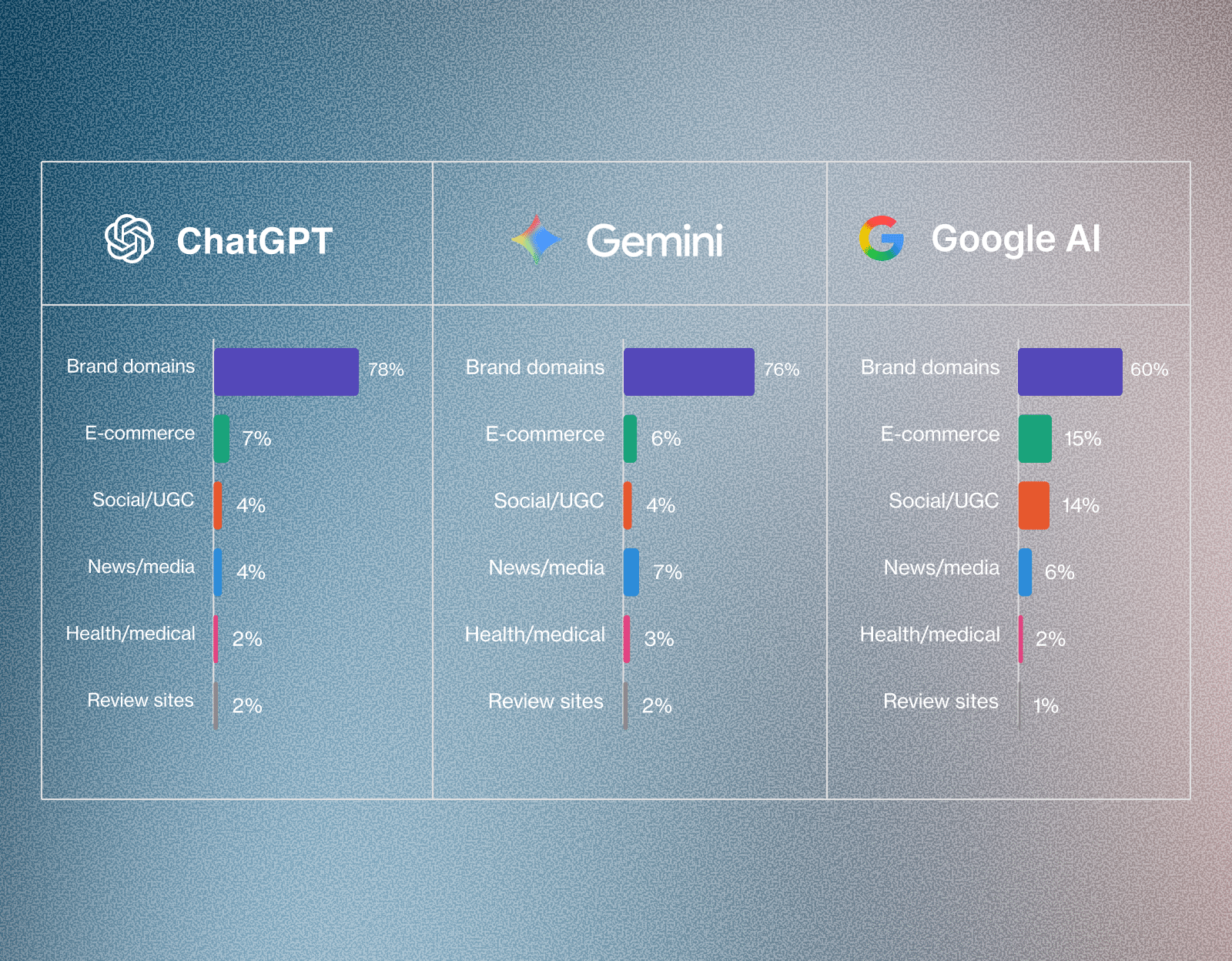
We classified every cited URL by domain type across ChatGPT, Gemini, and Google AI Mode. What we found was that yes, two of the three do want your website but the third has built its citations around something else entirely.
Six of Google AI Mode’s ten most cited domains are social platforms or Amazon, and most of that content is coming straight from the customers.
Key Takeaways
- Google AI Mode’s top cited domains are Reddit, Amazon, TikTok, YouTube, and Instagram, six of its top ten are social platforms or marketplaces.
- ChatGPT and Gemini both lean heavily on brand domains, with over 75% of their citations going to .com brand sites, including product pages with embedded reviews and customer content.
- Google AI Mode cites social and UGC content at more than three times the rate of the other two engines, 14% vs. 4% for ChatGPT and Gemini.
- At consideration stage, one in six citations across all engines comes from social and UGC content. Customer discussions, video reviews, and community comparisons are what the engines surface when shoppers are deciding.
- The review sites finding is counterintuitive: standalone review aggregators account for only 1-2% of citations, but reviews embedded on brand product pages are part of the brand domain category, the most cited source across all three engines.
How We Measured It
We classified all cited URLs into domain categories: news and media, e-commerce, social and UGC, reviews, health and medical, blogs, and brand domains. Brand domains cover brand-owned .com sites. E-commerce covers marketplaces and retail platforms like Amazon and eBay. Health/medical covers health information sites and wellness publishers. Review sites refers to standalone aggregators like Trustpilot and Yelp. For each engine, we measured what share of citations came from each category both overall and broken down by funnel stage.
Each Engine Has a Different Source Diet
ChatGPT and Gemini look nearly identical. Both pull the vast majority of their citations from brand domains. Things like product pages, policy pages, and brand-owned content that includes the reviews and community content living on those pages.
A well-structured brand site that answers buyer questions and surfaces authentic customer voice is the primary currency for those two engines.
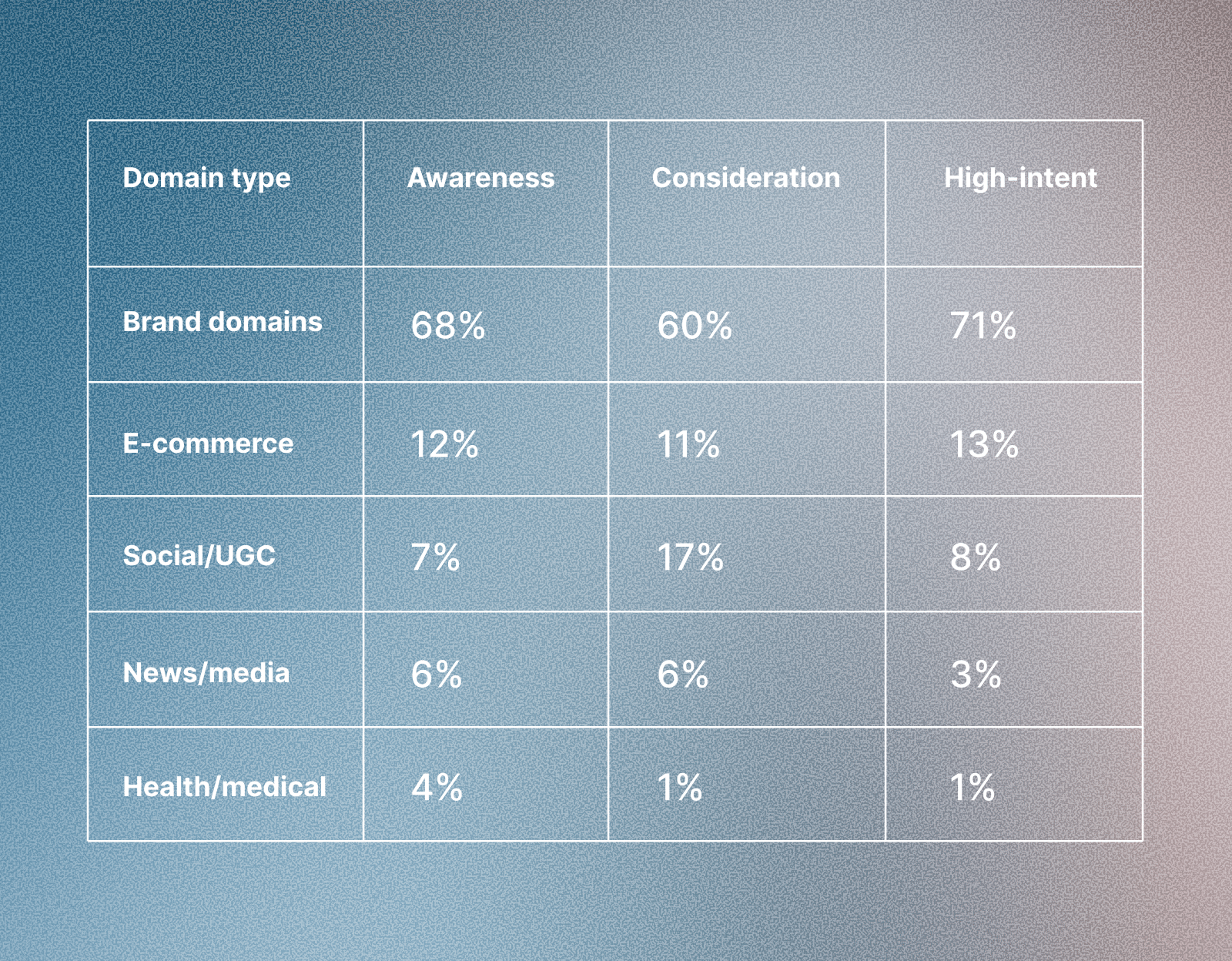
Google AI Mode is a different engine. Brand domains still make up the majority of its citations, but at 60% that’s a meaningful gap from the other two. Social platforms and e-commerce sites fill the difference, and when you look at its most cited domains specifically, six of the top ten are social platforms with Reddit at number one. It cites social and UGC content at more than three times the rate of ChatGPT or Gemini and that content is almost entirely generated by customers, not brands.
Source Preferences Shift by Funnel Stage
The source diet changes depending on what a shopper is asking, but one pattern holds true across all three engines.
Social and UGC spikes to 17% of citations at the consideration stage.
When shoppers are comparing options and asking direct questions like:
“Brand A vs Brand B” or “[brand] reviews”
Reddit threads, YouTube comparisons, and community discussion are heavily surfaced across all three engines. This is customer voice doing the work of consideration: organic reviews, unboxing videos, honest community takes. Brands with an active customer base generating this kind of content have a structural citation advantage at the stage where purchase decisions actually get made.
High-intent queries pull back toward brand domains and e-commerce sites. When someone asks a specific question about a return policy or shipping timeline, the engine returns to the source with the clear answer, which is your product page.
News and media content peaks at awareness. Broad category queries surface editorial coverage, and that signal fades as the shopper moves closer to purchase.
What This Means for Brands
Google AI Mode requires a social proof strategy, not just a website strategy.
Reddit threads, YouTube reviews, and TikTok content are first-class citation signals on this engine. A brand with strong website optimization and no social presence is structurally invisible to a meaningful share of Google AI Mode’s citations, the engine with the highest raw citation volume in our dataset. The brands winning here aren’t necessarily creating all that content themselves. They’re the ones whose customers are talking about them on these platforms. Activating your existing customer base to generate authentic content on Reddit, YouTube, and TikTok is how this presence gets built.
ChatGPT and Gemini reward your brand domain.
For these two engines, well-structured, authoritative brand content is what gets cited. That includes more than just copy, things like product pages that carry customer reviews, Q&As, and community content give the engines more to work with and more reason to return to the same source. Brands with clean, crawlable pages that surface genuine customer voice have the most defensible AI real estate on both engines.
The review sites finding deserves a closer read.
The 1-2% figure for review site citations refers specifically to standalone review aggregators as independent domains. Reviews embedded directly on your product pages are part of your brand domain, which accounts for 60-78% of citations depending on the engine. Review content matters. Where it lives matters too. Reviews hosted on your own site contribute to the most cited category across all three engines, not the least cited one.
News and media coverage drives awareness-stage visibility.
Editorial mentions spike at awareness and then fade. For brands trying to win broad category queries, media relations and PR are a direct input to AI visibility at the top of the funnel.
FAQ
Does this mean brands should shift budget away from their website toward social? The website is still the dominant citation source across all three engines. The shift is additive. The risk is treating website optimization as the whole picture when Google AI Mode is running on a significantly different source mix, and when the content that wins on that engine is predominantly generated by customers, not brands.
Does this mean reviews don’t matter for AI visibility? The opposite. The 1-2% figure refers to standalone review platforms as separate domains. Reviews that live on your product pages are counted under brand domains, the most cited category across all three engines. And the 17% social/UGC spike at consideration stage is the engines surfacing consumer sentiment to help shoppers decide. Customer reviews, community discussions, and authentic user content are heavily weighted when shoppers are comparing options. The question isn’t whether reviews matter — it’s where they live and whether your customers are generating the kind of conversation that shows up on Reddit and YouTube.
Which social platforms matter most for Google AI Mode citations? Reddit and YouTube account for the largest citation volumes. Reddit dominates at consideration stage, where community comparison threads are heavily surfaced. TikTok and Instagram are both in Google AI Mode’s top five overall. The common thread is that all of them are driven by customer-generated content, not brand-created content.
Why does social/UGC spike specifically at consideration stage? Consideration queries are comparison-focused, and that’s the kind of content that lives on Reddit and YouTube. When a shopper asks the engines to help them compare or evaluate, the most contextually relevant source is often an honest community discussion or a customer review video, not a brand’s own website.





 Join a free demo, personalized to fit your needs