



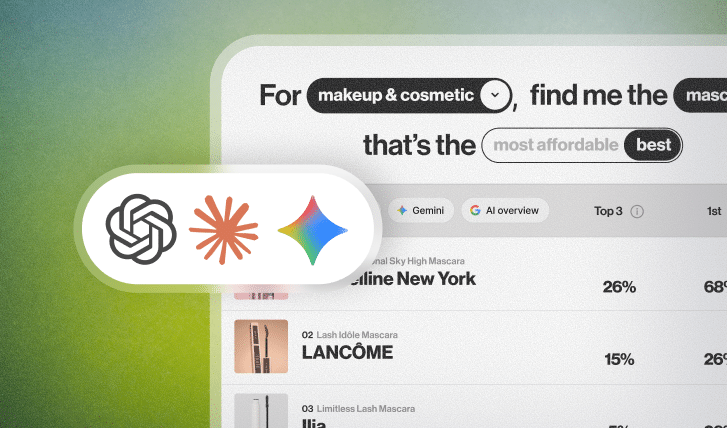






If you sell online, here’s the short version of Generative Engine Optimization (GEO): it’s the work of shaping your content, product data, and brand signals so AI engines cite and recommend your products. Classic SEO fights for one of ten blue links, while GEO chases the answer itself, meaning the reply ChatGPT, Gemini, or Google AI Overviews hands a shopper directly.
Buyers don’t find products the way they used to. Showing up now takes data that machines can read plus honest feedback from real shoppers. Clean product feeds help too. AI tools can pull from all of it.
Key takeaways
- Generative Engine Optimization (GEO) means getting your brand cited inside AI-written answers. Climbing the blue-link rankings isn’t the goal.
- In NVIDIA’s survey, about 91% of retail and CPG companies said they’re actively using or assessing AI. That figure covers AI adoption in general. It doesn’t isolate AI-visibility work.
- One forecast says AI answers could take 40% of organic search clicks by 2027.
- OpenAI said in early 2026 that ChatGPT had reached 900 million weekly active users. That’s a big crowd, and every one of them can ask for product advice.
- Adobe’s holiday 2025 survey found that 65% of consumers who use AI for online shopping felt more sure about a purchase because of it.
- Our five-stage framework ties it together: structured SKU-level data, authentic shopper proof, answer-ready content, off-site citations, and multi-engine tracking.
Why generative engine optimization matters for ecommerce
Shopping is drifting away from keyword lookups and toward chat-style answer engines. Not long ago, a shopper would type something like “best trail running shoe for wide feet arch support” and scan whatever came back. These days they ask a full question and spell out what they need. Then they expect one clear pick that weighs the details.
A shopper asks a chat engine for the best rain jacket for a cold-weather bike commute. It will often answer with a short list of picks, not ten links. Before it names a few jackets, it can weigh specs and reviews against outside opinions. With thin product data, your jacket may never make that shortlist.
Don’t file this under small tweaks to search. People now size up and buy products online in a different way. Old SEO ran on a few keywords that hinted at intent. AI engines can take plain language and context, then may combine product specs with what real shoppers say on other sites.
Brands that built their reach on keyword density now face models that paraphrase and compare. They don’t just list links. So what helps? The answer is clean product data, trusted voices beyond your own site, and markup in formats these engines can read.
Open your analytics before anything else. The data’s probably sitting there already. Put organic impressions next to referral visits from chat tools and see if the two curves pull apart.
Plenty of shoppers now ask AI tools to compare options and trim a shortlist. That goes beyond looking up a basic fact. If the language models behind those tools can’t read your catalog, your products may not appear in those answers.
How AI engines select sources and recommend products
Where does an answer come from? Many engines can fetch live pages first and then write the reply from those pages plus what they learned in training. People call that retrieval-augmented generation, or RAG. It may keep shopping answers fresh, though the engines don’t publish their full recipes, so treat the steps below as a simplified model.
When a shopper types in a question, an engine may work through steps like these:
- Intent extraction. The model can pull the prompt apart into product type, price ceiling, material needs, and use case.
- Information retrieval. Then the system may search its indexes and live web sources for candidate pages, product feeds, and forum threads.
- Source evaluation. Sources packed with facts and clean structured data may get favored, particularly when other sources back them up.
- Answer synthesis. Finally, the language model can write a comparison or a single pick, often with sources shown as footnotes or linked text.
In this simplified model, every step is a chance to win or lose a spot in the answer. If a model can’t read your product details during retrieval, it has nothing to weigh later. Pages with no clear facts leave it little to quote, too.
Vague marketing copy gives an engine little to work with. Glossy promo language is unlikely to help on its own. Content built on specific facts and exact numbers, backed by clear signs that shoppers agree, gives it far more to use.
SEO vs. generative engine optimization (GEO)
SEO and GEO share the same technical roots, but they part ways on goals and on how you measure success.
With SEO, you chase a high spot on a results page. That spot earns the click to your site. GEO wants something different: an AI answer that cites your brand as a trusted name.
They split in four main areas:
- Target surface. SEO is a race for ranking spots 1 through 10 on Google or Bing. GEO targets AI citations, chat answer summaries, and AI Overviews.
- Content structure. Keyword targeting, search intent matching, and full page depth carry the most weight in SEO. GEO shifts toward structured schema and machine-readable specs, plus information gain, meaning new facts your page adds beyond what others say. Easy-to-extract question-and-answer pairs help too.
- Authority signals. Domain rating and backlink counts, anchor text mix included, carry SEO. GEO leans more on entity checks and real shopper reviews. Even brand sentiment without links can count, as can agreement across outside sources such as forums.
- Performance metrics. A classic SEO dashboard tracks rankings, organic impressions, and click-through rate. The questions change once you measure GEO: how often does an engine cite you, and what share of voice do you hold inside AI answers? Sentiment and AI referral conversions belong on that list too.
GEO doesn’t replace SEO. Picture it as a second layer resting on a healthy website, one that can stretch your reach into chat engines. Either way, crawlable pages and clear content still count.
Our 5-stage framework: implementing GEO for ecommerce
A good GEO plan needs a clear structure. Our five-stage framework for improving AI visibility ties catalog structure and real social proof to ongoing tracking. Take the stages in order. Each one builds on the last.
Stage 1: technical schema and SKU-level data structure
What does this stage involve?
AI engines don’t browse a site the way people do. A crawler can read the code underneath a page and pull out structured details. An engine may then assemble a record of each product from them.
Stage 1 is all about clean, complete structured data for each SKU. You write Schema.org markup such as Product, Offer, AggregateRating, Review, and MerchantReturnPolicy. Picture a spec sheet that a machine can skim in a second. Nothing about specs, price, stock status, or physical traits should be left for it to guess.
How to execute
Audit every product page. Does each one carry complete JSON-LD? Dimensions, materials, color options, compatibility, and certifications belong in clean key-value fields. Image graphics and loose paragraphs are the wrong place for them.
Check that price and stock status match what shoppers see on the page. Mismatched facts can make a source look unreliable.
Tools can help keep this clean. In Yotpo Discover, the Onsite Agent scans your online store. It fixes schema markup, internal linking, and product page clarity problems that can get in the way of machine reading.
Common pitfalls
Basic store templates often produce thin default schema. Nested review schema can go missing, variant data can stay incomplete, and broken markup makes things worse. Any of these gaps can keep an AI model from reading your catalog correctly.
Stage 2: entity grounding through authentic shopper voices
Why do shopper voices matter?
Language models can make things up, which is why signals from outside sources can help them check the facts. Say an engine is judging whether a winter coat is truly warm enough for sub-zero days. What real shoppers say about that coat can give it something solid to go on.
Stage 2 grounds your brand in real-world proof, which you build by surfacing rich feedback from verified buyers. The best of it speaks to concrete product traits.
How to execute
Collect and structure verified reviews. Look especially for ones that name product details, sizing accuracy, how long items last, and conditions of use. Voices like these can hand language models detailed facts about product quality.
A review saying a coat “kept me warm on a windy ferry ride” tells an engine far more than a star rating can.
Include verified reviews in your product page markup so crawlers can read them. Engines may look for that kind of verified agreement when they weigh what brands claim about themselves.
Common pitfalls
Some stores load reviews only through client-side JavaScript widgets, and some crawlers can’t render those. That hides shopper voices from those crawlers, so AI engines may be unable to use them to back up your products.
Stage 3: answer engine optimization (AEO) content structure
What makes content easy to extract?
Older blog posts that just repeat keyword variations can do poorly in AI answers. Direct answers and precise product details are easier for an engine to extract, especially with comparison tables to back them up.
Stage 3 is about writing content that chat answer engines can pull from with ease.
How to execute
Build your guides and product content around clear question and answer pairs. Is this jacket fully waterproof or only water resistant? Which size fits a wide foot? Answer questions like these in plain words. Then layer on numbered steps, simple breakdowns of product details, and comparison tables where they fit.
Doing that by hand gets tedious, so automation can help. The Content Agent in Yotpo Discover writes review-backed content for your brand’s own blog, using real shopper reviews and order data. Its output includes buying guides and comparison pages that AI engines can cite as source material.
Common pitfalls
Generic AI-written text can repeat itself and adds no proprietary data or fresh insight. Engines may have little reason to cite it. Original facts tend to stand out from synthetic filler that rehashes what’s already on the web.
Stage 4: off-site consensus and third-party citations
Where can AI models find validation?
An AI model that forms a recommendation isn’t stuck with your own domain. It can also draw on editorial roundups, independent review hubs, and forums like Reddit. Those places may show where opinion lands.
Stage 4 starts with finding the outside sites that AI answers in your category cite. From there, you build a real, honest brand presence on them.
How to execute
Start with ChatGPT, Gemini, and Google AI Mode. Look for the community threads and publication pages they cite for your main product categories. Think about where you’d look yourself before a big purchase. Then invite happy customers to join the relevant forums and take part openly.
In Yotpo Discover, the Activation Agent handles this off-site work. It mobilizes verified reviewers and loyalty members to share real experiences on places AI engines cite, such as Reddit and marketplaces.
Common pitfalls
Promo bots that steer forum talk are a risky shortcut. Moderators may pull promotional posts, or even ban the accounts behind them. Then your brand has a weaker presence on those sites, not a stronger one.
Stage 5: multi-engine tracking and automated execution
What it involves
AI answers can change over time as models get updated and search indexes refresh. Competitor citations can move from week to week, too.
Stage 5 sets up a steady loop of measuring and responding. Through it, you can see how your products show up across ChatGPT, Gemini, and Google AI Mode.
How to execute
Track your brand’s share of voice across those three engines, and break it down to the SKU level. Don’t stop at whether your brand appeared at all. Note which rival products come up in your place, and what their pages offer that yours don’t.
Block thirty minutes every Monday for a short review. Check your citations, note which rivals gained ground, and pick one fix to ship before Friday.
Brands such as Beekman 1802 and David Protein work with Yotpo Discover.
Common pitfalls
Treating tracking as a static report is a trap. Seeing that your citation score dropped fixes nothing if you can’t act on it. Without a quick way to update schema or publish a missing comparison page, rivals may keep the citations you want.
Measuring success: core KPIs for ecommerce GEO
Judging GEO work takes metrics that show how you appear in chat, since where a page ranks only tells part of that story.
SEO reporting usually leans on organic keyword positions and click-through rates. What does a GEO scorecard look like for an online brand, then?
We recommend tracking these five indicators:
- AI share of voice. It’s the share of chat queries in your product category where your brand or SKUs get recommended.
- Citation frequency. This is how often AI responses link back to your domain or product pages as source material.
- Sentiment polarity. Tone matters here, whether positive, neutral, or negative, and so do the exact words AI models use to describe your products.
- Attribute accuracy. Check whether AI engines get your price, specs, materials, and product features right, or invent details instead.
- AI referral traffic and conversion. Count the qualified visits that land straight from chat tools, and use dedicated referral tags so you can measure them.
Record a baseline for each metric first. Then check the numbers on a steady schedule, and tie every drop to a clear fix. Over time, patterns often show which stages move your citations the most.
“Generative Engine Optimization isn’t about gaming an algorithm with keywords. It’s about giving AI engines clear, structured proof of what your product is and why shoppers trust it. When accurate technical schema sits alongside authentic customer feedback, you give chat-based engines good reasons to mention your brand, though no one can guarantee how a given engine will respond.”
Ben Salomon, Growth Marketing Manager at Yotpo.
How Yotpo Discover drives automated AI visibility
Yotpo Discover is a purpose-built AI-visibility platform for ecommerce. Its focus is ecommerce catalogs, where stock, product variants, and review sentiment change often. It blends SKU-level catalog data with real shopper voices. Discover is designed to go beyond showing where your products appear, and its agents then act on what the tracking surfaces.
Discover runs three agents, and each one handles a different part of the job:
- Scans your store with the Onsite Agent to find and fix issues that make pages harder for machines to read.
- Writes review-backed buying guides and product comparisons for your brand’s own blog from real reviews and order data, using the Content Agent.
- Mobilizes verified reviewers and loyalty members to share real experiences on off-site places such as Reddit and marketplaces, using the Activation Agent.
The agents map onto the site, content, and off-site work in Stages 1, 3, and 4. Tracking then shows how your visibility shifts after each fix.
You can read more about search strategy on the Yotpo blog, or review platform options on our pricing page.
Frequently asked questions
What is the difference between SEO and GEO?
SEO is the fight for a top spot on a results page. GEO (Generative Engine Optimization) is a different contest. You’re trying to get AI models like ChatGPT, Gemini, and Google AI Overviews to cite and recommend your brand in their answers, and they draw on content, product data, and off-site consensus.
How does GEO relate to SEO?
GEO builds on the SEO groundwork rather than replacing it. Crawlability, site speed, and trusted content all still count. What GEO adds is SKU-level structured data, information gain, and entity checks, which can help chat engines understand your products.
Which AI engines should ecommerce brands optimize for?
Ecommerce brands should start with ChatGPT, Gemini, and Google AI Mode. Those are where shoppers increasingly ask product questions. Tracking all three shows you how each engine presents your products.
How do customer reviews impact GEO?
Reviews give language models verified, detailed data to check a product’s claims against. If actual buyers keep saying the same thing, an engine may be more confident in what it suggests.
What role does structured data play in GEO?
JSON-LD schema and other structured data hand AI crawlers specs they can parse without guessing. Cover product details, price, stock, and reviews, and AI tools can understand your catalog more easily. The right details also become easier to pull out.
How can brands track their visibility in AI search engines?
An AI-visibility platform such as Yotpo Discover can follow your AI presence, tracking how your products rank across ChatGPT, Gemini, and Google AI Mode. For a quick first look, you can also get a free AI visibility score at commerce-gpt.yotpo.com.
Why do traditional keyword strategies fall short in GEO?
AI engines don’t just match isolated keyword strings. They can build answers from what content means and how far the source can be trusted, so content that repeats keywords without adding structured information gain can get passed over by chat-based models.
How long does it take to see results from GEO initiatives?
Results vary by site and by engine. No AI engine publishes a fixed timeline. Crawlers refresh on their own schedules. Schema fixes and data updates can show up in AI answers sooner, while broader gains in entity authority and third-party consensus tend to build over several months.
Curious how ready your store is for chat-based search? Get your AI visibility score. To see how Yotpo Discover could work on your catalog’s presence in AI search, learn more and request a demo.







 Join a free demo, personalized to fit your needs
