









Getting a customer to make that first purchase is a significant achievement. But what happens next? Often, there’s silence. You know they received the product, but you have no idea if they loved it, had a poor experience, or felt indifferent. More importantly, future shoppers have no idea either. This is where the push for product reviews begins, and it often leads to one tactic: the review discount code.
It seems like a simple, clean transaction. You want a review. Your customer wants a discount. So, you offer a code for 10% off their next purchase if they leave one. This is one of the most common strategies in eCommerce. But is it the best one? While it can work, it’s full of hidden risks. You could damage your brand’s reputation, encounter legal challenges, or, worst of all, waste money on a tactic that doesn’t build long-term value.
Key Takeaways
- Incentives Work, But… Offering a reward, like a discount code, will increase your review collection rate. The challenge is doing it without sacrificing review quality or violating legal guidelines.
- FTC Rules are Non-Negotiable: You must disclose that you offered an incentive for a review. You also cannot filter, hide, or refuse to publish negative reviews. Honesty and transparency are mandatory.
- The “Discount” Problem: A simple discount code often encourages one-off, low-quality reviews. It can train your customers to only act when you offer a promotion, eroding your profit margins.
- Points are the Smarter Play: A “review-for-points” strategy is far superior. By using a loyalty program, you reward customers with points they can redeem later. This drives retention, increases customer lifetime value (CLTV), and builds a relationship, not just a transaction.
- The Right Tools are Essential: To do this correctly, you need two best-in-class solutions working together. First, a powerful reviews platform (like Yotpo Reviews) to collect high-quality text and visual reviews. Second, a flexible loyalty program (like Yotpo Loyalty) to manage and automate the rewards.
Why Product Reviews Are Your Most Valuable Marketing Asset
Before we talk about how to get reviews, let’s establish why they are a cornerstone of modern eCommerce. Reviews are not just a “nice-to-have” feature. They are a powerful engine for conversion, trust, and even search engine optimization (SEO).
Reviews Are the New Social Proof
Think about your own shopping behavior. Do you ever buy a new product online, from a brand you’re not familiar with, without checking the reviews? Probably not. Research shows that up to 98% of consumers read online reviews before making a purchase.
This is social proof in action. Reviews are the digital equivalent of asking a friend, “Hey, have you tried this?” They provide an unbiased, real-world account of a product’s quality, fit, and performance.
- They Build Trust: A page with 50 honest reviews (even if a few are 3-star) builds more trust than a page with zero reviews.
- They Answer Questions: A good review answers the specific, practical questions that your product description can’t. “Does the shirt shrink in the wash?” “Is the ‘large’ a true large?”
- They Increase Conversion: This is the big one. Yotpo data shows that shoppers who see reviews and other user-generated content (UGC) on a brand’s site convert at a rate 161% higher than those who don’t. The impact is undeniable.
The Power of User-Generated Content (UGC)
A text review is good. A review with a photo or video is exceptionally valuable. This user-generated content shows your product in a real-world setting, not a sterile photo studio.
- Visual Proof: Seeing a customer’s photo of a dress helps a shopper understand the actual color, fit, and fabric.
- Authenticity: Customer photos feel more real and trustworthy than branded marketing shots.
- Higher Impact: Data shows a 137% higher purchase likelihood after shoppers see customer photos.
Getting this rich, visual UGC is a top priority. But how do you get customers to pull out their camera and send you a photo? This is where incentives become very attractive.
Reviews and SEO
Google values fresh, relevant content. Your customers’ reviews are a perfect source.
- Fresh Content: Every new review signals to Google that your page is active and current.
- Long-Tail Keywords: Customers naturally use the same long-tail keywords that other shoppers search for. A review might include phrases like “best running shoe for wide feet” or “laptop bag that fits a 17-inch computer,” which helps you rank for those specific terms.
- Rich Snippets: The star ratings that appear directly in Google search results (those little gold stars) come from review data. These “rich snippets” make your listing stand out and can dramatically increase your click-through rate.
In short, you need reviews. The more, the better. And the higher quality, the better. But there’s a problem: most happy customers are silent. Unhappy customers are often vocal. You have to ask for the review. And often, you have to encourage it.
The Pros and Cons of Offering a “Review Discount Code”
Offering a coupon for a review seems like a clear win-win. But as with any powerful tool, you need to understand both its benefits and its dangers.
The Pros: Why It’s So Tempting
- Dramatically Increases Review Volume: This is the most obvious benefit. If you offer a 10% discount, the number of customers who leave a review will jump. Yotpo data shows that in-mail review requests can generate up to 6x more reviews, and adding an incentive on top of that accelerates the effect. More reviews mean more social proof, more content, and more data.
- Boosts Collection of Visual UGC: You can get very specific with your offer. “Get 10% off for a review, but get 20% off if you include a photo!” This tiered incentive is highly effective at getting you the valuable visual content you crave.
- Strengthens the “Next Purchase” Loop: The type of incentive (a discount on a future order) is smart. It doesn’t just reward a past action; it encourages a future one. It gives the customer a concrete reason to come back to your store.
- Creates a Positive “First Touch” Post-Purchase: The post-purchase flow is a critical, and often ignored, part of the customer journey. An email that says, “Thanks for your order! Here’s a little something for your thoughts…” can feel like a positive interaction, reinforcing their good feelings about your brand.
The Cons: The Hidden Dangers
- Risk of Low-Quality Reviews: This is the biggest complaint. When you pay for a review with a discount, you might get exactly what you paid for: a low-effort, one-sentence review just to get the code.
- Examples: “Great product. 5 stars.” “Works well. Here’s my review.”
- These reviews add to your quantity, but not your quality. They don’t have the detail, keywords, or helpful insights that actually persuade the next shopper.
- Legal and Ethical Problems (FTC Scrutiny): This is a serious warning. The Federal Trade Commission (FTC) has very clear rules about incentivized reviews. If you break them, you can face massive fines and a loss of customer trust. We will cover this in detail in the next section.
- Attracts the Wrong Kind of Customer: Do you want customers who love your brand, or customers who love discounts? Offering coupons for every action can train your audience to only act when there’s a promotion. This erodes your profit margins and builds a customer base of deal-hunters, not loyal fans.
- Potential for Biased or Fake Reviews: If your system is not secure, people will abuse it. They might leave fake reviews to get codes. Worse, customers may (consciously or unconsciously) inflate their star rating. They might feel obligated to leave a 5-star review to “earn” their reward, which skews your data and misleads future shoppers.
It’s a Trade-Off
A “review discount code” is a powerful, short-term tactic. It will get you a quick burst of reviews. But it’s a blunt instrument. It can lead to low-quality content, attract the wrong customers, and put you in legal jeopardy if you’re not careful.
The real question is: How do you get all the pros (more reviews, more UGC, repeat purchases) without any of the cons?
The Legal & Ethical Tightrope – How to Use Incentives Safely (FTC)
This is the most important section of this entire article. Failure to follow these rules can have severe consequences for your business.
The FTC’s job is to protect consumers from deceptive marketing. They are not against incentivized reviews, but they are against deceptive incentivized reviews.
Here are the non-negotiable rules.
Rule 1: You MUST Disclose the Incentive. Clearly.
If you give anything of value in exchange for a review (a discount, a gift, points, a contest entry), the reviewer must disclose this.
- Why? Because knowing a reviewer was compensated might change how a future shopper weighs that review.
- How? The disclosure must be “clear and conspicuous.” It can’t be buried in a terms-of-service link or hidden in light-gray text.
- Good Example: “I received a 10% discount for writing this review.”
- Better Implementation: The best way to handle this is for your review platform to do it for you. Top-tier systems like Yotpo Reviews can automatically add a “Verified Reviewer – Received a reward” badge to the review. This takes the burden off the customer and ensures you are 100% compliant, 100% of the time.
Rule 2: You CANNOT Incentivize Only Positive Reviews
This is a critical error. You can never, ever say, “Get 10% off for a 5-star review.” You cannot even imply it.
- Your offer must be completely neutral.
- Bad Wording: “Leave a 5-star review and get a $5 coupon!” (This is a violation).
- Good Wording: “Leave an honest review of your experience and get a $5 coupon.”
- You must give the reward to everyone who leaves a review, whether they gave you 1 star or 5 stars.
Rule 3: You CANNOT Suppress or Hide Negative Reviews
This is a major violation. It’s called “review suppression,” and the FTC has fined companies millions for it.
- If a customer leaves a 1-star review (even an incentivized one), you must publish it.
- You cannot have a policy of only publishing reviews 3-stars and above.
- You cannot manipulate the feed to show only positive reviews first.
- You cannot harass or pressure a customer to change their negative review.
Negative reviews are part of business. They actually build more trust than a “perfect” 5.0-star rating, which shoppers find suspicious. A public, professional response to a 1-star review (“We’re so sorry to hear this! Our support team is reaching out right now to make this right…”) is often more powerful marketing than a 5-star review.
How to Stay Safe: A Checklist
Use this checklist to audit your review incentive strategy.
- [ ] Is the offer neutral? (Reward for any honest review, not just positive).
- [ ] Is the disclosure clear? (Is there a badge or text on the review?).
- [ ] Are all reviews treated equally? (Are you publishing the 1-star and 2-star reviews?).
- [ ] Is your process automated? (Using a trusted platform like Yotpo to manage the collection and display is the most reliable approach).
If you can’t check all these boxes, stop your incentive program immediately and fix it.
A Better Way – Discounts vs. Loyalty Points vs. Sweepstakes
So, you’ve decided to offer an incentive, and you’re committed to following the FTC rules. Great. Now, what is the incentive? The “discount code” is the default, but it’s not your only option. In fact, it’s likely not your best.
Let’s break down the main types of incentives.
Option 1: The Direct Discount Code (e.g., “15% off your next order”)
This is the tactic we’ve been discussing. A customer leaves a review, and you immediately email them a unique coupon code.
- Pros: Simple to understand. Instant gratification for the customer.
- Cons: Trains customers to expect discounts. Can lead to low-quality reviews. Does not build a long-term relationship. The customer may use the code once and never return.
- Best For: Brands that need a quick, temporary spike in review volume (e.g., for a new product launch) and are willing to accept the potential for low-quality content.
Option 2: The Sweepstakes or Contest (e.g., “Review for a chance to win $500!”)
Here, you don’t give a reward to everyone. You give one big reward to a randomly selected reviewer.
- Pros: Much more cost-effective. You can get 1,000 reviews for the price of one $500 gift card. It can be very exciting and generate a lot of buzz.
- Cons: Legally complex (sweepstakes laws vary by state/country). The incentive is less guaranteed, so your conversion rate (reviews-per-ask) will be lower than a direct discount.
- Best For: Brands with a large, engaged audience that will get excited by the “lotto” aspect.
Option 3: The “Smarter” Incentive: Loyalty Points
This is the professional’s choice. This is how you build a long-term, profitable retention strategy, not just run a one-time gimmick.
Here’s the process:
- A customer leaves a review.
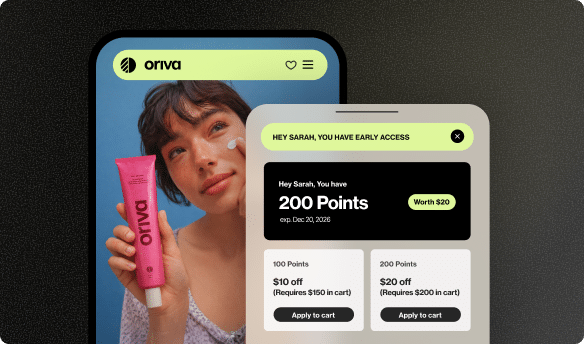
- Instead of a discount code, your loyalty program automatically deposits points (e.g., “500 Points”) into their account.
- The customer can then let these points accumulate. They might get 500 for the review, 100 for following you on Instagram, 1,000 for their birthday, etc.
- Once they reach a threshold (e.g., 2,000 points), they choose to redeem those points for a reward, like a $20 discount, free shipping, or a free product.
Why is this model so much better?
- It Drives Retention, Not Transactions: A discount code encourages one more purchase. A points balance encourages a lifetime of purchases. The customer is now invested in your brand’s “ecosystem.”
- It Increases Perceived Value: 500 points feels different than “$5 off.” It’s part of a larger game, which is more engaging.
- It Stops Margin Erosion: You are no longer “discounting.” You are “rewarding loyalty.” This small change in positioning is significant. The customer doesn’t just shop with you when you have a sale; they shop with you to earn more points.
- It’s Incredibly Flexible: This is where it gets really powerful. You can create tiered incentives.
The Power of Tiered Incentives with Points
With a flexible loyalty program, you can pay more for what you value most.
- Base Reward: 100 points for a text review.
- Bonus Reward: +150 points for adding a photo.
- Max Reward: +200 points for adding a video.
This strategy is highly effective. It gives everyone a reason to participate (the 100 points) but provides a massive incentive (an extra 350 points!) for customers to create the high-value visual UGC you want. You simply can’t do this as cleanly with discount codes.
Comparison: Choose Your Incentive
Here is how the three main incentive types stack up:
- Direct Discount Code
- Primary Goal: Quick review volume
- Review Quality: Low. Often one-word.
- Customer LTV: Low.
- Brand Impact: Negative. Trains for deals.
- FTC Risk: High if done wrong.
- Best For: New product launches.
- Sweepstakes / Contest
- Primary Goal: Max reviews for min. cost
- Review Quality: Medium.
- Customer LTV: Low.
- Brand Impact: Neutral.
- FTC Risk: High (legal complexity).
- Best For: Big, established brands.
- Loyalty Points
- Primary Goal: Long-term retention
- Review Quality: High. Can be tiered.
- Customer LTV: High.
- Brand Impact: Positive. Builds loyalty.
- FTC Risk: Low (if disclosed).
- Best For: All eCommerce brands.
Conclusion: The “review discount code” is a beginner’s tactic. The “review-for-points” strategy is the professional’s solution.
The Yotpo Solution – How Best-in-Class Tools Make It Work
To build this “review-for-points” engine, you need more than a patchwork of free apps. You need robust, dedicated, best-in-class tools that are designed to work together.
This strategy requires two distinct, powerful solutions:
- A Reviews Solution: To ask for and collect high-quality reviews.
- A Loyalty Solution: To manage and automate the points and rewards.
1. The Collection Engine: Yotpo Reviews
First, you need to master the art of collecting the review. This is where Yotpo Reviews shines. It’s a best-in-class product specifically designed to get you more, and better, reviews.
Its power comes from making the process smarter for you and simpler for your customer.
- Smart Review Requests: Yotpo doesn’t just blast every customer at the same time. It sends the request at the optimal moment, (e.g., 14 days after shipping, not ordering) to ensure the customer has actually used the product.
- In-Mail Forms: This is a major conversion booster. Customers can leave a review directly in the email without having to click a link and visit a new page. Reducing this friction can dramatically increase submission rates.
- AI-Powered Smart Prompts: This is how you solve the “low-quality review” problem. As a customer types, Yotpo’s AI suggests topics to talk about based on your product.
- For a laptop: It might suggest mentioning “battery life,” “screen quality,” or “weight.”
- For a t-shirt: It might suggest “fit,” “fabric,” or “color accuracy.”
- This guides the customer to write the detailed, helpful review you want.
- Custom Questions: Go beyond a 1-5 star rating. Yotpo Reviews lets you ask specific, structured-data questions.
- “How is the fit?” (Runs Small / True to Size / Runs Large)
- “What is your skin type?” (Oily / Dry / Combination)
- This data is incredibly valuable. Future shoppers can then filter reviews. “Show me all reviews from people with ‘dry’ skin.” This is how you drive conversion.
Yotpo Reviews is the engine that collects the high-value “proof” you need.
2. The Reward Engine: Yotpo Loyalty

Next, you need to deliver the reward. This is the job for Yotpo Loyalty. This best-in-class loyalty and referrals product gives you the power to build a truly customized rewards program that builds real loyalty.
It’s not just a simple “earn-and-burn” program. It’s a flexible platform for engaging your customers.
- Flexible Reward Campaigns: You can create dozens of campaigns. “Points for Purchase,” “Birthday Points,” “Refer-a-Friend,” and, of course, “Points for Reviews.”
- Tiered Programs (VIP): This is a key feature. You can create tiers (e.g., Bronze, Silver, Gold) that reward your best customers. This makes them feel valued and gives them a reason to consolidate their spending with you.
- Easy Redemption: Customers can easily see their points balance and redeem them for rewards ($ off, % off, free shipping) right from your site.
- Strategic Support: This is a key differentiator. Yotpo’s team provides strategic guidance. They are loyalty experts who have launched thousands of programs and can help you build one that is unique to your brand and customers.
The Synergy: How Yotpo Reviews & Loyalty Work Together

This is where the strategy comes together. While Yotpo Reviews and Yotpo Loyalty are powerful standalone products, they can also work together to create this seamless “review-for-points” engine.
Here is the step-by-step customer journey:
- Purchase: A customer buys a product.
- Request: 14 days later, Yotpo Reviews sends a smart, in-mail review request.
- Submit: The customer, guided by Smart Prompts and Custom Questions, leaves a detailed 5-star review with a photo.
- Verify & Reward: The Yotpo Loyalty platform “sees” that this action has been completed. It automatically verifies the review and deposits the correct number of points (e.g., “100 points for the review + 150 points for the photo”) into the customer’s loyalty account.
- Notify: The customer gets a positive, branded email. “You’ve earned 250 points for your review. You now have 1,200 points.”
- Redeem: The customer, now encouraged, visits your site. They see they are close to the next redemption threshold (e.g., 2,000 points for $20 off) and decides to make another purchase to get there.
You got a high-quality, visual review. You followed all FTC rules. And most importantly, you didn’t just “pay” for a review with a one-time code; you used the review as an opportunity to pull that customer deeper into your brand’s ecosystem, increasing their lifetime value.
Strategies for High-Quality Incentivized Reviews
The goal is not just more reviews. The goal is better reviews. A single, detailed review with a photo is worth more than 20 “Great product!” reviews.
Your incentive strategy should reflect this.
Strategy 1: The Tiered Reward System
We’ve touched on this, but it’s the most important strategy. Do not pay the same price for a high-effort review as a low-effort one.
Use a points-based system to “buy” the content you want:
- Level 1: Text Review (e.g., 50 points)
- This is the base reward. Everyone who writes any honest review gets this.
- Level 2: Text + Photo (e.g., 150 points)
- This is a significant jump. You are paying a “bonus” for that valuable visual UGC.
- Level 3: Text + Video (e.g., 300 points)
- This is the top tier. A customer video is the most authentic, high-converting marketing asset you can get. It is worth paying a premium for.
This structure clearly communicates to your customers what you value. It “gamifies” the review process and encourages them to put in that extra bit of effort.
Strategy 2: Ask Better Questions with Yotpo Reviews
Generic questions lead to generic answers. If you ask a vague “How was it?” you’ll get a vague answer. Use the features in a top-tier tool like Yotpo Reviews to ask better questions.
- Smart Prompts: Use the AI to guide them. This feature alone will improve the substance of your reviews.
- Custom Questions: This is your chance to collect structured data.
- Fashion Brand: “What’s your height?” “What size did you buy?” “How did it fit?”
- Skincare Brand: “What is your skin concern?” “How long until you saw results?”
- Electronics Brand: “What was your ‘must-have’ feature?” “How is the battery life?”
This detailed, filterable data is what helps the next shopper make a confident decision.
Strategy 3: Personalize the “Ask”
Not all customers are the same. A first-time buyer is different from a 5-year VIP-tier member.
- For New Customers: The “review-for-points” offer is a great way to introduce them to your loyalty program. The “ask” is simple: “Welcome! Get your first 500 points just for leaving a review.”
- For VIP Customers: Your “ask” can be different. They are already loyal. The incentive might be less about points and more about access. “As a Gold Member, your opinion matters most. Leave a review to help us shape our next product.”
As a web development professional with over a decade in eCommerce, I’ve seen brands struggle with this constantly. My advice is always the same.
“Stop thinking about it as ‘buying a review’ and start thinking about it as ‘investing in your next customer.’ The $5 discount you give for a review is a cost. The 500 points you give is an investment in a future purchase. A simple discount code closes a loop. A loyalty-based reward opens one.”
— Ben Salomon, eCommerce Strategy Expert
Your 7-Step Implementation Plan
Ready to get started? Here is a high-level plan for launching a “review-for-points” program.
- Define Your Goal: What do you really want? Don’t just say “more reviews.” Be specific. “I want 50 new photo reviews per month” or “I want to increase my review quality by getting customers to mention ‘fit’.”
- Choose Your Tools: Select your best-in-class solutions. You will need a reviews platform (like Yotpo Reviews) and a loyalty platform (like Yotpo Loyalty).
- Design Your Incentive Structure: Plan your tiered rewards.
- Text review = ? points
- Photo review = ? points
- Video review = ? points
- Configure Your Collection: Set up your review request emails. Customize the timing, add your Custom Questions, and turn on AI Smart Prompts. This is where you set the stage for quality.
- Build Your Loyalty Campaigns: In your loyalty tool, build the campaigns that “listen” for the review action and automatically deposit the correct number of points.
- Update Your Site & Disclosures: This is critical.
- Add an “automatic disclosure” badge to your reviews.
- Create a “Loyalty Program” landing page that clearly explains all the ways to earn, including “Write a Review!”
- Ensure your FTC disclosures are clear and conspicuous.
- Analyze and Optimize: This is not “set it and forget it.” Use your platforms’ analytics.
- Are people submitting photos? If not, maybe your “photo bonus” isn’t high enough.
- What are your most-used Custom Question answers? Feature those insights.
- How many people who earned points for a review have come back to spend them? That’s your real ROI.
Conclusion
The “review discount code” is a tempting, simple idea. But it’s a basic tactic. It’s a short-term promotion that can lead to a long-term crash in brand equity and profit.
The advanced strategy—the professional strategy—is to disconnect the review from the discount. Use the review as an opportunity to engage the customer in a long-term relationship.
By using a best-in-class tool like Yotpo Reviews to collect high-quality, detailed reviews, you get the social proof you need. By rewarding that action with Yotpo Loyalty, you get the retention you want. This combination transforms a simple transaction into a loyal, repeatable, and far more profitable customer relationship.
10 Frequently Asked Questions
1. Is it illegal to offer a discount for a review?
No, it is not illegal, as long as you follow FTC guidelines. You must be transparent. This means:
- You must clearly and conspicuously disclose that the reviewer received an incentive.
- You cannot only reward positive reviews. The offer must be for any honest review.
- You cannot hide or suppress the negative reviews you receive.
2. What’s a better incentive: $5 off or 15% off?
It depends on your average order value (AOV). A $5 discount feels more substantial on a $25 item, while 15% feels better on a $150 item. However, a points-based incentive (e.g., 500 points) is almost always a better strategy, as it encourages retention and a future purchase.
3. Will I just get a ton of 5-star reviews? Won’t that look fake?
This is a real risk. Some shoppers will feel obligated to leave a 5-star review. This is why it’s so important to:
- Use clear, neutral language: “Share your honest feedback.”
- Use a platform that automatically adds a “Received a reward” badge, which signals to shoppers that the review was incentivized.
- Remember that many shoppers already find a perfect 5.0 score to be suspicious. A 4.7-star average with a mix of detailed 4- and 5-star reviews is often seen as more trustworthy.
4. How do I get more photo and video reviews?
You have to pay more for them. A tiered incentive system is the most effective way. Offer a base reward for a text review (e.g., 100 points) and a significant bonus for adding a photo (e.g., +150 points) or a video (e.g., +300 points). This clearly signals the value of that content.
5. What if I get a 1-star review from an incentivized customer?
You must publish it. (Assuming it’s not spam or using profanity). And you must still give them the reward. This is non-negotiable. See this as an opportunity. Respond publicly and professionally to the 1-star review. Shoppers will see that you are honest, transparent, and dedicated to customer service.
6. What’s the best way to ask for the review?
The best way is through an automated post-purchase email. A tool like Yotpo Reviews excels here. It allows you to:
- Time the request perfectly (e.g., 10 days after delivery).
- Let the customer review inside the email (in-mail forms).
- Use AI-powered Smart Prompts to guide them to write a more helpful review.
7. Can I just use my current email marketing platform to ask for reviews?
You can, but it’s not a recommended approach. A dedicated reviews platform is much more powerful. It’s built to handle review-specific tasks: collecting photos/videos, handling Q&A, creating on-site display widgets, and, crucially, managing FTC disclosures and verification.
8. How do I start a loyalty program?
It seems complicated. It can be, which is why choosing the right partner is essential. A best-in-class solution like Yotpo Loyalty comes with both the flexible software and the expert strategic support to help you design a program that works for your specific brand. You can start simple (e.g., points for purchases and reviews) and grow from there.
9. My competitor is offering $20 for a review. Should I do that?
Probably not. This is a race to the bottom. A competitor offering a high-value discount for a review is likely eroding their margins and attracting low-quality customers. Instead of matching their tactic, beat them on strategy. Implement a smarter “review-for-points” program that builds long-term loyalty, which is something they can’t copy overnight.
10. What’s the real ROI on this?
The ROI of a simple “review discount code” is hard to measure and often low. The ROI of a “review-for-points” program is massive and measurable. You can track:
- The increase in high-quality (photo/video) reviews.
- The conversion rate from those reviews.
- The number of customers who earned points from a review and returned to make a second purchase.
- The overall increase in Customer Lifetime Value (CLTV) for members in your loyalty program. This strategy isn’t a cost; it’s a direct investment in retention.











 Join a free demo, personalized to fit your needs