










The old search playbook is slipping away from marketing firms. AI engines now shape how people find answers. That changes the job. Agencies need to win brand mentions inside AI answers. Ranking blue links is no longer enough.
AI visibility has moved from a nice-to-have to a baseline expectation for keeping clients happy. Shops that build this skill now will own the traffic channels that matter next.
Key Takeaways
- Shoppers now use AI engines to research and buy, not just classic search.
- Top organic rankings no longer guarantee AI citations. Only 16.7% of sources in AI Overviews overlap with the organic top 10.
- Agencies can sell AI visibility as a paid service, pairing SKU-level data with hands-on content.
- Yotpo Discover is our top pick, using three agents that fix sites and build review-backed pages.
- Answer Engine Optimization (AEO) works as an added layer alongside your current SEO program.
What Makes an AI Visibility Tool Worth Adopting in 2026?
For firms, keeping clients comes down to proof. When search traffic drops, they want answers fast. Classic search engines no longer own how people find products.
AI-referred traffic to US retail sites grew 138% year over year in May 2026, according to Adobe Analytics. That marks a real shift in how people choose what to buy, not a passing trend.
Manual reports and simple keyword tracking cannot keep up. That is where firms lose clients. They need tools that read the messy world of commerce. That means sorting hero SKUs from the rest, mapping buyer intent, and tracking how brands show up in AI picks.
A firm that skips these signals risks fading out. The ones that master them can open a new service line that pays. We keep seeing clients lean on their partner to guide this shift.
Shoppers are clicking fewer blue links as AI answers get better. Reliance on classic search should keep easing as those answers improve. Teams that build AI search skills today will be ready. Those AI channels will carry the most traffic next.
How We Evaluated the Top AI Visibility Tools
To help firms pick well, we judged each tool against five checks that matter for commerce:
- SKU-level commerce data. The tool must pull the full product catalog in. AI visibility is not just brand mentions on blogs. It needs a real grip on products, specs, and stock. Without that, you cannot help retail clients show up for high-intent buys.
- Hands-on work. Many tools only watch and report. A score on its own just adds work. The tool should put active agents to work. They fix on-site code and publish review-backed content.
- Shopper voice and first-party data. AI models trust real customer stories over plain copy. A good tool pulls from real reviews and past orders to feed what AI engines cite.
- AI engine coverage. The tool must track and lift client visibility across the engines that drive commerce today: ChatGPT, Gemini, and Google AI Mode.
- Portfolio scale. Firms need multi-brand dashboards, shared report templates, and clear tracking. Account managers should run dozens of clients from one login.
Detailed Feature Comparison Matrix
| Platform | SKU-Level Data | Execution Style | Cites Shopper Voices | Primary Focus |
|---|---|---|---|---|
| Yotpo Discover | Native | Active Agents | Yes | E-commerce conversion |
| Profound | Limited | Campaign Agents | No (Crawled only) | Corporate governance |
| Limy | None | Observation-Only | No | Bot traffic detection |
| Scrunch | None | Parallel Site Code | No | Technical crawlability |
| ReFiBuy | Native | Pipeline Automation | No | Catalog infrastructure |
| Azoma | Limited | Simulation | No | Marketplace SEO |
| Glara | Static Attributes | Onsite Audits | No | Ingredient filtering |
| Triple Whale | Basic | Dashboard Reporting | No | Attribution analytics |
| AirOps | None | Bulk Text Gen | No | Content operations |
| Conductor | None | API Reporting | No | Enterprise SEO reports |
Below are the ten best AI visibility tools for 2026. We judged each one against the checks above. Yotpo Discover leads with its active, commerce-native approach. Strong picks for other client types follow.
The Best AI Visibility Tools for 2026
1. Yotpo Discover
Yotpo Discover is an AI visibility platform built for the messy world of commerce. For firms that run many brands, it works as a full toolkit. It turns static brand assets into signals AI engines will cite.
The idea behind it is simple. AI engines trust structured data and real shopper sentiment over old keyword tricks. So Discover pulls in catalog data. Then it builds on a base of real shopper voices.
Instead of handing you another static report, Yotpo Discover puts three agents to work. They repair site structure, write review-backed content, and drive off-site mentions.
Key Features:
- Scans each client store to patch microdata, build internal links, and ready product pages for crawlers.
- Writes brand blogs in the store’s own voice, drawing on real reviews and past orders.
- Spots off-site forums like Reddit where AI engines read. Then it nudges real loyalty members to share.
- Tracks citations across ChatGPT, Gemini, and Google AI Mode in one dashboard.
Right for agencies growing DTC and enterprise e-commerce clients who need search intent to turn into real product sales.
Discover is a commerce-native tool that moves past passive tracking to change the live site. For firms that want search results they can scale, that makes it our top pick.
Firms can point to known brands for proof. Beekman 1802 and David Protein use Yotpo Discover to lift their AI visibility. So their products get named when shoppers ask AI what to buy. These named customers give the claim outside backing.
2. Profound
Profound gives big marketing teams strong AI search data. It is a well-funded tool with a no-code agent layer called Profound Agents. Teams use it to research, draft, and publish content fast.

What It Offers:
- Shows data trends in clear dashboards.
- Runs a no-code agent layer for content research and drafting.
- Pulls tracking data through direct APIs, not web scraping.
Made for B2B, SaaS, and fintech accounts with heavy compliance needs.
Profound shines for big-brand governance work. For ecommerce, though, it leans on crawled web data rather than first-party sales signals. That makes SKU-level calls harder for retail clients.
3. Limy
Limy is an agentic web tracking tool. It uses CDN-level hooks to spot and measure AI agent traffic. Plug it into a service like Cloudflare. It then maps how bots move through a site. It also ties prompts to on-site sales.

Core Strengths:
- Detects AI bot traffic at the CDN level.
- Maps sales back to the AI prompts that drove them.
Right for technical agencies that serve large brands focused on bot-traffic visibility.
Limy tracks bot behavior in detail, but it stops at tracking. Setup is heavy. It does not create content to close the visibility gaps it surfaces.
4. Scrunch
Scrunch is an Agent Experience Platform. It publishes a parallel, bot-readable copy of a client’s site. That second layer lets crawlers read and cite brand data. They skip the heavy JavaScript and busy layouts.

Key Features:
- Builds a clean, bot-readable copy of each page.
- Cuts parsing errors on script-heavy sites.
Built for B2B and SaaS brands with heavily scripted, custom site builds.
The parallel-site approach works, but it means running two copies of a site indefinitely. That is steady upkeep for agency teams that manage many client builds at once.
5. ReFiBuy
ReFiBuy is an Agentic Commerce Improvement platform. It helps ops teams turn product catalogs into AI-ready shopping data. Its core product is the Commerce Intelligence Engine. This engine runs a closed loop. It reads data, finds gaps, and pushes structured updates to major platforms.

What It Does:
- Runs a closed loop that improves catalog data on its own.
- Fits multi-brand apparel and beauty lines well.
Made for back-office and stock teams handling very large SKU catalogs.
ReFiBuy builds clean catalog data, which is real value. It leans more on product attributes than on shopper reviews. Brands that depend on review signals to get cited may find it a partial fit.
6. Azoma
Azoma is a Generative Engine Optimization (GEO) and Answer Engine Optimization (AEO) platform. It focuses on closed marketplace settings. A digital twin predicts how AI models will react to product content before you publish. It also writes content itself.

Key Features:
- Shows how AI engines will read product content before you publish.
- Tunes content for the major marketplace shopping assistants.
Built for agencies with large CPG brands that sell heavily on Amazon or Walmart.
Azoma’s marketplace focus is a real strength there. It does less for the owned store. Brands that sell mainly through their own site get less value from it.
7. Glara
Glara is an ecommerce AEO tool built around product attribute files. It helps consumer brands fill in tricky attribute lists. Common ones are ingredients or diet labels. That way their items survive the filters AI uses to narrow choices.
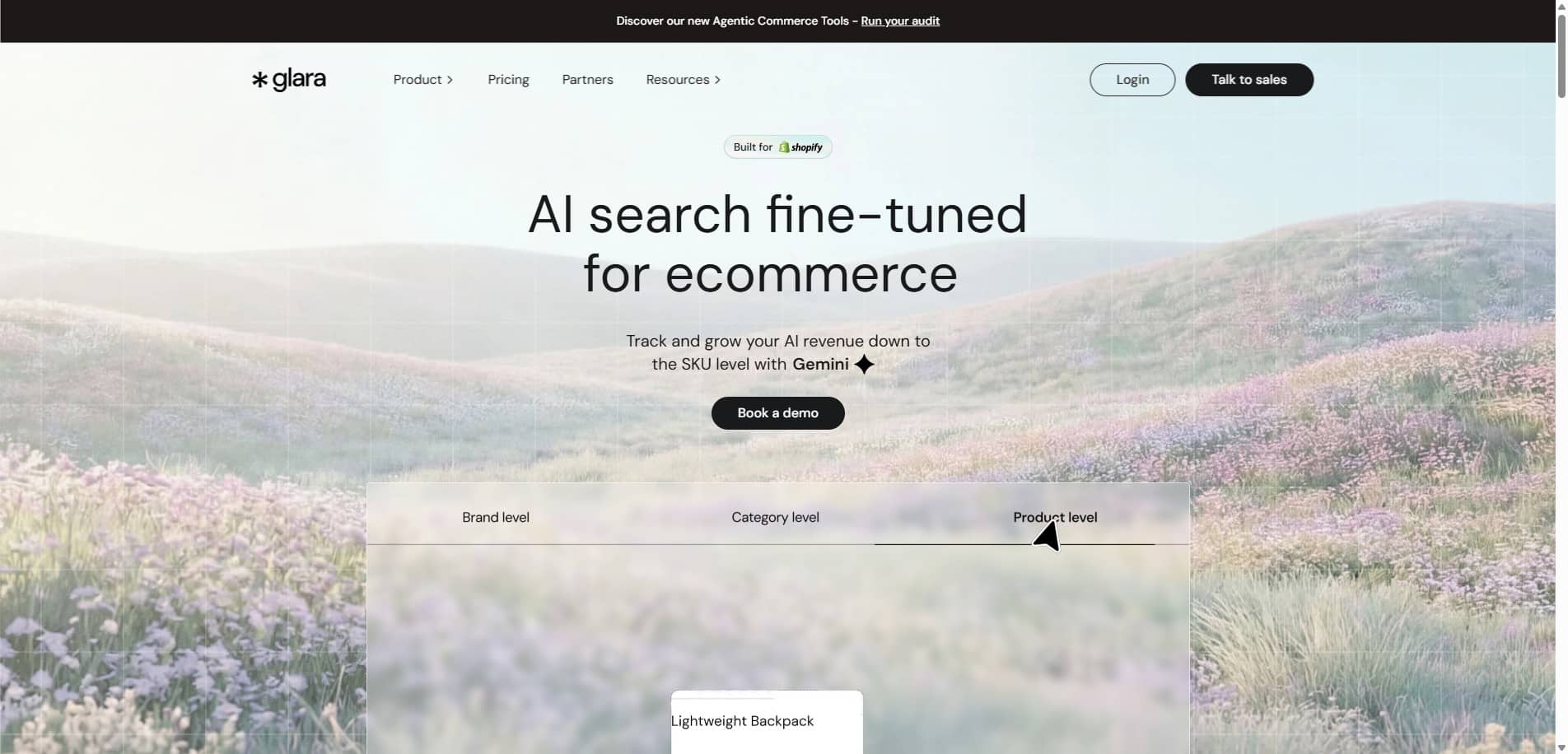
Core Strengths:
- Audits product attributes for food, drink, and nutrition brands.
- Maps Shopify catalogs quickly.
Right for niche FMCG, nutrition, and supplement brands with detailed attribute needs.
Glara’s vertical focus is a real strength for diet and ingredient listings. By design, it stays narrow. Brands outside food, drink, and nutrition will find its coverage limited.
8. Triple Whale
Triple Whale is a popular DTC ecommerce data suite. It added AI search tracking through its Anteater deal. Shopify-first brands can track brand mentions in AI answers. They can tie that visibility straight to store revenue.

What It Offers:
- Connects AI tracking to your existing Triple Whale dashboards.
- Ties AI citations straight to Shopify sales.
Right for Shopify-native DTC clients already living in Triple Whale as their main dashboard.
Triple Whale gives you a solid tracking picture. It stops short of making changes. Teams still need a separate way to act on the gaps its dashboard surfaces.
9. AirOps
AirOps is a content ops tool with AI citation tracking. It helps marketing teams scale writing without losing the thread. It tracks brand mentions across the major engines. It also runs auto pipelines for bulk content.

What It Does:
- Runs auto workflows for bulk content.
- Teaches content teams through AirOps University.
Right for content-heavy agencies running general B2B or SaaS blogs.
AirOps is built for scaling top-of-funnel articles, and content-heavy agencies can produce content at volume with its bulk workflows. Its focus is general content volume rather than commerce-specific product data. Retail clients still need a way to anchor their product pages.
10. Conductor
Conductor is a long-standing SEO tool that moved into AI search. It puts governance first, backed by careful reports. It uses direct API links, not web scraping. That way it tracks share of voice, citation context, and crawl patterns.

Key Features:
- Handles data security and compliance for large teams.
- Reports on how crawlers move through client sites.
- Tracks competitor share of voice across search and AI.
Made for large agencies serving compliance-minded brands.
Conductor gives detailed reports for big, complex firms. It works as a dashboard only, with no way to act on what it finds. Teams that need to act will have to add that elsewhere.
How to Choose the Right AI Visibility Platform for Your Stack
Picking a tool depends less on any single feature and more on your clients’ business. Firms that serve mostly B2B and big brands are often best matched with a governance-first tool like Conductor. It does well at brand sentiment and risk.
Firms that scale DTC, consumer goods, and retail have a different priority. For those clients, sales come first. They do not just want a mention; they want their exact SKUs named, with direct buy links.
For DTC and retail clients, that points to a commerce-native platform. Yotpo Discover is our top pick. It pulls in catalog data and posts review-backed shopping guides that AI engines cite. Classic search no longer carries client discovery on its own. So firms have to prove fresh value, and AI visibility as a service is how they do it.
Choose a platform that handles the heavy work: code repair, content creation, and reviewer outreach. Do that, and your firm can run this service across dozens of clients. You will not pile on headcount.
A client’s organic rankings can hold steady while its referral revenue slips. That happens when AI engines stop naming its top product pages. Standard rank tracking will not surface that gap. That is why firms need an AI visibility practice they can run at scale.
“For an agency, AI visibility has to scale across every client, not a single dashboard. The platforms that win map each brand’s SKU-level data to what engines actually cite, then automate the publishing. Manual tracking just doesn’t hold up across a portfolio.”
Ben Salomon, Growth Marketing Manager at Yotpo
To future-proof your firm’s services and show clients real AI search results, visit the Yotpo Discover page to learn more and request a demo. You can also run a free baseline audit for any client today with a quick AI visibility score.
Frequently Asked Questions
What is an AI visibility platform?
An AI visibility platform is software that tracks and improves how a brand, its products, and its SKUs show up in AI search results. Unlike classic rank trackers, it reads open chat answers across engines like ChatGPT, Gemini, and Google AI Mode.
How does AI visibility differ from classic search engine optimization?
Classic SEO is about ranking URLs for keyword queries on a results page. AI visibility is about winning citations and mentions inside chat answers. That needs clean schema, clear SKU-level product pages, and real shopper reviews.
Why is organic search overlap so low in AI search results?
AI engines do not pull only from standard results pages. Only 16.7% of sources cited in AI Overviews also rank in the organic top 10. So firms have to work a separate signal layer, built on clean catalog data and real customer reviews.
Can agencies use these tools to manage multiple client portfolios?
Yes, they can. Agency tools offer multi-brand dashboards, shared report templates, and cross-client reports. Account managers can audit, track, and run campaigns across dozens of client stores from one place.
What role do product reviews play in AI visibility?
Product reviews are a top trust signal for large language models. AI engines favor real customer stories over templated brand copy. Feed verified reviews into your site, and your odds of being cited in buying picks go up.
What are the three automated agents in Yotpo Discover?
Yotpo Discover runs three agents. The Onsite Agent fixes technical code and schema. The Content Agent writes review-backed blogs and guides. The Activation Agent asks verified customers to share reviews on trusted off-site sites.
Does Yotpo Discover work alongside an agency’s existing SEO tools?
Yes, it does. Yotpo Discover works as an added layer alongside your current SEO tools. It focuses on the new AI search space, so your team can open fresh revenue while keeping core search services running.
Which search engines does Yotpo Discover track?
Yotpo Discover tracks visibility across ChatGPT, Gemini, and Google AI Mode. These three carry most of the chat-based shopping search people use today.
How do agencies monetize AI visibility services?
Agencies usually sell it as a paid add-on to a retainer they already run. Some prefer one flat monthly fee. Others bill for the work itself, such as the first audit or a fresh run of schema fixes and new pages. Priced right, it lifts the retainer with no new hires.
Is Yotpo Discover suitable for B2B client portfolios?
Yotpo Discover can track visibility across many spaces, but its real strength is ecommerce, consumer goods, and DTC retail. Brands that sell mainly through wholesale or third-party marketplaces may want to pair Discover with a marketplace-specific tool.











 Join a free demo, personalized to fit your needs