










Generative engine optimization (GEO) is about how your brand shows up in AI answers. It works alongside SEO and does not replace it. Shoppers increasingly ask AI tools what to buy, so those answers matter to retail brands.
The right GEO platform depends on your catalog and on how much work you want automated. Twelve options are compared below.
Key takeaways
- In an Adobe survey, 39% of people said they have used AI for online shopping.
- BrightEdge found that 54.5% of AI Overview citations now come from pages that rank in organic search.
- Top rankings may not be enough, since only 16.7% of AI Overview citations come from top 10 organic results.
- Adobe data reported by TechCrunch shows AI traffic to US retail sites up 393% year over year in early 2026.
- The 12 tools here differ in focus, from product data and crawler access to content and brand tracking.
- Yotpo Discover pairs data for each SKU and real shopper voices with three AI agents that work on gaps in AI visibility.
What makes a GEO tool worth adopting in 2026?
GEO is about how your brand and products show up when AI tools write answers. These tools don’t say how they pick their sources. So a practical approach is to keep product data clean and to build proof from real buyers, such as reviews.
SEO still matters. BrightEdge found that 54.5% of AI Overview citations come from pages that rank in organic search. Yet only 16.7% of citations come from top 10 results. That suggests a high rank does not guarantee a citation. GEO adds to SEO and does not replace it.
Showing up in AI answers is not only about ranking one page. Clear product facts and real shopper proof give AI tools more to draw on.
Online retail adds extra layers. Catalogs have product variants and hero SKUs, and some items sell out. Shoppers also say different things at each step of the buying journey. A tool for this work needs to handle that detail for each SKU.
How we compared these GEO platforms
The right software depends on how well it handles retail detail. We looked at five points for each platform, using public product information from each vendor:
- SKU-level data: can it map product variants and attributes by category, not just top-level blog URLs?
- Action versus tracking: does it fix issues and create content, or does it focus on reports?
- Real shopper voices: does it use genuine reviews and ratings as product proof?
- AI coverage: which tools does it track, such as ChatGPT, Gemini, and Google AI Mode?
- Clear reports: does it show share of voice and where citations come from, so your team can act on the gaps?
Below are 12 GEO and AI visibility platforms for online retail teams in 2026. Yotpo publishes this guide, so Yotpo Discover is listed first. Yotpo built it for SKU-level retail work, and it pairs tracking with agents that act on the results. Eleven other platforms follow.
The best GEO tools for ecommerce in 2026
1. Yotpo Discover
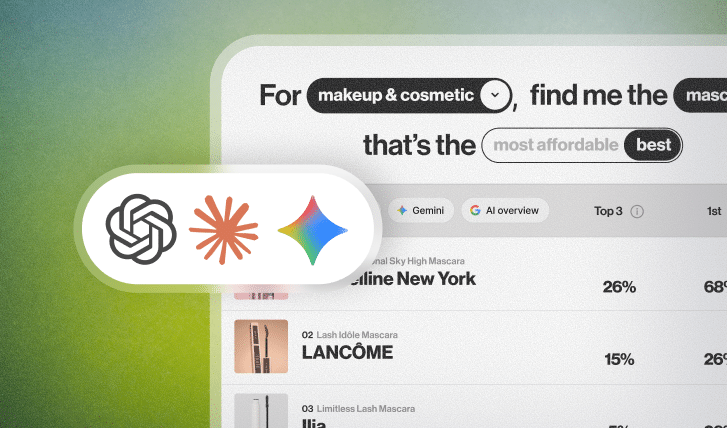
Yotpo Discover is a purpose-built AI-visibility platform for ecommerce. It tracks how products show up in ChatGPT, Gemini, and Google AI Mode. Three AI agents then act on what it finds.
Discover also identifies your AI competitors and shows what drives their rankings and where visibility gaps exist. The agents then work on those gaps.
The Onsite Agent checks how ready your store is for AI tools. It works on technical gaps, such as schema markup, internal links, and product page clarity.
The Content Agent creates SEO-ready content and publisher briefs. It draws on authentic shopper voices from reviews and UGC. The Activation Agent works with real reviewers and loyalty members on Reddit, retail marketplaces, and online communities.
Discover builds on data from Yotpo Reviews and Yotpo Loyalty. So the content it makes reflects what verified buyers say about each product. AI tools can draw on reviews and other outside signals when they describe products. Content rooted in real buyer experience may be easier to cite. New reviews keep coming in, so the agents have fresh buyer language to work with.
Key Features:
- Works at the SKU level, using your catalog and Yotpo review, loyalty, and commerce data
- Includes three AI agents: Onsite, Content, and Activation
- Tracks ChatGPT, Gemini, and Google AI Mode
- Builds on real shopper reviews from Yotpo
- Shows what drives your AI competitors’ rankings and where visibility gaps exist
Discover suits DTC brands and omnichannel retailers. It fits teams that want tracking plus agents that act on the results.
Yotpo positions Discover for teams that want to base their AI visibility work on real buyer proof.
Brands like Beekman 1802 and David Protein work with Yotpo Discover.
2. ReFiBuy
ReFiBuy is an Agentic Commerce Optimization (ACO) platform. It helps brands and retailers get product catalogs ready for AI shopping tools. Its Commerce Intelligence Engine runs a closed loop. It ingests and checks catalog data, enriches product content, and sends it to AI shopping tools. It then syncs updates back to your systems and tracks results.
What It Does:
- Pulls product data from the catalog stack and normalizes it at the SKU level
- Audits catalog data and product pages for schema, crawl access, and content issues
- Sends enriched data to AI shopping tools and syncs updates back to your systems
ReFiBuy is aimed at brands and retailers with large catalogs. Its customer logos include beauty and fashion names.
Its focus is catalog data and technical enrichment. That suits teams whose main limit is product data quality.
3. Azoma
Azoma calls itself end-to-end Agentic Commerce Optimization software for enterprises. It connects to Amazon, Walmart, Shopify, PIM systems, and Google Merchant Center. It also builds a digital twin of shoppers from marketplace data, keywords, and personas.
Azoma writes product page copy and blog content to answer shopper prompts. It also targets shopping agents on marketplaces, such as Amazon Rufus and Walmart Sparky.
Core Strengths:
- Tracks visibility by brand, category, and SKU across LLMs and retailer shopping agents
- Writes product page copy and blog content that answers shopper prompts
- Builds a digital twin of shoppers from marketplace data and personas
Azoma is designed for enterprise brands that sell on big marketplaces such as Amazon and Walmart.
Its marketplace links suit that work well. A brand that sells mostly on its own site would use fewer of those links.
4. Glara
Glara is an AI visibility platform for ecommerce merchants with physical products. It runs targeted prompts across AI models and shows which prompts bring up each product.
Its advice on product attributes changes by category. A fashion item and a beauty product get different recommendations.
Notable Capabilities:
- Tracks single SKUs and shows which products appear in AI answers
- Flags missing or unclear product data that may limit recommendations
- Connects to Shopify, Centra, and Salesforce Commerce Cloud to read your catalog, so there is no manual product entry
Glara serves ecommerce merchants in fashion, beauty, and food and beverage. Those are the categories its tailored advice covers today.
5. Channel3
Channel3 offers a product graph and API for AI shopping and agentic commerce. Its pitch is one API for 100M+ products. Developers can use it to build shopping tools where AI agents search for and recommend products.
Rather than tuning one storefront, it offers one shared product graph for developers and brands to build on.
What It Does:
- Gives AI agents a product graph to search and recommend from
- Offers one API for 100M+ products, with a free developer tier
- Lets developers earn on sales, with enterprise checkout listed as coming soon
Channel3 is built for developers and platform teams who create AI shopping tools.
Engineering teams can build on it right away. Marketers who want citations for their own brand may find it sits further from their daily work.
6. Triple Whale
Triple Whale is an ecommerce analytics platform. In January 2026 it bought an AI visibility platform and added AI tracking. The tool runs prompts that mirror what shoppers ask. It shows when a brand is mentioned and which sources are cited.
Triple Whale says brands can view AI search results next to their usual commerce and marketing numbers. It also says they can tie that exposure to revenue.
Core Strengths:
- Runs thousands of prompts that mirror shopper questions
- Shows which sources AI answers cite
- Puts AI search results next to commerce and marketing metrics
Triple Whale makes the most sense for teams that already use it and want AI tracking in the same dashboard.
AI visibility is one module in a wider analytics product. How deep that module goes is worth checking against your needs.
7. Brandlight
Brandlight is an enterprise platform that tracks how a brand shows up in AI tools. It follows brand mentions on ChatGPT, Gemini, and Perplexity. It also reports on sentiment and share of voice.
Its focus is reputation. It flags wrong statements about a brand and escalates them for review.
What It Does:
- Tracks brand mentions on ChatGPT, Gemini, Perplexity, and other AI platforms
- Reports on sentiment and share of voice alongside AI visibility
- Alerts you to negative or unauthorized brand references and flags errors for escalation
Brandlight is aimed at marketing leaders at large companies and at global agencies.
Its materials stress brand reputation and sentiment. That is a different job from product discovery at the SKU level.
8. Limy
Limy is an AI search platform. It shows how AI agents find and recommend a brand, then ties AI-referred visits to site events. Its Agent Monitor uses CDN request data. That data shows which agents and crawlers visit a site and which pages they request.
Notable Capabilities:
- Uses CDN request data to show which AI agents and crawlers visit a site
- Adds a tracking script, the Limy Pixel, to record AI visits and what visitors do next
- Links AI-referred visits to set website events and their estimated value
Limy suits teams that can connect CDN request data and add a tracking script.
Limy centers on measurement and attribution, with tips for improving visibility. Content and catalog changes still happen in your own systems.
9. Scrunch
Scrunch offers an Agent Experience Platform (AXP). It creates a lightweight, parallel version of a website for AI agents. The pages are compressed and machine readable, so agents can parse them fast. The design that shoppers see stays the same.
Scrunch also shows how AI bots crawl a site and flags when they can’t.
Core Strengths:
- Creates lightweight page versions that AI agents can read
- Leaves the site design that shoppers see unchanged
- Shows how AI bots crawl a site and detects when they can’t
Scrunch is aimed at teams that want AI agents to read a cleaner version of their site.
A parallel version of a site may need extra upkeep. Retail teams can plan for that early.
10. AirOps
AirOps is a content and search operations platform. It combines AI visibility tracking with content workflows. It tracks mentions and citations in ChatGPT, Perplexity, Claude, Gemini, and Google AI Overviews.
AirOps says it links visibility insights to prioritized actions and content workflows. A gap report can then lead to a page refresh or a new article in the same platform.
What It Does:
- Reports mention rate, share of voice, and citation rate for tracked pages and prompts
- Flags pages that rank well in Google but aren’t cited in AI answers
- Finds openings on your own content, outside sites, and Reddit threads
AirOps appeals to teams that publish content at volume and want visibility data tied to their workflow.
Its structure follows content and pages, not SKU-level catalogs. Retail teams with large catalogs should ask how it handles product data.
11. Attensira
Attensira is an AI search platform. It tracks buyer questions across ChatGPT, Perplexity, Claude, Gemini, and Google AI Overviews. Each prompt is one buyer question put to every tracked model on a schedule. The platform reports how often answers name or cite a brand, along with sentiment.
Its content feature proposes fixes as changes to real pages. They arrive as pull requests or CMS drafts, and nothing ships without your approval.
Notable Capabilities:
- Picks the questions buyers ask AI tools and tracks them on a schedule
- Measures sentiment in answers that take a position on the brand
- Re-reads the same prompts 7, 14, and 30 days after a change goes live
Attensira lists solution pages for ecommerce, including Shopify stores and DTC brands, as well as for SaaS teams, agencies, and professional services firms.
Its reports center on buyer questions and brand mentions, so they suit teams that want to see how AI answers treat their brand.
12. Store Rank
Store Rank is an AI search optimization app for Shopify. It installs from the Shopify App Store without code. It adds structured data, including Product, Offer, and FAQPage schema, to store pages on its own.
It also has a Smart FAQ Generator and an AI Product Content Optimizer. The first writes Q&A content in structured schema. The second works on titles and descriptions. Correct schema is a common first step for stores new to GEO.
What It Does:
- Adds Product, Offer, and FAQPage schema to store pages
- Writes Q&A content in structured schema
- Tunes product titles and descriptions for AI visibility
Store Rank fits Shopify merchants who want schema and FAQ basics handled with little setup.
It focuses on schema and content inside Shopify, so off-site work sits outside that focus.
Feature comparison matrix
This matrix sums up what each vendor says it focuses on, based on public information as of October 2026.
| Platform | Data Focus | Approach | Customer Reviews Layer | Primary User |
|---|---|---|---|---|
| Yotpo Discover | SKU-level commerce data | Three AI agents | Built on Yotpo Reviews data | DTC Brands and Omnichannel Retailers |
| ReFiBuy | Catalog data at SKU level | Closed-loop catalog enrichment | Not a stated focus | Brands and Retailers with Large Catalogs |
| Azoma | Marketplace and SKU-level visibility | Content generation and digital twin | Not a stated focus | Enterprise Brands |
| Glara | Product attributes by SKU | Gap flags and optimization tasks | Not a stated focus | Merchants with Physical Products |
| Channel3 | Shared product graph | Developer API | Not a stated focus | Developers |
| Triple Whale | Brand mentions and revenue metrics | AI visibility inside an analytics suite | Not a stated focus | Existing Triple Whale Users |
| Brandlight | Brand-level mentions and sentiment | Tracking, alerts, and escalation | Not a stated focus | Enterprise Marketing Leaders |
| Limy | AI agent traffic and site events | CDN data and tracking script | Not a stated focus | Teams Tracking AI-Referred Traffic |
| Scrunch | Machine-readable site pages | Parallel lightweight site version | Not a stated focus | Teams Managing AI Agent Access |
| AirOps | Page-level citations | Tracking tied to content workflows | Not a stated focus | Content Teams |
| Attensira | Buyer prompts and brand mentions | Prompt tracking and proposed page fixes | Not a stated focus | Brands Tracking Buyer Questions in AI |
| Store Rank | Shopify schema markup | Automatic schema and FAQ tools | Not a stated focus | Shopify Merchants |
How to choose the right tool for your stack
The right GEO software depends on your team and where your bottlenecks sit. If engineering time is tight, look for a platform that can carry out fixes, not just list them.
Consider whether your business runs mostly through wholesale channels or direct-to-consumer stores. Brands selling primarily through wholesale or marketplace channels may want to pair Discover with a marketplace-specific tool.
Product discovery now includes AI answers next to normal search results. Organic rankings still matter. GEO adds a second area to manage, which is how AI answers describe your products and brand.
Yotpo’s report, The Shoppers Have Prompted, draws on 53M reviews. It shows what shoppers want and which brands are visible when they ask AI.
AI tools don’t say how they choose sources, so cover several bases. Clean product data and real reviews can both help. So can content that answers real shopper questions. A plan built only on blog posts and static schema tags may leave gaps when shoppers ask for product advice.
A workable GEO plan pairs a well-built site with real buyer evidence. It also links the step of spotting a missing citation to the step of publishing content that fills the gap.
“AI tools don’t browse product pages the way a shopper does. They can draw on buyer proof, catalog structure, and outside citations all at once. So tracking your presence without acting on it leaves the gaps in place.”
Ben Salomon, Growth Marketing Manager at Yotpo
To see how your store shows up across major AI search tools, get your free AI visibility score. To see how Discover works with your catalog and shopper reviews, learn more and request a demo.
Frequently asked questions
What is the difference between SEO and GEO?
SEO aims to earn high rankings on search result pages. It relies on indexing, metadata, and backlinks. Generative Engine Optimization (GEO) aims to structure your brand and product data so AI tools can read it and may cite it in answers.
Does GEO replace your existing ecommerce SEO?
No. GEO works alongside SEO. Organic search still drives direct query volume. GEO adds work on how your products appear in AI answers.
Which AI tools matter most for retail discovery?
The answer depends on where your own customers ask questions. Your referral data can show which AI tools already send visitors to your site, and a short customer survey can fill in the rest. AI tools don’t say how they choose sources, so it makes sense to watch several rather than rely on one.
Why are customer reviews part of a GEO strategy?
AI tools don’t say how they weigh reviews, so the effect on any one recommendation is hard to predict. Reviews still help in practical ways. They give shoppers first-hand detail. They also give your product content specific language from real customers. Keeping reviews current and tied to the right products is a sensible step in any GEO plan.
What is the difference between AI tracking and GEO execution?
Tracking tools show where your brand appears in AI answers. They may send alerts when that changes. Platforms with execution features add agents that carry out tasks, such as updating schema markup or writing review-based content. These can help address the gaps that tracking reveals. The two work together. Tracking shows where you stand, and execution acts on what tracking finds.
How can automated agents support a store’s AI visibility?
Agents can take on repetitive technical and editorial tasks. In Yotpo Discover, the Onsite Agent works on schema markup and internal links. The Content Agent creates review-based content. The Activation Agent works with reviewers and loyalty members on sites such as Reddit. Results depend on the store and its catalog, and they vary by AI tool, so track changes over time.
Can small ecommerce stores benefit from GEO?
Yes. Smaller stores can start with basic product schema, accurate product details, and real reviews. As catalogs grow, SKU-level tools can help keep product lines consistent.






 Join a free demo, personalized to fit your needs
