



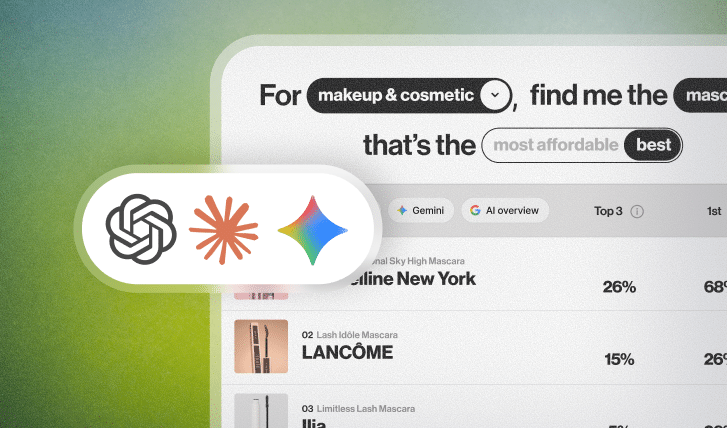





Many buyers now ask an AI assistant what to buy and act on the answer. Answer Engine Optimization (AEO) builds on classic SEO and does not replace it. For ecommerce leaders and heads of SEO, earning citations in AI answers can help protect top-of-funnel discovery.
This roundup compares the best AI visibility tracking tools for 2026. It draws on public product docs and company data. For each tool, we look at how it tracks citations and how it handles catalog data. We also check whether it helps you act on what it finds.
Key takeaways
- More shoppers now use generative AI to research and compare products. Showing up in AI answers matters for ecommerce brands.
- Organic rankings alone do not guarantee a place in Google AI Overviews. BrightEdge found that only 16.7% of citations there come from pages in the organic top ten.
- AI traffic to US retail sites rose 393% in Q1 2026 from a year earlier, according to Adobe data. AI answers now send real traffic to retail sites.
- A score shows where a brand stands in AI answers. The gaps in its catalog and content still need fixing, so look for tools that tie tracking to action.
- Yotpo Discover is a purpose-built AI-visibility platform for ecommerce. It pairs SKU-level tracking across ChatGPT, Gemini, and Google AI Mode with three automated agents.
What makes an AI visibility tracking tool worth adopting in 2026?
Older SEO tools were built to track ranked results pages. Keywords and backlinks matter most there. AI search works differently, because it writes an answer instead of listing links. Say a shopper asks an AI tool for the best cruelty-free moisturizer for sensitive skin. It may draw on product data and shopper reviews. The exact inputs are not published.
The shift already shows up in search results. According to BrightEdge, Google AI Overviews now appear on 48% of tracked queries, up from about 30% a year earlier. That figure covers BrightEdge’s own set of tracked queries, not all Google searches. A tool that only watches classic result pages misses this. It cannot show how your products appear in AI answers.
Imagine a merchandiser at a growing footwear brand. Organic traffic to her product pages is softening, yet demand looks steady. She types a buying question into ChatGPT. A rival sits in the top spot, backed by product details and buyer quotes. Without AI tracking, her team has no direct signal for what changed.
A brand with thousands of SKUs needs more than one share-of-voice score. Good tracking works at the SKU level. It helps show where a recommendation was lost, and it points to the work that fixes it.
How we compared the AI visibility tracking tools
These tools were built for very different jobs, from broad SEO suites to commerce platforms. To compare them fairly, we used five criteria. We relied on public product docs and company data, not live product trials.
- SKU-level commerce awareness. The tool should track product variants and categories, not just site-wide pages. It should tell hero SKUs from long-tail items and read details such as stock status.
- Engine coverage and tracking method. The tool should cover the main AI assistants and search features, and say clearly which ones. Coverage differs between products. Prompts should mirror how real people ask questions.
- Data sources and sentiment. Shopper sentiment may shape which products an AI tool recommends. Engines do not publish how they weigh it. A good tool shows whether reviews and off-site talk appear among the sources AI answers cite.
- Execution capability. Tracking shows where the gaps are, and fixing them takes work. We checked whether a tool offers agents or built-in workflows that help. Examples include repairing schema or updating product copy.
- Business reporting. The tool should tie citation share of voice to business results. Retail leaders can then compare gains with category revenue.
Side-by-side comparison of AI visibility tools
The table below compares the platforms in this roundup.
| Platform | Primary Focus | Execution Layer | Commerce Data Depth | Target User |
|---|---|---|---|---|
| Yotpo Discover | Commerce AI Visibility & Execution | Automated Agents (3) | Native SKU-Level & Reviews | Growing to Enterprise Brands |
| Profound | Enterprise Corporate AEO | Profound Agents (No-Code) | Crawled Web Data | B2B & Brand Tech |
| ReFiBuy | Agentic Catalog Optimization | Catalog Enrichment Pipeline | Technical Catalog Graphs | Operations & Data Teams |
| Azoma | Marketplace & Retail AEO | Content Generation | Retail Assistant Feeds | Large CPG Brands |
| Triple Whale | DTC Analytics & Visibility | Manual Dashboard Reports | Shopify Store Metrics | Shopify DTC Operators |
| Limy | AI Bot Observability | CDN Traffic Detection | Server Log Telemetry | Technical Web Ops Teams |
| Scrunch | Agent Experience Platform | Parallel Site Rendering | HTML Parsing Layers | Technical Digital Agencies |
| AirOps | Content & Prompt Ops | Grid Content Automation | General B2B Content | Content Marketing Teams |
| Attensira | Prompt Research & Planning | Research Discovery Only | Keyword & Prompt Maps | Digital Agencies & Planners |
| Store Rank | SMB Shopify AI Schema | Automated Schema Injection | Basic Catalog Attributes | Small Shopify Stores |
| Otterly | Lightweight Brand Tracking | Alert Notifications Only | Basic Product Data | SMB Marketers |
| Semrush | Horizontal Search Suite | Manual Optimization Workflows | Aggregated Organic Search | General Brand Marketers |
| Conductor | Brand SEO Governance | AI Agents & Reporting | Corporate Web Content | Corporate SEO Teams |
| Glara | FMCG Attribute Management | Attribute File Auditing | Niche Nutrition Tags | Shopify CPG Brands |
| Channel3 | Agentic Commerce Infrastructure | API Graph Endpoints | Universal Product Graph | Platform Developers |
The best AI visibility tracking tools for 2026
Below are closer looks at each platform, starting with Yotpo Discover.
1. Yotpo Discover
Yotpo Discover is a purpose-built AI-visibility platform for ecommerce. It tracks how products appear in ChatGPT, Gemini, and Google AI Mode, with SKU-level data and shopper reviews behind the results.
Discover pairs tracking with three AI agents. When an engine recommends a rival product, Discover looks for the cause. It might be missing schema or thin product details. Sometimes it is a lack of review content. The agents then work on closing the gap.
The Onsite Agent works on your storefront’s AI readiness. That covers schema markup, internal links, and product pages. The Content Agent writes review-backed SEO and AEO content for your brand’s own blog. It draws on real reviews and order data. The Activation Agent works off-site, in places like Reddit, marketplaces, and online communities. It prompts verified customers to share real feedback.
Together, the agents let a team act on what tracking finds. Brands such as Beekman 1802 and David Protein work with Yotpo Discover.
Discover’s main features include:
- Tracks citations by SKU across ChatGPT, Gemini, and Google AI Mode. You see which products gain or lose recommendations.
- Runs an Onsite Agent that repairs schema and internal linking on your storefront.
- Writes review-backed SEO and AEO content for your own blog through the Content Agent.
- Asks verified customers for feedback off-site through the Activation Agent.
- Connects with Yotpo Reviews, so verified buyer reviews can feed the content the agents create.
Discover fits ecommerce brands and DTC retailers that want SKU-level tracking and action in one platform.
2. Profound
Profound is a well-known AI search platform. It pairs brand analytics with a workflow builder called Profound Agents. The company is well funded. It mainly serves B2B, SaaS, and fintech teams.
Teams can track brand mentions across major AI engines and build no-code workflows for AI content. Profound is strong on brand sentiment and prompt-level share of voice.
Profound does a few things well:
- Tracks citations across the major AI tools at large scale.
- Drafts and publishes content with Profound Agents.
- Builds executive dashboards that show share of voice at a glance.
Profound suits large B2B firms that want deep brand tracking and no-code content workflows. Its AI-visibility agents serve general marketing teams and work from crawled web data. Profound also offers a shopping module for retail teams.
3. ReFiBuy
ReFiBuy positions itself as a tool for agentic commerce. It helps ops teams get product catalogs ready for shopping agents. Its focus is data pipelines and feed readiness.
Its Commerce Intelligence Engine runs in continuous loops. It pulls in catalog feeds and flags missing product details. It then enriches specs and tracks results in ChatGPT, Perplexity, and Gemini. It has found traction with beauty and apparel retailers.
Its strengths cluster around the catalog:
- Pulls in catalog feeds and flags gaps in a closed loop.
- Enriches product specs so shopping agents have more to read.
- Tracks results across engines, with a focus on catalog details.
Tech ops teams that need to enrich complex product feeds should look at ReFiBuy first. Its strength is catalog enrichment. Teams that also want reviews and sentiment would run it next to a platform built for that.
4. Limy
Limy comes at AI search from the network side. It uses CDN-level integrations to detect and measure bot traffic on brand domains. By linking to setups like Cloudflare, it maps crawler activity to web sessions.
The software ties prompt interactions to later conversions. Engineering and web ops teams get detailed data on how agents crawl a site. They also get a clear read on scraping patterns.
A few features stand out:
- Detects AI crawlers and bots at the CDN level.
- Maps prompt-to-conversion paths for agentic web visitors.
- Reads server log data and crawl-frequency patterns.
Limy works best for engineering teams that put bot-traffic monitoring first. It measures crawler traffic directly. It does not include workflows for content or site changes.
5. Scrunch
Scrunch is an agent experience platform that bridges human web design and machine reading. It builds a clean, parallel version of a brand’s pages. AI crawlers can then read the content with ease.
This dual setup can keep scripts and animations from blocking engines as they read the content that matters. Tech agencies and B2B firms use it to give crawlers clean access without rebuilding their public site.
You get these core features:
- Renders parallel pages that AI crawlers can read.
- Delivers structured data tuned for how LLMs read pages.
- Tracks crawler access and reports on site indexing.
Scrunch is a good fit for tech teams. They can serve a lighter, crawler-friendly version of their content. The approach is sound. Keeping a parallel version of the site up to date can add work.
6. AirOps
AirOps blends AI citation tracking with a flexible content ops grid. It helps teams grow their SEO and AI search reach. It tracks which brand URLs show up in ChatGPT, Gemini, Perplexity, and Claude.
Beyond tracking, teams can build content pipelines that draft articles and refresh stale passages. The pipelines can also fill topic gaps. AirOps is aimed mainly at enterprise content teams. AirOps University helps teams learn the work.
AirOps covers a wide range of tasks:
- Tracks brand mentions across major chat tools.
- Generates content through grid-based workflows.
- Flags off-site content gaps for your team to fill.
B2B content teams that need to scale how-to writing get the most from AirOps. It is built for high-volume content work. Ecommerce catalogs that need SKU-level commerce logic may need an extra tool.
7. Attensira
Attensira centers on prompt research and AI search planning. It helps agencies map brand presence across the customer queries that matter in the major AI tools.
It surfaces the kinds of prompts people may use when they explore a category. That gives strategists a clear view of market position. Its self-serve interface suits agencies that are building a first AI search offer.
Its strongest work shows up here:
- Offers prompt research across product types.
- Maps brand presence across chat-style query variants.
- Gives strategists a self-serve research interface.
Attensira is built for agencies. It gives them an easy way to benchmark client share of voice across new prompts. It is a planning and research layer. It shows where presence is missing and leaves content work to the team.
8. Azoma
Azoma is an end-to-end platform for consumer packaged goods brands. It aims to strengthen their position at major retailers. It pays special attention to marketplace assistants such as Amazon Rufus and Walmart Sparky.
Its standout feature is a digital twin simulator. It models how marketplace AI tools may judge product listings before content goes live. CPG teams can then refine titles and descriptions to raise their odds.
Key Azoma features include:
- Tunes marketplace listings for Amazon Rufus and Walmart Sparky.
- Simulates AI responses to product updates with a digital twin.
- Refines product content for marketplace listings.
Azoma is the closest match for CPG makers that sell mainly through third-party marketplaces. It is highly specialized for closed platforms like Amazon. It has less focus on an independent brand’s own storefront and off-site authority.
9. Channel3
Channel3 takes a developer-first approach to agentic commerce. It is building a real-time product database to power AI shopping assistants. Instead of a dashboard for marketers, it ships APIs.
The platform organizes live stock, specs, and prices from many merchants into a product graph. Shopping agents can query it to find, compare, and recommend products. For teams that build their own agents, a shared graph can cut a lot of setup work.
The platform leans on these features:
- Powers an API product graph for commerce agents.
- Syncs catalogs in real time across merchants.
- Routes backend queries for third-party AI builders.
Channel3 is meant for software engineers and platform developers. They use its API infrastructure to connect inventory to chat-based agents. It is a building block for automated shopping. Marketers who need results today will find limited use for it out of the box.
10. Triple Whale
Triple Whale is a widely used analytics platform in the Shopify DTC market. It added AI tracking through an acquisition. The module sits inside the main data dashboard.
DTC merchants can see how often their brand shows up in popular AI queries. The data sits right beside blended ROAS and acquisition costs. For brands that already use Triple Whale for daily metrics, that is familiar ground.
The module handles the basics:
- Tracks brand citations across major consumer AI models.
- Shows AI presence next to store revenue and attribution data.
- Uses native Shopify data for DTC operators.
Shopify brands on Triple Whale can get a first look at their AI presence without leaving the dashboard. It is a handy reporting add-on. It focuses on monitoring rather than on fixing tech or content gaps.
11. Otterly
Otterly is a lightweight tracking app. It watches your brand’s presence across AI search tools. These include Google AI Overviews, ChatGPT, Gemini, Copilot, and Perplexity. It is distributed through the Semrush App Center. That makes it an easy starting point for small teams.
It tracks selected keywords and checks whether your domain appears in AI summaries. Alerts flag any shift. The simple interface keeps ongoing tracking easy for teams with few tech resources.
Otterly keeps its strengths simple:
- Tracks your presence across several AI search surfaces.
- Sends alerts when your numbers shift.
- Installs quickly through the Semrush App Center.
Otterly suits solo marketers and small businesses that want easy tracking across major chat tools. It alerts you when something changes. It has no layer for acting on those changes.
12. Semrush
Semrush is a global search marketing platform. It folds AI tracking into its SEO, competitor research, and paid media tools. It became part of Adobe in April 2026. It connects with enterprise content setups.
Semrush offers AI Overviews tracking as one piece of a full search plan. It highlights queries where AI summaries appear. It also shows how SEO rankings line up with citation placement.
Semrush covers a broad range:
- Reports on classic SEO and AI Overviews in one place.
- Includes competitor research and a large backlink database.
- Connects with Adobe Commerce and Experience Manager workflows.
Semrush serves teams that run broad search campaigns across many industries. It offers extensive classic SEO data. It is not built around fast-changing SKUs or customer reviews.
13. Conductor
Conductor is an enterprise SEO platform built around governance and direct API data collection. It has broadened its reporting to include AI search insights.
Conductor gets its data from APIs, not from scraping. Its reports cover citations, sentiment, and share of voice, each with a clear method. That suits corporate SEO teams in regulated fields, where data integrity matters most.
Conductor focuses on a few things:
- Tracks citations through direct API connections.
- Analyzes sentiment and maps share of voice against rivals.
- Manages brand workflows and team tasks.
Conductor fits enterprise SEO leaders in regulated fields who put data integrity and a clear method first. It pairs reporting and governance with AI agents that create and optimize content. It is not built around SKU-level catalog work.
14. Glara
Glara is a vertical AEO tool built around what it calls AI shelf space. It serves fast-moving consumer goods, nutrition, and wellness brands, with a focus on product detail checks.
It audits listings for missing ingredient details, dietary labels, and nutrition specs. AI models may look for these when they answer specific shopper questions. A simple Shopify link-up helps wellness merchants keep data accurate. That matters most where one missing label could keep a product out of an AI answer.
Glara concentrates on product data:
- Audits product detail files and ingredient specs.
- Tracks AI shelf space for nutrition, supplement, and food brands.
- Plugs into Shopify for tagging.
Food, beverage, and supplement brands whose product details must meet dietary prompt filters are Glara’s target users. It suits static nutrition tagging in CPG. It offers less of the broader schema and sentiment work that general retail needs.
15. Store Rank
Store Rank is a Shopify app for smaller merchants. It sets up basic readiness for AI search. Its focus is fast tech setup.
The app adds structured JSON-LD product schema, basic FAQ blocks, and microdata to product pages. Setup is low-maintenance, so small shops can check off the essentials quickly. For a brand-new store, it can be a fast path to a crawlable, structured catalog.
Store Rank sticks to the essentials:
- Installs directly on Shopify.
- Injects product schema markup and FAQ sections.
- Runs with low upkeep for non-technical store owners.
Small Shopify boutique owners can use Store Rank to put baseline schema in place. They do not need to hire a developer. It is a helpful starter app. It focuses on setup rather than ongoing tracking and action.
How to choose the right AI visibility platform for your stack
The right tool depends on your tech resources and how complex your catalog is. For retail brands, a useful first question is simple. Do you only want to watch trends, or do you also want to act on what you learn?
In B2B tech or financial services, product catalogs play a smaller role. General-marketing platforms such as Profound can cover the brand-level reporting you need there. Their agents work from crawled web data. Enterprise SEO suites like Conductor are another option. A large CPG brand that leans on Amazon or retail partners may prefer Azoma for its marketplace tracking. The right answer usually follows your sales channels more than your team size.
DTC and omnichannel brands with changing catalogs need tracking that leads to action. Suppose your main skincare line starts losing AI citations over a quarter. Learning that is only the first step. Someone still has to find the cause and fix it.
For owned storefronts, we recommend treating tracking and action as one workflow. Yotpo Discover is built around that idea. It pulls in product details and customer sentiment. Its agents can then update on-page schema and write review-backed content. Brands that sell mostly through wholesale or third-party marketplaces may want to pair Discover with a tool built for those channels.
“AI visibility is no longer a single dashboard metric; it’s an active commercial surface that demands deep SKU-level catalog data and fast content execution. Brands treating Answer Engine Optimization as a passive reporting exercise watch their share of voice slip quarter after quarter.”
Ben Salomon, Growth Marketing Manager at Yotpo
To see where your store stands in AI answers, get your free AI visibility score. To see how Yotpo Discover works with your catalog, learn more and request a demo.
Frequently asked questions
What is an AI visibility tracking tool?
An AI visibility tracking tool measures how often a brand or product is cited in AI-generated answers. It also checks whether the mention is favorable. Unlike classic rank trackers, it does not record static results pages. It asks AI tools such as ChatGPT and Gemini instead. Some tools also check Google AI Overviews. The results show which products get recommended and how much share of voice a brand holds.
How is AI visibility tracking different from classic SEO rank tracking?
Classic SEO tracking records where a domain ranks for set keywords. AI tracking looks at the answers an AI tool writes in reply to prompts. It records which sources are cited and whether your product is recommended over the others.
Which AI engines should an ecommerce brand track?
A practical starting point is the assistants your shoppers already use for product research, such as ChatGPT and Gemini. Add Google’s AI search features to that list. Google AI Mode and Google AI Overviews are separate surfaces. Check which ones a tool covers before you buy. Coverage differs between products.
Why is SKU-level data critical for ecommerce AI tracking?
Shoppers who use chat-based search often ask about specific products. They want exact details, such as price, ingredients, or sizing. A tool that cannot track single SKUs cannot show which products gain or lose recommendations.
Does classic organic ranking guarantee citations in AI Overviews?
No. BrightEdge found that only 16.7% of citations in Google AI Overviews come from pages in the organic top ten. Google does not publish how it picks sources. Complete product data and customer reviews may help a page earn citations. They are worth working on alongside classic SEO.
What are automated AI visibility execution agents?
Execution agents are tools that act on tracking data. In platforms like Yotpo Discover, agents can help fix schema errors on your site. They can also write review-backed SEO and AEO content for a brand’s own blog. Another agent prompts customers to share feedback on sites that AI engines may cite.
How do customer reviews impact AI search visibility?
Reviews are one input that may shape how AI tools describe and recommend products. The engines do not publish how they use them. Verified reviews and ratings add first-hand detail about quality and use. Marketing copy alone does not.
Can AI visibility tools replace our existing SEO software?
AI tracking platforms complement classic SEO software. They do not replace it. Conventional search remains an important source of web traffic. AI search is an emerging channel that may reward different signals, so it calls for its own tools.






 Join a free demo, personalized to fit your needs
