



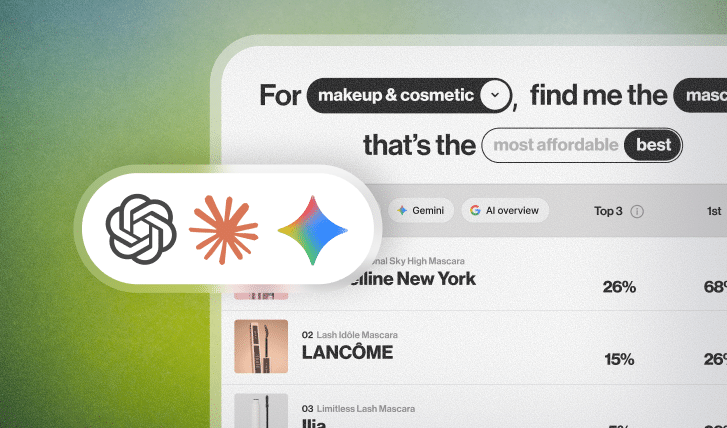







We recently partnered with Validify for a panel discussion, alongside leaders from Fortnum & Mason and M&M Direct to explore how AI and large language models (LLMs) are redefining the customer journey and what that means for brand and product visibility.
The takeaway was clear: the way consumers discover products is changing faster than ever.
We’ve moved from “searching” to “asking” and in this new landscape, customer reviews are emerging as one of the most powerful signals brands can use to stay visible.
From Search → Ask → Answer
Consumers are no longer typing “best moisturizer for dry skin” into a search bar. Instead, they’re asking AI assistants:
“What’s the best moisturizer for sensitive skin in winter?”
And instead of ten blue links, they’re getting two or three AI-curated recommendations.
This shift — from searching to asking to being answered — marks a fundamental change in digital discovery. For the first time ever, Google’s share of search has dropped, signaling that customers are moving toward conversational, assistant-driven experiences.
In this new reality, the goal is no longer just to be found, it’s to be recommended.
And AI doesn’t recommend based on ad spend alone. It recommends based on credibility, context, and consensus — all of which can be found in how your customers talk about you.
Reviews as the New Discovery Engine
Reviews used to be the last step in the buying journey. Today, they’re becoming the first.
Large language models learn from the content they can access — and that includes the collective voice of your customers. Each review, rating, and snippet of user-generated content (UGC) helps models understand your brand’s authenticity, quality, and customer experience.
Fraser Wilson (Yotpo) summed it up:
“If trusted sources, including your own customers, don’t talk about you, models can’t triangulate trust. Reviews are no longer just social proof; they’re data for discoverability.”
This shift reframes the role of reviews entirely. They now teach AI who you are.
Positive sentiment, consistent product descriptions, and verified reviews all help AI models form a more accurate understanding of your brand, which directly influences whether your products are surfaced in generative answers.
From SEO to AEO
Traditional SEO was built on keywords, backlinks, and rank. But AI search is built on meaning.
We’re entering the era of AEO — Answer Engine Optimization — where discoverability depends on semantic, structured, intent-driven content. Models don’t just scan for terms; they interpret context.
Dan Lake (CTO, M&M Direct) emphasized that structured data is the foundation of AI visibility:
“Rich product data (taxonomy, schema, and conversational copy) is what allows models to understand your products. If your data isn’t clear, you’re invisible.”
For brands, this means your PDPs, reviews, and UGC must be AI-readable. Schema markup, structured metadata, and natural language descriptions all help AI connect the dots between your products and customer intent.
The New Rules of Trust
Panelists identified three content pillars that help brands earn visibility in AI-driven environments:
- Branded, rich content
- Unique storytelling that clarifies your values, personality, and intent in your customers’ language.
- Expert and third-party coverage
- Mentions in the press and trusted publications that signal authority.
- Customer sentiment through reviews and UGC
- Authentic, detailed reviews that provide volume, context, and credibility.
Together, these layers form a trust triangle — the combination of authority, authenticity, and relevance that AI models use to decide which brands to recommend.
This shift creates both opportunity and risk for retailers.
Opportunity:
Brands that invest early in review quality, data structure, and semantic content can claim new AI shelf space before competitors do. They’ll be the ones assistants recommend when customers ask for “the best,” “the most sustainable,” or “the highest rated.”
Risk:
If your brand story isn’t clearly articulated or backed by reliable customer sentiment, LLMs may hallucinate it — filling gaps with generic or inaccurate information.
Your brand’s authenticity, heritage, and differentiation need to be made explicit through the content you and your customers create.
As one panelist put it:
“AI isn’t breaking SEO — it’s just changing the rules. Visibility will now belong to brands whose voice, data, and customer sentiment align.”
Practical Steps for Brands
The good news? Brands can act now to prepare their content ecosystem for AI discovery.
Here are five actions every brand should take:
- Audit your reviews for AI readability
Ensure reviews include context, sentiment, and detail, not just star ratings. - Add schema markup to reviews and ratings
Help AI parse and connect customer sentiment to your product pages. - Leverage reviews as “training data”
Feed authentic customer language into PDP copy and FAQs to reflect how real people describe your products. - Structure your product data
Use standardized taxonomy and metadata to make every PDP machine-readable.
Balance paid and organic discoverability
AI-driven results may still include sponsored placements, but authentic, review-rich content builds long-term authority.











 Join a free demo, personalized to fit your needs