







Black Friday and Cyber Monday still drive more ecommerce revenue than any other two days. Mark them down: November 27 and November 30 in 2026. Winning them comes down to basics: sharp offers, full shelves, a checkout that holds up under a traffic rush. But the shopping trip has changed. Many shoppers now open an AI chat window before they touch a search bar. An engine can end up naming a handful of brands in its answer. This guide covers both halves of that strategy: the hands-on checklist and the AI-visibility layer most stores skip.
Key takeaways
- Black Friday 2026 lands on November 27, three days before Cyber Monday on November 30. Most shoppers start hunting for deals well before that, sometimes weeks ahead.
- AI-referred traffic to ecommerce sites jumped hard during BFCM 2025. It also tends to convert better and hold a shopper’s attention longer. And it sticks around at a higher rate than most other channels manage.
- A real Black Friday ecommerce checklist covers more than inventory and pricing now. AI-ready product data sits right next to the usual checkout prep.
- Reviews and other real shopper voices rank among the trust signals an AI engine can draw on. That can shape which products it ends up describing and suggesting.
- AI engines can take weeks to index new content. Teams that start their AI-visibility work in September and October tend to show up more. That’s mainly true once the holiday rush hits.
Why a Black Friday ecommerce strategy needs an AI-visibility layer in 2026
Search used to be the clear starting point for holiday research, and it still matters, but plenty of shoppers now ask an AI assistant directly. They might ask which mattress brand has the best Black Friday deal. Or they might ask whether a winter coat will hold up on a below-freezing commute.
Yotpo’s BFCM 2026 AI Visibility Guide puts a number on that shift: AI-referred traffic to ecommerce sites grew 752% year over year during BFCM 2025. That’s not a rounding error. It’s a real change in where holiday shopping research starts.
Volume alone isn’t why this traffic matters. What matters is quality. The same research found that shoppers arriving from AI answers tend to convert about 31% higher than non-brand organic traffic, spend around 45% more time evaluating products on-site, and bounce roughly 33% less than visitors from other channels.
Shoppers who reach a product through an AI answer often arrive with more context already in hand. They already know roughly what they want. Now they’re checking whether your product really matches the description an AI engine may have given them.
Reviews and other real shopper voices are part of what AI engines can lean on. That can shape which products they end up describing and suggesting. Nobody outside these companies has published the exact mechanism behind any single answer. Treat it as a pattern worth building toward, not a fixed formula. One thing does seem to hold up. Steady, detailed, review-backed product content tends to give a model more to work with than a bare spec sheet.
The 2026 Black Friday and Cyber Monday timeline
Black Friday falls on November 27, 2026, and Cyber Monday follows on November 30. Both dates sit fixed on the calendar. Shopper behavior around them keeps shifting earlier every year.
Yotpo’s BFCM 2026 AI Visibility Guide finds that around 75% of shoppers research Black Friday deals before mid-November, and roughly 40% begin buying in October. A Black Friday ecommerce strategy built only for the two peak days misses most of the real decision-making window.
That timing matters even more once AI engines enter the picture. They often don’t update quickly. ChatGPT can begin surfacing new content within about 1 to 3 weeks, longer for lower-traffic pages. Google AI Overviews typically reflect new content within about 14 to 45 days, per the same guide. It also notes that building a consistent AI share of voice usually takes 3 to 6 months.
Any honest 2026 Black Friday ecommerce forecast has to account for that lag. Content published the week of Thanksgiving may not get indexed anywhere in time to matter. So treat September and October as the real working window for the checklist below. It’s not a nice-to-have head start.
Why early movers see more AI visibility
Per Yotpo’s BFCM 2026 AI Visibility Guide, brands that start early can see about 3.4x more AI visibility than late entrants. That gap tracks directly with the indexing lag above.
Picture a brand publishing gift guides, comparison pages, and FAQ content back in September. It has a real head start over a brand that waits until Black Friday week. That’s simply because the earlier content has had time to get picked up.
Black Friday ecommerce checklist for 2026
The seven steps below move roughly in order of how much groundwork they take. They start with product data and PDPs, then move to reviews, off-site citations, content, operations, measurement, and post-purchase follow-through. Treat it as a working checklist, not a strict sequence. Most of these run in parallel once the September prep window opens. None depends on finishing the one before it.
1. Get your product data and PDPs AI-ready
Product pages are still the foundation. That’s true whether a shopper lands on one from a search result or an AI answer. Keep titles, specs, sizing, and availability correct and steady across every channel that carries them. That includes any marketplace or syndicated listing.
Clean structured data on price, availability, and reviews gives an AI engine a machine-readable version of your facts. That can reduce mistakes a model might trip over. Run this check well before Black Friday week. A promo price that hasn’t synced to your schema, or a variant marked in stock when it’s really sold out, is easy to miss under deadline pressure. It’s just as easy to fix, though, if you catch it early.
2. Turn reviews and UGC into a trust asset
Reviews earn their place on this checklist because they pull double duty. They help shoppers decide, and they give AI engines outside proof they can point to. According to Yotpo’s BFCM 2026 AI Visibility Guide, moving a product page from 0 to 100 reviews is associated with a 106.5% lift in conversion.
Your top BFCM sellers might still be light on reviews. Closing that gap before Black Friday week ranks among the best moves on this whole list. Review syndication can help too. Sharing reviews across your own site, retail partners, and social channels multiplies the number of places a genuine review shows up. On top of that, syndication can help a brand gather up to 20x more reviews within 30 days, per the same research.
3. Map where AI engines really cite brands
It’s tempting to assume AI answers pull mostly from a brand’s own site. The data points the other way. The guide backs that up: roughly 85% of AI brand mentions tend to come from third-party pages rather than a brand’s own site, and about 80% of AI citations tend to come from high-authority sources.
That’s a good reason to widen a Black Friday ecommerce checklist beyond your own product pages. Press mentions, comparison roundups, and forum threads carry real weight too. None of that means your own site stops mattering, though. It just means the plan should reach further, out to the places shoppers already check. The AI engines asking those questions tend to check those same spots too.
4. Prepare content that answers real shopper questions
A shopper already has one question in mind before they land on your page. Answer it right away. An AI engine might hand back something close to “best deals on X this Black Friday,” “is Y worth buying on Cyber Monday,” or “how does Z compare to the other option?” Put that answer in the opening line, not three paragraphs down. Then stack the supporting detail, specs, price, shipping window, right underneath it.
That structure pulls double duty. A person skimming on a phone finds the answer fast. A model hunting for a clean, citable line can often find one too. A short comparison table, a plain-language spec list, or a few real customer quotes pulled straight from reviews can carry real weight. That often beats another paragraph of marketing copy.
5. Lock in your BFCM promotion and inventory plan
None of the AI-visibility work above replaces the everyday basics. Confirm stock levels for your top sellers. Set promo rules and code logic well before launch day. Then load-test checkout for the traffic spike that Black Friday and Cyber Monday both bring.
Mobile checkout deserves extra attention. Most BFCM browsing, and a good share of the real buying, now happens on a phone.
6. Track AI visibility alongside your usual analytics
Most teams already track search rankings, ad performance, and site conversion during BFCM. Add AI visibility to that list. Yotpo’s guide puts the average brand’s mention rate at about 17.2% of relevant AI answers, while top-performing brands reach roughly 56.7%.
That gap is worth watching the same way you’d watch a search-ranking report. It tends to move slower than paid metrics. And it rewards teams that check in throughout the whole season, not just once.
7. Plan review requests and loyalty follow-through after the sale
The checklist doesn’t end at checkout. Every BFCM order is also a chance to build the review base and the repeat-purchase habit. Both carry a brand into next year. Send review requests once a product has had time to arrive and get used. Don’t fire them off the day after the order ships; give the feedback time to show a real experience.
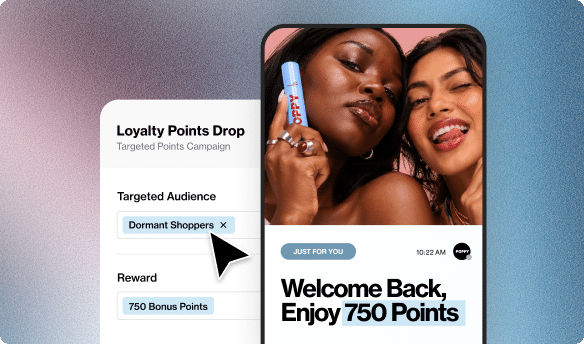
Running a loyalty program? Tie BFCM purchases into it right away. Points earned, tier progress, or a reward unlocked by the order gives a first-time holiday buyer a real reason to come back in December. That beats a one-off transaction that ends at checkout.
Ecommerce Cyber Monday: extending Black Friday momentum
Cyber Monday isn’t just a Black Friday rerun. It’s built for online shoppers who skipped the in-store rush entirely. And it tends to reward brands that keep offers, stock, and messaging fresh, instead of running the same deal for four extra days straight.
An ecommerce Cyber Monday plan often adds new categories or restocks a Black Friday sellout. It might also extend a deal just for shoppers who didn’t convert the first time around. It’s also a natural point to refresh the AI-facing side of the same pages. Updated pricing, current stock status, and any new reviews collected since Black Friday all give an AI engine a fresher, more accurate picture to work from.
Search habits are shifting fast. Yotpo’s BFCM 2026 AI Visibility Guide puts a number on it: traditional search volume is projected to fall by about 25% as AI answers absorb more queries. The same guide also flags a number on the marketing side: 98% of CMOs are investing in answer-engine optimization for 2026.
SEO still matters for Cyber Monday, and for every other stretch on the calendar too. AEO complements SEO rather than replacing it. That checklist above pushes both goals at once: clean data, real reviews, answer-first content.
Where Yotpo Discover fits into your BFCM strategy
Everything in this guide can be done by hand: a spreadsheet, a review-request routine, and a lot of manual checking across ChatGPT, Gemini, and Google AI Mode. Yotpo Discover is one way to put it into practice instead, without the manual grind.
In plain terms, it’s a purpose-built AI-visibility platform for ecommerce, built on Yotpo’s base of authentic reviews, verified purchase data, and loyalty signals. Three linked agents split the work: the Onsite Agent checks schema, internal links, and PDP readiness, while the Content Agent turns review data into review-backed content and outreach briefs. From there, an Activation Agent locates the forums, marketplaces, and communities AI engines tend to cite, then sends verified reviewers to post there.
The stakes behind that work keep climbing, too. AI-influenced ecommerce spend is projected to reach $595 billion by 2028, Yotpo’s BFCM 2026 AI Visibility Guide shows.
Beekman 1802 and David Protein both work with Yotpo Discover today. Both brands keep their product content clear, well-organized, and backed by real review detail. An AI assistant can find and cite that kind of detail. Neither case promises the same result for another brand. Results still depend on category, competition, and how much of the checklist above is already in place.
The point of pairing Discover with the rest of this guide is simple. The two reinforce each other instead of running as separate projects. The Onsite Agent’s readiness checks line up with the product-data step above. The Content Agent’s briefs line up with the answer-first content step.
A Black Friday ecommerce strategy that treats AI visibility as one more line item, not a separate initiative bolted on afterward, tends to be easier to keep up with. That holds mostly once the season really starts.
Frequently asked questions
When is Black Friday and Cyber Monday in 2026?
Black Friday falls on November 27, 2026. Cyber Monday follows three days later, on November 30. Both dates are fixed on the calendar, but shopper behavior isn’t. Research and early buying tend to start well before either date, often as early as October.
Is AI visibility a substitute for SEO?
AI visibility isn’t a substitute for SEO. AEO and SEO share a lot of the same groundwork, including clean structured data and truly useful content. Running them as one program tends to work better than budgeting them separately. Traditional search still matters, even as AI answers absorb more queries.
How far in advance should a Black Friday ecommerce strategy start?
Most teams should start earlier than they assume they need to. AI engines can take weeks to reflect new content. Building a consistent AI share of voice often takes months rather than weeks. September and October make solid windows for publishing content and cleaning up product data. They’re also a good stretch for building out a review base ahead of the holiday rush.
Do reviews really influence what AI engines recommend during BFCM?
Reviews appear to be one input among several that AI engines can draw on, alongside product content, structured data, and outside mentions. No outside party has published the exact mechanism behind any single answer. So it’s fair to treat this as a pattern worth building toward, not a fixed formula. One thing does hold up. Detailed, review-backed content tends to give a model more to work with than thin product copy alone.
What’s the single highest-leverage item on a Black Friday ecommerce checklist?
There isn’t one single answer here. It depends on how much groundwork a given brand has already done. For most teams, though, closing gaps in product-page reviews and cleaning up structured data pay off fastest. Both feed conversion directly, and both give an AI engine cleaner material to work with. That’s material it can draw on if it builds an answer about your products.
Ready to see where your brand stands before the Black Friday and Cyber Monday rush hits? You can learn more and request a demo at yotpo.com/discover, or start with a free AI visibility score to see how your products show up across ChatGPT, Gemini, and Google AI Mode today.












 Join a free demo, personalized to fit your needs