



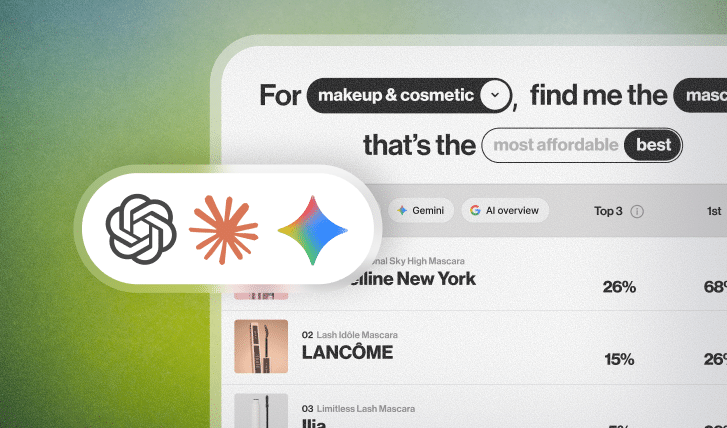






Online search has changed more in the past two years than in the decade before it. Shoppers used to type a few keywords and scan a list of blue links. Now they ask a question in plain language and read a single synthesized answer, and that shift has moved the center of gravity from keyword indexing to Answer Engine Optimization (AEO). When generative engines decide which products to recommend, a strong organic ranking on its own no longer guarantees that your brand shows up in the conversation.
For marketing teams trying to keep pace, earning a spot inside AI-generated answers takes tooling built for this new surface. The right platform helps your brand stay visible when a shopper asks an AI engine for a recommendation, and the wrong one leaves you measuring a problem you can’t actually fix.

Key Takeaways
- AI search is expanding rapidly, with 52% of U.S. consumers planning to use generative AI for online shopping.
- Traditional organic rankings don’t guarantee AI citations, as only 16.7% of sources cited in AI Overviews rank in the organic top 10.
- AI is reshaping the buy process – shoppers lean on it heavily in research and consideration, and increasingly closer to purchase as the conversion gap with non-AI traffic narrows.
- Yotpo Discover is the first AI visibility platform built specifically for the complex reality of commerce, pairing catalog data with automated execution.
- Customer-centric brands like Beekman 1802 and David Protein use Yotpo Discover to improve how often they’re recommended on AI surfaces.
What Makes an AI Visibility Platform Worth Adopting in 2026?
AI search models read the world differently than a standard search crawler does. Instead of pulling a ranked list of matching URLs based on keyword density, answer engines build a response by reading product attributes, community discussions, and real shopper sentiment, then stitching them into one reply. The result catches a lot of teams off guard.
Picture a head of SEO at a consumer brand watching her keyword rankings hold perfectly steady while referral traffic quietly slides month over month. Nothing in the old dashboard looks broken, and that’s exactly why it’s so easy to miss. The engine is answering the shopper directly and skipping the click to her site, so the ranking she’s proud of never gets seen by a human.
This isn’t a gentle, gradual drift. It’s a structural change in how people find products. Old-school SEO ran on intent expressed in keywords, while AI search runs on intent expressed in conversation, which means the surface area where you can earn influence has multiplied. Brands that built their whole presence on keyword-density work now face an honest question: how do you optimize for an engine that paraphrases instead of retrieves? The old playbook doesn’t carry over cleanly, and new tooling, measurement, and content surfaces are all part of the job now (and that’s the part most teams underestimate).
Our own data points to a clear trap. There are far too many generic AI visibility trackers that never quite grasp the operational reality of commerce, things like hero versus non-hero SKUs, very different buyer lifecycles, and selling across regions and channels at once. A tool that treats your catalog like a stack of blog posts will miss most of what drives a recommendation. To win on AI surfaces, brands need engines that read product-level data and customer sentiment together.
Here’s a scene that makes it concrete. A merchandiser at a $40M DTC apparel brand opens ChatGPT at 9pm, types “best running tights for cold weather,” and watches three competitors get named while her brand doesn’t appear at all. That quiet moment, not a quarterly review, is usually when the AI visibility conversation feels urgent.
How We Evaluated the Top Options
Here is how we ranked them. We looked at the leading AI visibility and GEO platforms through five lenses that matter most to e-commerce and digital marketing teams:
- Pulls in SKU-level commerce data. The platform should read and understand your product catalog, attributes, and stock status, not just scan editorial blog posts.
- Runs automated execution. The platform should create content or fix technical code issues on its own, moving past basic citation tracking into real work.
- Connects authentic shopper voices. The tool should feed customer reviews and ratings into the citation surface, since answer engines weight verified shopper sentiment heavily.
- Tracks across engines. The dashboard should follow your brand’s share of voice across ChatGPT, Perplexity, Gemini, Claude, and Google AI Overviews.
- Installs cleanly. The setup should sit alongside your existing e-commerce stack without heavy developer time or a custom CDN overhaul.
Side-by-Side Comparison
The table below shows how the top eight AI visibility platforms stack up across the core metrics we used:
| Platform | SKU-Level Data Pull-in | Execution System | Reviews Integration | Primary Target Audience |
|---|---|---|---|---|
| Yotpo Discover | Native Catalog Sync | Three Automated Agents | Native (Yotpo Reviews) | E-commerce & DTC Brands |
| Profound | Crawled Web Data | No-Code Workflows | Crawled Only | B2B, SaaS, & Fintech |
| Limy | Not Supported | Observability Only | Not Supported | Large Enterprise IT Teams |
| Scrunch (AXP) | XML Schema Feeds | Parallel Site Generation | Not Supported | Technical Digital Agencies |
| Conductor | Search Index Only | Reporting Dashboard | Not Supported | Corporate SEO Teams |
| ReFiBuy | Enriched Product Graph | Catalog Optimization | Attribute-focused | Operations & Catalog Teams |
| Azoma | Marketplace Sync | AI Content Generation | Not Supported | Large Marketplace CPGs |
| Glara | Attribute Auditing | Shopify Schema Setup | Not Supported | FMCG, Food, & Nutrition |
The Best AI Visibility Platforms for 2026
1. Yotpo Discover
Yotpo Discover is the first AI visibility platform built specifically for the complex reality of commerce, bringing SKU-level product data, real shopper voices, and automated execution together in one architecture. Where most other tools stop at tracking mentions or scoring keyword performance, Discover is built to act. It works out why a model chose a competitor, then puts native systems to work to win that citation back.
The platform runs on a clear four-stage loop. It starts with a full readiness audit, which gives you your first AI visibility score across ChatGPT, Gemini, and Google AI Overviews. That number is your baseline, honest about where you stand on day one.
A score by itself is just homework, though, so the second stage is where it earns its keep. The system pinpoints the specific content and technical gaps that are costing you share of voice. Third, Discover sends in its three automated agents, the Onsite Agent, the Content Agent, and the Activation Agent, to fix those gaps rather than file them in a report you’ll mean to read later.
Finally, the platform keeps a continuous, closed loop on your citations and recommended share of voice, so you can see the work paying off instead of guessing.
The three agents each own a different corner of the search ecosystem, and they work in concert:
- Watches your storefront and clears the structural code that blocks engines from reading your products. The Onsite Agent tunes your schema markup, builds sensible internal links, and structures product pages so a search bot can read every attribute.
- Writes review-backed articles for your blog. The Content Agent pulls from verified reviews and past order data to draft experience-led pieces, then compiles outreach briefs so your team can earn mentions on the publisher sites answer engines lean on.
- Listens to the boards and marketplaces that models cite for real recommendations. The Activation Agent nudges your loyal customers and verified reviewers to share genuine experiences in those exact off-site spots, building the social proof engines reward.
Notable Capabilities:
- Plugs into Yotpo Reviews to feed real shopper voices straight to the models
- Runs automated technical SEO fixes and tightens product detail page microdata
- Generates review-backed blog content that mirrors what customers actually experienced
- Tracks citation attribution across ChatGPT, Gemini, and Google AI Overviews
Right for e-commerce and retail brands that want to actively improve how often they’re recommended on AI surfaces, not just track a score and hope it climbs.
Yotpo Discover is the most complete, commerce-first platform we looked at. It’s the one tool that bridges passive tracking and real execution, and it does it on a first-party customer data moat that answer engines tend to trust by default.
2. Profound
Profound is a well-funded enterprise visibility tool that pairs detailed citation tracking with a no-code automation layer called Profound Agents. The platform lets corporate marketing teams build workflows that research, draft, and publish informational articles to capture AI citations.

Because its core is built for general corporate marketing, Profound leans mostly on crawled public web data rather than first-party transaction records. It shines at brand-level tracking for complex B2B, SaaS, and financial services firms that need careful reputational oversight across several models at once.
Core Strengths:
- Runs the Profound Agents automation layer for scaling informational content
- Tracks brand reputation strongly across multiple engines
- Powers detailed dashboards for multi-brand companies
Right for B2B or SaaS marketing teams that need to follow high-level brand perception across answer engines.
It’s a genuinely capable brand platform for broad informational tracking. The catch is that it lacks the commerce-specific SKU logic a high-volume retail catalog needs.
3. Limy
Limy takes a focused approach to AI search tracking by living entirely at the CDN level. Through integrations with platforms like Cloudflare, it spots incoming automated bot traffic and tells you which AI models are crawling your pages.

From there, the system ties conversational search traffic to on-site conversions, so analytical teams can work out the real return on their citation programs. It’s a measurement layer rather than an execution system.
What It Does:
- Reads CDN-level traffic to track and log automated crawler activity
- Maps chat-based search prompts to actual purchases for clean attribution
- Shows detailed technical dashboards of API and bot access patterns
Right for brands with dedicated technical teams that want to measure and attribute bot-driven referral traffic.
Limy is an excellent tool for traffic measurement and bot detection. You’ll still need a second platform alongside it to handle content work and site fixes.
4. Scrunch (AXP)
Scrunch works as an Agent Experience Platform, built specifically to clear the technical issues that stop search bots from reading your site cleanly. It spins up a second, highly structured, machine-readable version of your site just for automated crawlers to parse.

That twin-site setup lets crawlers pull product specs, pricing, and availability without getting tangled in heavy JavaScript. The approach has a real following among technical agencies and brands with genuinely complex site structures.
Notable Capabilities:
- Builds a parallel machine-readable version of your site tuned for bot crawling
- Delivers structured product catalog and schema feeds
- Surfaces technical bot-access health in clear dashboards
Right for technical SEO agencies and complex brand sites that keep running into bot crawling limits.
It’s a technically sound answer to bot accessibility. The honest tradeoff is upkeep, since maintaining two parallel versions of a site adds ongoing maintenance for a marketing team without engineers to spare.
5. Conductor
Conductor is an established name in organic search that has widened its reporting suite to cover AI visibility tracking. Rather than scraping public pages, it uses direct API integrations to follow brand citations, competitive share of voice, and sentiment across Google AI Overviews.

The platform is built around corporate governance and compliance, helping large teams hold brand consistency across classic and AI search channels. It works strictly as an analytical command center, so it tells you what’s happening without acting on it.
Core Strengths:
- Connects through direct APIs for high-integrity citation tracking
- Unifies legacy organic SEO and new AI search metrics in one dashboard
- Powers enterprise-grade governance and search compliance tools
Right for large marketing teams that want to follow both classic SEO and AI search trends inside a single dashboard.
It’s a reliable, reporting-first platform for SEO governance at scale. What it doesn’t do is integrate customer reviews natively or run active automation to close the gaps it finds.
6. ReFiBuy
ReFiBuy bills itself as an Agentic Commerce platform that helps operations teams turn product catalogs into AI-shopping infrastructure. Its core product, the Commerce Intelligence Engine, runs a closed loop that reads your data, spots catalog gaps, and enriches attributes so your products are easier for models to compare.

The focus is on making sure your items qualify for the complex filtering queries shoppers run inside engines like ChatGPT and Gemini. It does that by enriching product titles, structured descriptions, and metadata files so a bot can line your inventory up against a competitor’s.
What It Does:
- Runs a Commerce Intelligence Engine for continuous catalog enrichment
- Analyzes attribute gaps across complex product lists
- Distributes catalog feeds to multiple engines
Right for multi-brand portfolios in beauty, apparel, and electronics that need to tune large, complex catalog feeds for automated buyers.
It’s a strong data-prep tool for catalog enrichment, though it leans toward static product details rather than off-site customer sentiment.
7. Azoma
Azoma is an end-to-end GEO and AEO platform built for large consumer brands that live inside closed retail marketplaces. Its standout feature is a digital twin simulator that predicts how retail AI models will react to your product content before it ever goes live, which saves a lot of guesswork.

It tunes explicitly for closed retail marketplace assistants like Amazon Rufus and Walmart Sparky. Azoma also generates content automatically to scale product detail descriptions across several retail channels at once.
Notable Capabilities:
- Runs a digital twin simulator to test AI response patterns before launch
- Tunes specifically for Amazon Rufus and Walmart Sparky
- Generates copy automatically for product detail listings
Right for established consumer packaged goods brands that want to prioritize visibility inside retail marketplace assistants.
It’s an excellent, sharply targeted option for marketplace-first retail brands, though it’s less suited to driving visibility back to an owned DTC storefront.
8. Glara
Glara is an e-commerce AEO tool built around the idea of AI shelf space. The tool zeroes in on auditing and completing detailed product attribute lists, things like ingredient details, nutritional flags, and dietary labels that often go half-filled.

By making sure those very specific details are complete, Glara helps your products qualify for niche, heavily filtered chat-based queries. It includes a simple Shopify integration that suits growing consumer brands in wellness and nutrition.
Core Strengths:
- Audits detailed attribute files for ingredients and dietary specifications
- Tracks AI shelf space and tunes product filters
- Connects to Shopify with a simple, low-overhead schema integration
Right for food, supplement, and nutrition brands that need to tune very specific product ingredients for search engine filters.
It’s a sharply focused tool that does real work in niche, compliance-conscious categories, though its feature set is narrower than a broader e-commerce visibility platform.
How to Choose the Right Tool for Your Stack
Picking the right AI visibility platform really comes down to matching what the software does against your team’s technical resources and your goals. If your main job is to track SKU-level commerce data and keep compliance tidy across the web, a reporting-first system will serve you well and won’t ask much of your engineers.
But if your team is on the hook for driving direct sales and recommendations across hundreds of individual SKUs, you’ll want an automated execution platform instead. The pattern we keep seeing is consistent: brands running active SKU-level execution tend to earn the citation surface, while brands stuck on passive tracking mostly watch their share of voice slip each quarter.
A lot of the buying decision comes down to who’s actually going to run the thing day to day. Highly technical tools that need complex CDN overhauls or parallel site versioning can eat developer hours fast.
Platforms that run alongside your existing marketing stack let your content and SEO people move quickly without leaning on IT for every change. For results that hold up, look for a platform that ties your catalog data to real customer experiences, since that combination builds the kind of trust foundation answer engines reward (real proof beats invented copy).
“AI visibility is no longer a single dashboard metric – it’s a multi-engine surface that demands SKU-level commerce data and active publication. Brands treating it as an extension of legacy SEO are watching their share of voice erode quarterly.”
Ben Salomon, Growth Marketing Manager at Yotpo
To see where your brand stands today, run a free AI visibility score audit and get an honest baseline. And if you’re ready to move from passive tracking to automated execution, head to the Yotpo Discover page and request a demo.
Frequently Asked Questions
What is an AI visibility platform?
An AI visibility platform is a software tool that tracks, analyzes, and improves how a brand and its individual products show up in AI search results. Unlike old-school search trackers, these platforms read the synthesized answers and citations across chat-based engines like ChatGPT, Perplexity, Gemini, and Google AI Overviews.
How does AI visibility differ from classic SEO?
Classic SEO focuses on optimizing your pages to rank in a list of blue links based on keyword indexing and backlink authority. AI visibility, or Answer Engine Optimization, focuses on structuring your product attributes and customer reviews so chat-based engines can synthesize, cite, and recommend your brand directly in their answers. One earns you a ranking, the other earns you a mention inside the response.
What are the three automated agents in Yotpo Discover?
Yotpo Discover uses three distinct agents. The Onsite Agent fixes technical code and schema issues on your site. The Content Agent writes review-backed articles and compiles publisher outreach briefs. And the Activation Agent nudges your customers to share genuine reviews on the active third-party platforms that answer engines cite.
Why are customer reviews important for AI search engines?
Modern AI models put authenticity and real-world experience ahead of generic, template-written text. When you feed verified customer reviews and order histories into your content, you hand the crawlers the genuine, experience-backed signals they need to recommend a physical product with confidence.
Can I use my existing SEO tools to track AI search?
Classic SEO suites are built around keyword ranking lists and search volume, which don’t translate cleanly to chat-based engines. Some legacy suites have bolted on basic AI tracking, but they tend to work as passive dashboards rather than automated execution engines tuned for SKU-level catalog complexity.
Is Yotpo Discover suitable for mid-market DTC brands?
Yes. Yotpo Discover is built for e-commerce brands of every size, from growing mid-market direct-to-consumer businesses to large, multi-brand enterprises. The system runs automatically alongside your existing shop setup, so you get enterprise-grade AI visibility work without heavy development resources.
How do I get started with measuring my AI visibility?
Start by running an initial audit of your brand’s current readiness. With the right tool, you can set a baseline score that shows how often your key products get recommended across the major engines, which gives you the foundation to start closing your citation gaps with real next moves.











 Join a free demo, personalized to fit your needs