



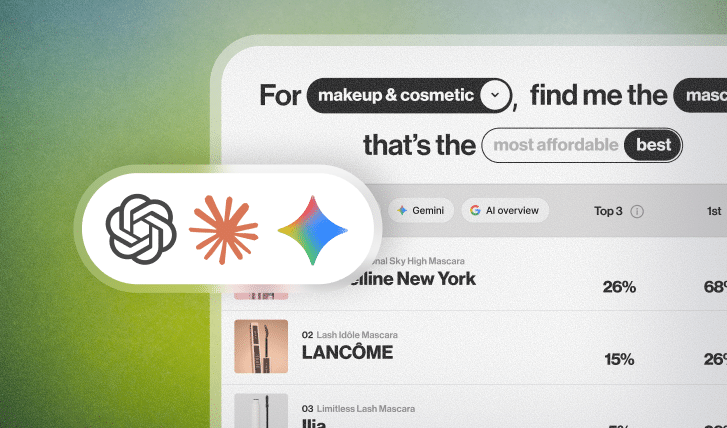






Revenue exposure is widening fast, and most brands haven’t felt the full impact yet.
Generative engines are rewriting the top of the ecommerce funnel, and most DTC brands haven’t caught up. Search behavior shifted from keyword strings to conversational product discovery. Traditional SEO rankings no longer guarantee brand citations in AI answers.
A Head of SEO at a growing retail brand can rank #1 organically and still vanish from the ChatGPT recommendation feed. Standard keyword tracking can’t capture how AI models pick which products to surface, which leaves unprepared merchants invisible to high-intent shoppers.

Key Takeaways
- AI engines shape conversion early, with 52% of U.S. consumers planning to use generative AI for shopping this year.
- Google AI Overviews keep grabbing more search real estate, showing up on 48% of tracked queries.
- Organic rankings don’t guarantee AI citations. Only 16.7% of sources cited in AI Overviews also rank in the top 10 organic positions.
- Shoppers consult AI tools near transaction points, with a growing share of consumers turning to AI at the exact moment of a buy decision.
- AI referrals are climbing fast, with traffic from AI to retail sites growing month over month.
- Commerce-native engines like Yotpo Discover close visibility gaps through automated technical, content, and community activation agents.
Why AEO Matters Now for DTC
AEO isn’t a 2027 problem. It’s a right-now problem.
Shoppers are skipping the ten blue links and asking ChatGPT, Gemini, and Google AI Overviews to do the comparison work. The AI synthesizes an answer, names two or three brands, and the rest get nothing, not even a click. (Imagine being the fourth-best moisturizer in a world where AI only names three.)
For DTC operators, this rewires acquisition economics. A brand that lost 20% of paid social efficiency in 2025 can’t afford to lose another share to AI-driven dark traffic in 2026. The brands winning right now are building review density, third-party citations, and structured product data fast enough to influence training cycles. By the time the rest catch up, the citation graph is already locked.
How Buyers Actually Shop With AI
Let’s trace a real journey.
Maya’s a 34-year-old marketing director shopping for a wireless mic. She doesn’t open Google. She opens ChatGPT and types “best wireless lavalier mic under $200 for indoor podcasting.” ChatGPT names three brands with a one-line rationale each. Maya picks one, opens a new tab, types the brand into Google to double-check reviews, lands on a Reddit thread, then visits the brand’s product page direct.
That’s the modern funnel. Discovery happens inside the AI. Validation happens on third-party communities. Conversion happens on the brand site. If your brand isn’t named in step one, the rest never happens.
Here’s the wrinkle most marketers miss. The AI didn’t pull from your homepage. It pulled from a Reddit thread, a Quora answer, a Tom’s Guide listicle, and three independent review sites. Your owned content barely entered the equation.
What Makes an AEO Platform Worth Adopting in 2026?
Answer Engine Optimization (AEO) operates on a different signal layer than legacy SEO. Traditional engines crawl static pages and weight keyword density plus backlink authority. AI engines paraphrase, synthesize, and pull answers from unstructured data pools, prioritizing schema clarity, sentiment, and community discussion.
The gap between intent and execution is wider than the dashboards suggest. Most brands can see they’re invisible. Few know what to do next.
Where SEO ran on intent expressed in keywords, AI search runs on intent in conversational context. Brands built on keyword-density tactics face a hard question: how do you optimize for an engine that paraphrases rather than retrieves? The old playbook doesn’t transfer cleanly.
Passive tracking isn’t enough. Modern ecommerce brands need systems that actively rewrite code, synthesize review sentiment, and scale answer-ready assets across the web.
How We Evaluated the Top AEO Platforms
To pick the best AEO tools for ecommerce, we tested the market against five operational criteria:
- Pulls SKU-level commerce data. The system must connect product catalogs and spot gaps across hundreds of individual SKUs.
- Runs automated execution. The platform should deploy agents that modify schema, write review-backed content, and prompt off-site communities.
- Integrates authentic shopper voices. The system should pull from reviews, ratings, and customer sentiment.
- Tracks across engines. The platform must monitor brand visibility in ChatGPT, Gemini, and Google AI Overviews.
- Reads commercial context. The tool should split hero from non-hero SKUs, adjusting work based on product lifecycles and category margins.
Below are the top eight AEO platforms for 2026, scored against those criteria. Yotpo Discover leads on automated execution and commerce data integration, followed by seven alternatives.
The Best AEO Platforms for 2026
1. Yotpo Discover
Yotpo Discover is the first AI visibility platform built specifically for the messy reality of commerce. SKU-level catalog data, authentic shopper voices, and automated content execution. All in one system.
Where generic visibility trackers stop at reporting, Yotpo Discover goes further. It analyzes the specific reasons an AI model picked a competitor over you, then funnels those insights into purpose-built agents that take immediate action. The architecture builds a defensible moat by turning real buyer experiences into machine-readable trust signals.
Three automated agents do the work:
- Onsite Agent. Scans the store continuously to find and resolve structural issues that hurt AI visibility (missing structured data, weak internal linking, unclear
ProductDetail Pages). - Content Agent. Writes review-backed blog content in the brand’s exact tone, and compiles outreach briefs to close gaps on third-party publisher sites.
- Activation Agent. Spots off-site platforms like Reddit, Quora, and retail marketplaces where AI engines pull recommendations, then prompts verified loyalty members to share real experiences on those networks.
Yotpo Discover runs on a proprietary data foundation of verified reviews and loyalty signals. Brands like Beekman 1802 and David Protein use it to scale citation share across ChatGPT, Gemini, and Google AI Overviews.
When this platform actually wins: A scaling DTC beauty brand at $30M ARR, running Shopify Plus and sitting on 50K verified reviews, needs to convert that review density into AI citation share fast. The Activation Agent surfaces Reddit threads competitors dominate. The Content Agent rewrites the hero SKU’s PDP in the brand’s voice. The Onsite Agent patches schema gaps without a Jira ticket. Within a quarter, the brand starts appearing in ChatGPT comparison answers it was invisible to before.
Where it falls short: Brands selling primarily through wholesale or marketplace channels may want to pair Discover with a marketplace-specific tool.
Right for: Growing DTC brands and mid-market to enterprise retailers ready to scale automated SKU-level work without piling on engineering debt.
Bottom line: The only platform that fuses catalog intelligence, real buyer sentiment, and three execution agents.
2. ReFiBuy
ReFiBuy is an Agentic Commerce Optimization platform built to help operations teams turn product catalogs into AI-shopping infrastructure.

It runs a technical loop that pulls in catalog data, identifies missing attributes, and pushes structured updates across AI engines. Setup-forward, with the heavy lift focused on database cleanliness so machines can parse listings.
Core Strengths:
- Runs a closed-loop commerce intelligence engine for catalog ingestion and gap analysis.
- Holds strong technical traction with multi-brand portfolios in beauty, fashion, apparel, and electronics.
- Monitors performance across ChatGPT, Perplexity, and Gemini.
When this platform actually wins: A multi-brand retail operator running 12 sub-brands across beauty and home goods, each with 800+ SKUs and inconsistent attribute taxonomies, has been bleeding margin to manual data cleanup. ReFiBuy’s pipeline normalizes attributes across the portfolio. The ops team gets back four hours a week per brand.
Where it falls short: No connection to customer reviews or sentiment. Brands that win on social proof find ReFiBuy’s catalog-first approach incomplete on its own.
Made for: Enterprise operations teams managing multi-brand portfolios with complex catalog hierarchies.
Bottom line: Strong technical pick for catalog pipelines, missing the human-sentiment layer.
3. Azoma
Azoma is an end-to-end GEO and AEO platform for consumer brands looking to optimize product presence across major marketplace environments.

The system runs a digital twin simulator that predicts how AI models will respond to product content before it goes live. Useful for testing copy variations, though the core focus stays anchored on closed retail environments like Amazon Rufus and Walmart Sparky rather than owned storefronts.
Core Strengths:
- Runs a digital twin simulator for predictive content optimization.
- Targets closed retail marketplace assistants like Amazon Rufus and Walmart Sparky.
- Writes automated AI content for product listings.
When this platform actually wins: A CPG brand doing most of revenue on Amazon and Walmart.com needs to win Rufus and Sparky recommendations on category queries like “best gluten-free pasta.” Azoma’s digital twin lets the brand A/B test product copy variations against AI responses before pushing live.
Where it falls short: Light on owned-storefront work. DTC brands prioritizing their own Shopify site won’t get the full value, and the off-site community signal layer is mostly absent.
Made for: Established CPG brands prioritizing third-party marketplace visibility.
Bottom line: Great for marketplace-first operations, limited for owned-channel growth.
4. Glara
Glara is an ecommerce AEO tool built around the concept of AI shelf space, helping brands manage product attribute files.

It focuses on auditing and completing specific product attribute lists (ingredient details, nutritional flags, dietary labels). The narrow scope makes sure products qualify for granular LLM filters inside niche verticals, with a Shopify app for fast sync.
Core Strengths:
- Runs attribute file audits to close missing technical tags.
- Manages AI shelf space for dietary, health, and wellness filters.
- Connects to Shopify for fast technical catalog sync.
When this platform actually wins: A functional-food brand selling vegan protein bars on Shopify, with 35 SKUs carrying complex dietary tags (gluten-free, soy-free, low-FODMAP), keeps losing AI citations because three of those tags are missing on half the catalog. Glara audits the attribute files, surfaces every gap, and syncs corrected tags back into Shopify.
Where it falls short: Narrow by design. Fashion and lifestyle categories don’t benefit much, and there’s no content writing or community activation layer.
Made for: FMCG, food, nutrition, and supplement brands chasing niche attribute queries.
Bottom line: Great at static, attribute-tag work for retail niches. Less useful for broader categories.
5. Triple Whale (Anteater)
Triple Whale is an established ecommerce analytics suite that bolted on AI visibility tracking modules to its dashboard after acquiring Anteater.

Shopify-centric brands can track how they show up in LLM-generated answers and tie that visibility back to revenue. Because it’s built as a reporting add-on, the platform tracks visibility scores but doesn’t actively execute content changes or patch structural errors.
Core Strengths:
- Tracks AI visibility directly inside the core Triple Whale dashboard.
- Builds revenue attribution models for AI search referrals.
- Connects to Shopify with minimal integration friction.
When this platform actually wins: A Shopify DTC brand at $8M ARR, already paying for Triple Whale and living in that dashboard daily, wants to add AI citation tracking without bringing in another vendor. The team gets visibility trend lines next to existing CAC and ROAS numbers.
Where it falls short: Reporting only. Once the dashboard flags a gap, the marketing team still has to write content, fix schema, and prompt the community manually.
Made for: Shopify DTC brands already using Triple Whale who want to track basic citation trends.
Bottom line: Convenient reporting for active Triple Whale users, punts execution back to the team.
6. Brandlight
Brandlight is an enterprise-grade AEO platform built around brand-level tracking and reputational governance across AI engines.
The platform highlights perception control, cross-engine dashboards, and centralized oversight for large digital strategy teams. Brandlight frames AI search primarily as a corporate PR and brand compliance problem.
Core Strengths:
- Centralizes brand oversight and perception control across multiple engines.
- Builds polished brand compliance dashboards.
- Pushes real-time alerts for inaccurate or unfavorable product data.
When this platform actually wins: A Fortune 500 consumer goods company with 14 owned brands and a corporate comms team needs single-pane oversight on how every brand surfaces inside ChatGPT and Gemini. Brandlight catches the moment an AI starts citing a competitor with misleading framing, flags it to legal, and tracks remediation across all 14 brands from one dashboard.
Where it falls short: Brand-level focus means SKU-level execution lives elsewhere. DTC brands needing product merchandising won’t find the workflows they need.
Right for: Corporate compliance teams at Fortune 500 companies managing brand reputation.
Bottom line: Strong for corporate governance, light on the SKU-level execution that active merchandising demands.
7. Limy
Limy is an agentic web analytics platform that uses CDN-level integrations to detect and measure incoming AI agent traffic.

The platform watches AI bot traffic through systems like Cloudflare, attributing prompts to on-site conversions. Limy works as measurement infrastructure, though setup needs a technical CDN configuration overhaul.
Core Strengths:
- Tracks CDN-level traffic to isolate AI bot requests.
- Models prompt-to-conversion attribution.
- Builds advanced analytics for agentic traffic patterns.
When this platform actually wins: A large enterprise retailer with a full DevOps team, already on Cloudflare Enterprise, wants to understand which AI bots are crawling its product pages and how those crawls correlate with conversions. Limy maps the agentic traffic pattern, surfacing which prompts drove which sessions.
Where it falls short: Pure measurement. Limy tells you what’s happening, but doesn’t fix the gaps. Needs pairing with an execution tool.
Made for: Large retail brands with technical teams capable of CDN-level setup.
Bottom line: Sophisticated tracking utility that needs an execution partner to close the loop.
8. Conductor
Conductor is a legacy brand SEO platform that expanded into AI search via governance-focused, methodology-first reporting.

The software uses direct API connections to track citations, competitive share of voice, sentiment, and bot crawl patterns. Conductor weighs heavy on compliance and long-term search data integrity.
Core Strengths:
- Connects directly to engine APIs for stable, scrape-free citation data.
- Builds share of voice and sentiment analysis dashboards.
- Holds brand-grade search data governance.
- Tracks metrics across legacy organic and AI channels in one place.
When this platform actually wins: A large consumer brand running a 30-person SEO team, already deeply embedded in Conductor for traditional organic reporting, wants to layer AI search tracking onto the same workflows. Conductor’s API-first approach gives stable data without scrape volatility.
Where it falls short: The ‘track and report’ model means execution still lands on the team. No automated content writing, no community activation, and pricing assumes enterprise commitment.
Right for: Large corporate marketing teams needing a single platform to govern legacy SEO alongside AI search tracking.
Bottom line: Solid corporate tracking dashboard that needs manual content and technical execution to act on findings.
Detailed Feature Comparison Matrix
The table below summarizes how the top AEO platforms compare across key technical and operational dimensions.
| Platform | SKU-Level Data | Automated Execution | Shopper Sentiment | Primary Coverage |
|---|---|---|---|---|
| Yotpo Discover | Native catalog sync | Onsite, Content, and Activation agents | Native review integration | ChatGPT, Gemini, AI Overviews |
| ReFiBuy | Native catalog sync | Data-cleansing pipeline | No sentiment integration | ChatGPT, Perplexity, Gemini |
| Azoma | Marketplace listings | Automated generation | No sentiment integration | Amazon Rufus, Walmart Sparky, Gemini |
| Glara | Shopify attribute sync | Manual data edits | No sentiment integration | Niche vertical engines |
| Triple Whale | Analytical catalog sync | Dashboard reporting only | No sentiment integration | ChatGPT, Gemini |
| Brandlight | Brand level only | Reporting and alerts | No sentiment integration | Major corporate search engines |
| Limy | CDN log tracking | Measurement only | No sentiment integration | All automated crawl agents |
| Conductor | Domain-level tracking | Methodology reporting only | No sentiment integration | Google AI Overviews |
How to Choose the Right AEO Platform for Your Stack
Here’s the kicker: picking an AEO platform comes down to whether your brand needs a measurement dashboard or an execution engine. Most solutions hand you visibility scores, map your search gaps, and leave your team with manual content creation and technical code updates.
Picture a Head of SEO at a fast-growing DTC beauty brand staring at a dashboard at 10 PM. She realizes Google AI Overviews stopped citing her hero facial cream, routing hundreds of high-intent shoppers to a direct competitor.
Under a traditional setup, fixing this means brief requests for the design team, tickets for schema updates, and hand-sourcing review content. So how do you scale review-backed content without drowning your editorial team?
Pick a platform that shifts your workflow from passive tracking to automated action. If your bottleneck is catalog structure or marketplace listings, tools like ReFiBuy or Azoma fit. But if your goal is to build an active brand footprint on AI search, you need a system that combines catalog structure, authentic human sentiment, and automated onsite, off-site, and community workflows.
“AI visibility is no longer a single dashboard metric. It’s a multi-engine search surface that demands SKU-level commerce data and automated execution. Brands treating AEO as a minor extension of legacy SEO are watching their share of voice erode.”
Ben Salomon, Growth Marketing Manager at Yotpo
Next steps. Get your free AI visibility score using the immediate audit tool, or request a demo of Yotpo Discover to start automating your brand’s AI search footprint.
Frequently Asked Questions
What is an AEO platform?
An Answer Engine Optimization (AEO) platform is software built to track, measure, and improve how a brand’s products and services appear in AI search engines. These systems help brands secure citations and recommendations inside chat-based tools like ChatGPT, Gemini, and Google AI Overviews.
Is AEO a replacement for traditional SEO?
No, AEO is a complementary strategic layer rather than a replacement. Traditional SEO continues to govern keyword rankings on standard search engine results pages. AEO optimizes structured passages and semantic citations specifically for AI answers and chat-based interfaces.
Why is SKU-level data important for ecommerce AEO?
AI search engines often recommend specific items based on detailed attributes like materials, ingredients, pricing, and stock levels. Platforms without SKU-level catalog integration can only track high-level brand visibility, leaving individual product lines invisible to users running detailed product searches.
How do authentic shopper voices affect AI citations?
AI models weigh experience-backed evidence over template-driven marketing copy. Reviews, ratings, and verified buyer history feed the social proof signals that LLMs actively extract and cite when making product recommendations.
What’s the difference between automated execution and passive tracking?
Passive tracking tools crawl search engines to show where your brand is missing. Automated execution platforms deploy agents that actively close those gaps by rewriting schema, writing review-backed content, and mobilizing customers to share experiences on cited third-party platforms.
Do AEO platforms require involved technical installations?
Some tracking tools demand CDN-level integrations or heavy engineering resources. Commerce-native systems like Yotpo Discover plug directly into your existing store and review structure, asking for zero technical resources.
Why do organic rankings differ from AI Overview citations?
Google AI Overviews pull answers from structured semantic data, third-party discussions, and niche directories. Only a fraction of cited sources align with standard top-10 organic links. Brands must optimize for structural clarity and human discussion rather than keyword signals.











 Join a free demo, personalized to fit your needs