










For nearly three decades, e-commerce discovery relied on a consistent model: users typed keywords, and engines returned lists of links. Today, that model is undergoing a significant evolution. We are observing a structural shift often called the “Great Decoupling,” where digital search volume continues to rise, while traditional click-through rates on those searches are changing.
The operating system of discovery is expanding from simple retrieval to complex reasoning. In this new landscape, AI agents like Amazon Rufus are designed to not just find products but to actively advise customers. To succeed in this environment, brands should consider pivoting from simply driving traffic to driving influence, ensuring their discovery layer is optimized for an agentic era.
Key Takeaways
- Keyword-only search no longer meets shopper expectations. Hybrid vector and keyword search can cut zero-result pages by up to 90% and reduce the risk of losing shoppers to Amazon.
- AI assistants are becoming the new storefront. Amazon Rufus drives a 60% conversion lift for engaged shoppers, and 61% of B2C retailers plan to deploy agentic AI of their own.
- Click-through traffic is declining while AI citations are rising. With 60% of Google searches ending without a click, brands cited in AI Overviews see 35% higher organic CTR than those that aren’t.
- AI needs to be grounded in real data to be trusted. 53% of shoppers distrust AI search results, and verified reviews are one of the most effective ways to ground models in authentic shopper experience.
- Owned discovery is becoming a priority over rented traffic. Leaders in 2026 are investing in on-site AI search, RAG, and structured data alongside, not in place of, paid media.
- The KPIs that matter are changing. Citation Share, Revenue per Search, and Conversation Turn Rate are emerging as the metrics that map to AI-era growth.
- AI visibility is its own layer of the stack. Commerce brands are adopting purpose-built platforms like Yotpo Discover to track and act on their presence in AI answers across SKUs, lifecycles, and regions.
Strategy 1: The Semantic Shift: From Lexical Matching to Neural Architectures
To navigate the future of discovery, it is helpful to understand the mechanics of the legacy “keyword” model. For twenty years, e-commerce search engines primarily operated on Lexical Matching. If a user searched for “winter warmer,” the engine looked for those exact words. If inventory was labeled “heated blanket” or “fleece throw,” the engine might return no results, even if the product was relevant.
This disconnect is known as the “Semantic Gap.” In 2026, as search technology improves, consumer expectations for relevance have increased significantly.
The Limitations of Legacy Search
The gap between user intent and search results can be a driver of customer churn. Recent data suggests that 68% of shoppers believe retailer site search needs improvement. When they encounter friction—such as zero results for a valid query—66% indicate they may switch to platforms like Amazon, which serve as a reliable backup for discovery.
Shoppers also place a high premium on efficiency. Approximately 55% of consumers state they would be willing to pay more for a product to avoid the effort of sifting through irrelevant results. This suggests that discovery speed and relevance are becoming integral parts of the customer experience.
The Solution: Vector Search and Embeddings
To bridge the Semantic Gap, many in the industry are adopting Vector Search. Unlike keyword search, which matches text strings, vector search maps data—products, reviews, and queries—into a geometric space.
- The Mathematics of Meaning: Machine learning models convert product data into “vectors” (numerical representations). In this space, concepts with similar meanings are positioned closer together.
- Proximity as Relevance: A product described as a “cozy fleece jacket” and a query for “warm winter layer” will sit near each other in vector space, despite sharing no keywords.
- The Result: By interpreting intent, vector search can significantly reduce “zero results” pages, often by as much as 90%.
The Hybrid Model: Precision Meets Recall
While Vector Search is effective for broad concepts, it can sometimes lack precision for specific SKUs. To address this, leading brands often adopt Hybrid Search.
This architecture combines two approaches:
- Dense Vector Retrieval: Captures semantic meaning and synonyms.
- Sparse Keyword Retrieval: Ensures exact matches for specific terms or model numbers.
By layering these technologies, retailers can ensure a search for “red sneakers” prioritizes exact matches, while also understanding that “crimson trainers” are relevant.
Strategy 2: The Agentic Era: Amazon Rufus and the Rise of Autonomous Shopping
Beyond improving retrieval, the next phase of evolution is Agentic AI. This shifts the focus from “search” (finding a list) to “service” (completing a task). A prime example of this is Amazon Rufus, an AI-powered assistant that has influenced consumer expectations.
Rufus by the Numbers
By late 2025, Rufus had served over 250 million customers, with monthly active users growing 140% year-over-year. The data suggests a correlation between assistant usage and performance:
- Conversion Lift: Shoppers engaging with Rufus are 60% more likely to purchase during that session.
- Sales Impact: Projections indicate Rufus could drive over $10 billion in incremental annualized sales.
- Engagement: Interaction volume has tripled, suggesting users are becoming accustomed to AI assistance.
Beyond Chat: The “Doing” Engine
Agentic AI distinguishes itself by its ability to perform actions. Rufus uses a strategy that directs simple queries to faster models and complex reasoning tasks to more powerful ones.
Capabilities include:
- Contextual Memory: Maintaining “account memory” allows the AI to understand requests like, “Show me dog food for the puppy I bought last month,” without needing repeated details.
- Action Execution: Features like package tracking or price watching add utility beyond discovery.
- Complex Reasoning: Users can ask, “What do I need for a dinosaur-themed party?” and receive a multi-category list.
The Industry Context
Amazon’s approach has encouraged broader adoption. Reports indicate that 61% of B2C retailers plan to implement agentic AI in the near future. The emerging standard for 2026 is shifting toward AI that offers decision support, not just search results.
Strategy 3: Adapting to the Zero-Click Landscape
As Agentic AI evolves on-site, the off-site discovery landscape is also changing. We are seeing a trend where search volume increases, but clicks to websites may decline—a phenomenon often referred to as “The Great Decoupling.”
The Impact of Google AI Overviews
Google’s AI Overviews (formerly SGE) place comprehensive summaries at the top of search results. This satisfies many informational queries directly, reducing the need for users to click through.
Data from late 2025 highlights the shift for “top of funnel” queries:
- Organic Click Trends: For queries triggering an AI Overview, organic Click-Through Rates (CTR) have seen declines of 61% to 65%.
- Paid Traffic: CTR for ads on these pages has also decreased by approximately 68%.
- The Zero-Click Trend: Currently, 60% of all Google searches may end without a click to a website. On mobile, this figure is reported to be 77%.
This suggests the Search Engine Results Page (SERP) is transitioning from a directory to a destination.
Shifting to “Answer Engine Optimization” (AEO)
In this environment, the goal of SEO expands from driving traffic to driving brand visibility within the answer itself.
Success in 2026 is increasingly measured by citation frequency. Brands cited in Google’s AI Overviews see a 35% higher organic CTR than those not cited.
To adapt, consider Generative Engine Optimization (GEO) strategies:
- “Lead with the Answer”: Structure content so it is easily parsed by Large Language Models (LLMs). Clear, concise summaries at the start of articles can increase the likelihood of citation.
- Entity Authority: AI models prioritize established “entities.” Building brand authority (Experience, Expertise, Authoritativeness, Trustworthiness) helps ensure your brand is recognized as a reputable source.
Strategy 4: Consumer Psychology: Building Trust with AI
While the technology exists, consumer adoption relies on trust. The “Uncanny Valley”—where AI feels unfamiliar—remains a factor. Retailers must navigate this to ensure users feel comfortable.
The Trust Gap
A Gartner survey from late 2025 notes that 53% of consumers distrust AI-powered search results. Concerns often center on “hallucinations”—inaccuracies in product features or policies.
Additionally, while 64% of shoppers have used GenAI tools, nearly half (45%) prefer human assistance for complex issues, often fearing AI might prioritize sales over solutions.
The Solution: Grounding AI with Verified Reviews
To build confidence, AI systems benefit from being “grounded” in verifiable data. User-Generated Content (UGC) is a strategic asset here.
AI models process language well but lack real-world experience. They can describe specs, but not the experience of using a product. By integrating data from Yotpo Reviews, you provide the “ground truth.” When an AI can state, “I recommend this tent because 50 reviewers confirmed it survived heavy rain,” it adds a layer of credibility. Features citing specific sources are requested by 61% of consumers, indicating a preference for transparency.
The Personalization Approach
Shoppers desire personalization but are wary of intrusiveness. Reports highlight that 41% feel retailers don’t know them, yet 55% would pay more for efficient discovery.
A “Glassbox” Personalization approach can help. Rather than opaque recommendations, explaining the why—“We recommended this jacket because you bought the matching pants last year”—can foster trust and reduce “ad blindness.”
Strategy 5: The B2B Frontier: High ROI Adoption
While consumer retail focuses on style, the Business-to-Business (B2B) sector is seeing rapid adoption of AI search. The complexity of B2B catalogs makes them ideal for these technologies.
Complexity Driving Adoption
B2B buyers are adopting AI-powered search at three times the rate of consumers, driven by the need for accuracy. A wrong part number can have significant operational costs.
AI-generated traffic in B2B is growing at 40% per month. Buyers often use tools like Perplexity for research. When they arrive via these channels, engagement is high: buyers referred by AI tools spend up to three times longer on-site.
Specific B2B Use Cases
- Function over Form: Vector search allows engineers to search by function rather than exact part number (e.g., “high-heat resistant gasket”).
- Dynamic Pricing: Agentic AI helps manage complex, customer-specific pricing structures, a priority for 39% of B2B leaders.
- Generative Buyers Guides: AI can automatically generate comparison summaries, helping to educate professional buyers during the research phase.
Reports suggest 67% of B2B companies are leveraging AI to support growth, prioritizing revenue scaling and personalization.
Strategy 6: Engineering the New Stack: RAG and Data Quality
Delivering an advanced search experience requires a robust technology stack. This typically involves the Data Layer (Vectors), the Reasoning Layer (LLMs), and the Infrastructure Layer.
Understanding RAG (Retrieval-Augmented Generation)
RAG is a standard architecture for enterprise AI. It functions like an “open book” test. Instead of relying solely on training data (which may be outdated), a RAG system retrieves relevant data from your live catalog before generating an answer.
- The Mechanism: For a query like “Is this bike good for trails?”, the system searches your database for relevant reviews and specs, then instructs the AI to answer using only that data.
- The Benefit: This reduces inaccuracies. If the data isn’t present, the AI is programmed to admit it doesn’t know, rather than inventing facts.
The Vector Database Boom
The shift to semantic search has spurred growth in the Vector Database market, valued at $2.58 billion in 2025. Retailers are utilizing specialized databases or cloud capabilities to give their AI “long-term memory” of product attributes.
The Importance of Data Quality
The success of AI depends heavily on data quality. Currently, 80% of enterprise data is unstructured—images, manuals, reviews. Retailers are working to “vectorize” this content. Techniques like “Attribute Enrichment” use AI to tag products automatically (e.g., “boho,” “summer”), improving filters and search. A clean, structured data layer is essential for an effective AI agent.
Strategy 7: Strategic Roadmaps for 2026: The “AI-First” Pivot
For e-commerce leaders, the path forward involves strategic investment. As discovery evolves, brands are restructuring teams and budgets to adapt.
Investment Priorities
Search is cited as a top digital investment for B2C decision-makers in 2026. This reflects a shift from traditional paid media toward Owned Discovery technology. The strategy focuses on maximizing the conversion rate of traffic by offering a superior on-site discovery experience.
Organizational Shifts
Search is increasingly viewed as a Product. Organizations are appointing Heads of Discovery to bridge the gap between Merchandising (business goals) and Engineering (technical implementation).
“The era of relying solely on keywords is evolving,” notes e-commerce expert Ben Salomon. “If a discovery layer cannot reason effectively, it risks losing not just traffic, but customer trust.”
Metrics That Matter
In an agentic world, new KPIs are valuable:
- Conversation Turn Rate: High interaction counts can indicate deep engagement.
- Revenue per Search (RPS): Vector search can improve conversion rates by reducing dead ends.
- Citation Share: Tracking how often your brand is cited in AI summaries for key terms.
How Yotpo Discover Helps You Win the New Discovery Layer
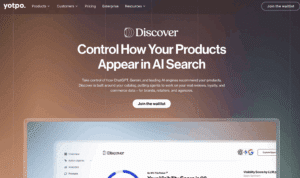
The strategies above only pay off if your brand actually shows up in AI answers, agents, and overviews. That requires more than a generic GEO tracker. It requires a system built for the complexity of commerce, where SKUs have lifecycles, hero products carry the brand, and visibility shifts by region and query intent.
That is what Yotpo Discover was built for. It is the first AI visibility platform purpose-built for commerce, not a repurposed SEO tool with an LLM layer bolted on. In reality, getting a visibility score and calling it a day is homework, not a product.
Discover runs on three AI agents that move you from tracking to action:
- Onsite Agent: Audits your site architecture, schema, and product data so AI engines can actually parse, trust, and cite your catalog.
- Content Agent: Generates SEO and AEO-ready content plus publisher briefs that surface your brand in the queries your buyers are asking AI.
- Activation Agent: Mobilizes real shoppers on Reddit, marketplaces, and forums, the exact sources LLMs train on and cite back to users.
The data moat behind all of this is the same shopper voice that already powers Yotpo Reviews and Yotpo Loyalty & Referrals, authentic ratings, language, and purchase signals at SKU level. That is the grounding data RAG systems and AI agents need to recommend your products with confidence.
You can join the waitlist or check your current AI visibility score at commerce-gpt.yotpo.com.
Conclusion
The transformation of e-commerce search from keyword matching to an agentic operating system represents a maturation of digital commerce. The landscape has shifted, and relying solely on third-party traffic sources is becoming less viable.
In 2026, value will likely be defined by Data Gravity and Agentic Capability. Retailers have the opportunity to build “Owned Intelligence,” transforming their sites into true destinations of discovery. The technology is available, and consumer behavior suggests a readiness for it. The focus now turns to ensuring your data is ready to support this new era.
Frequently Asked Questions
Will AI Search completely replace keyword search?
Likely not entirely. While vector search is excellent for broad discovery, keyword search remains efficient for specific “known-item” searches. The standard for 2026 is Hybrid Search, utilizing both methods.
How does “Zero-Click” search affect traffic?
It may reduce overall session count but often increases the intent of the traffic that does arrive. Users clicking through from an AI Overview are often “pre-qualified” by the summary.
What is a key risk of implementing AI search?
Inaccuracies, or “Hallucinations.” If AI isn’t grounded in verified data (like reviews), it may provide incorrect information, which emphasizes the need for strong RAG pipelines.
How does “Chunking” impact RAG accuracy?
“Chunking” breaks long text (like manuals) into smaller segments. This ensures the AI retrieves the specific paragraph needed to answer a question, improving relevance.
Can small retailers compete with major players like Amazon?
Yes, by leveraging “AI-First” SaaS platforms. These tools offer enterprise-grade vector search and personalization, democratizing access to advanced capabilities without requiring custom builds.
What is the difference between “Dense” and “Sparse” vectors?
“Dense” vectors capture conceptual meaning (semantic). “Sparse” vectors map to specific words (keywords). Hybrid search combines them for optimal results.
How does AI Search help with “Long-Tail” keywords?
Vector search understands concepts. A specific query like “red dress for 1920s party” might have returned zero results with keywords, but vector search can identify “1920s style” items, creating a match.
How will affiliate marketing change?
Generic lists may be replaced by AI summaries. Marketers may need to pivot to “high-authority” niches where their unique perspective is cited by AI as a source of truth.
How do we measure “Citation Share”?
Citation Share tracks how often your brand is named in AI answers for the queries that matter, across ChatGPT, Google AI Overviews, Perplexity, Gemini, and Amazon Rufus. Generic LLM trackers can give you a score, but commerce brands need SKU-level visibility, competitor benchmarks, and a clear next action. Platforms like Yotpo Discover are built specifically for this, pairing measurement with the Onsite, Content, and Activation agents that close the gap between “we know we’re invisible” and “we fixed it.” You can pull a free baseline score at commerce-gpt.yotpo.com.
Is “Visual Search” part of this shift?
Yes. Modern vector databases are “multi-modal,” capable of indexing images. This allows users to search using photos, bypassing text descriptions.
How does GEO differ from SEO?
SEO optimizes for ranking links. GEO (Generative Engine Optimization) optimizes for understanding and citation, focusing on data structure so AI models view the content as authoritative.
What is the role of “Zero-Party Data”?
Data users intentionally share (like quiz results) provides immediate context, helping AI agents personalize recommendations for new visitors (“Cold Start”).
Q10: How do we prevent fake pricing in AI results? A: A strict RAG pipeline should fetch pricing and availability from the ERP system in real-time during generation, rather than relying on the AI’s training data.











 Join a free demo, personalized to fit your needs