Remember in Edition 04 when I broke down how Google AI and ChatGPT are reshaping product discovery? How Google favors quick-hit queries while ChatGPT supports deep research?
Well, here’s the plot twist nobody saw coming this fast: IAC’s CEO just revealed their Google Search traffic cratered from 52% to 28%
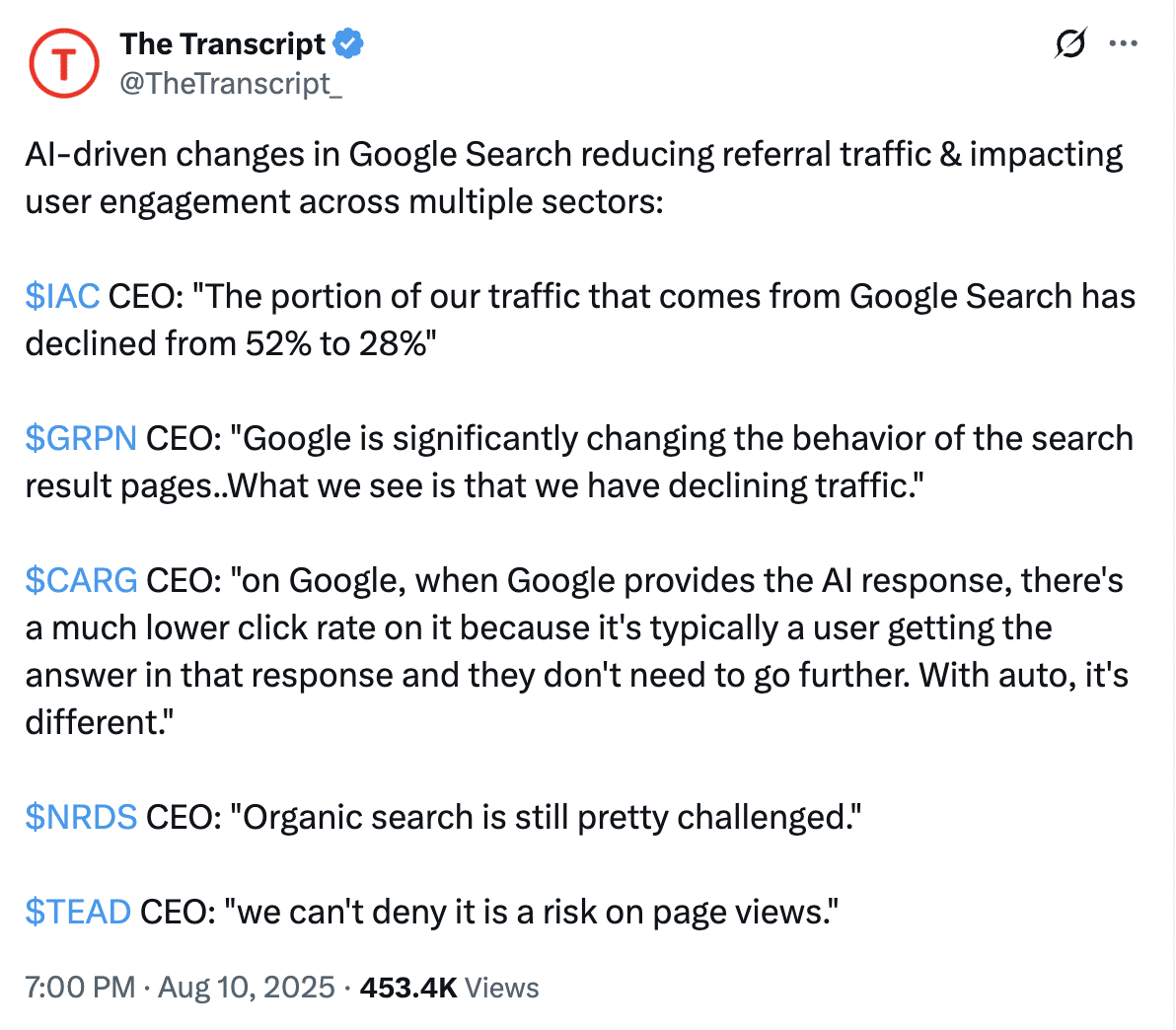
This isn’t about choosing between Google AI or ChatGPT anymore. It’s about Google AI eating Google Search and taking your traffic with it.
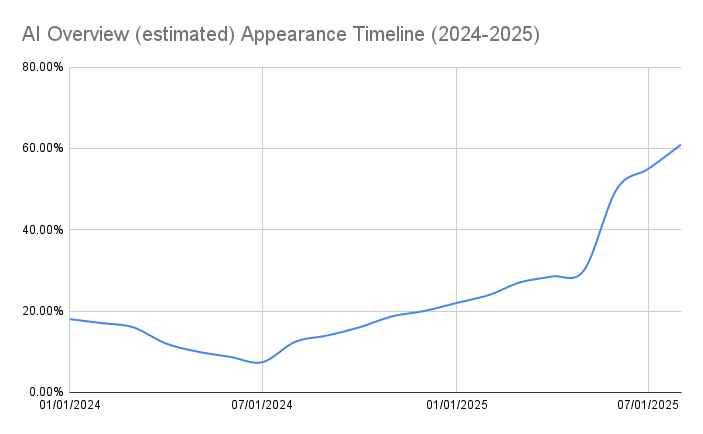
This chart tells the whole story: After a rocky launch in May 2024 that saw Google pull back AI Overviews from 18% to just 7% of searches, they’ve been steadily turning up the dial. By mid-2025, AI Overviews crossed the 50% threshold, meaning Google now answers the majority of searches directly, without sending users anywhere.
This isn’t a gradual shift anymore; it’s an exponential takeover that’s accelerating faster than most merchants realize. The traffic you’re losing today is just the beginning.
TL;DR:
- Google referral traffic is down 10-25% on average, but some merchants are seeing 40-70% drops
- Small e-commerce sites are getting crushed hardest; enterprise merchants are buying time with brand strength
- Zero-click searches will hit 70% by mid-2025 (up from 50% pre-AI)
- AI Overviews now appear in 35%+ of US desktop searches, answering questions before users click
- Smart merchants are already pivoting: feed optimization > traditional SEO, transactional > informational content
- The winners are treating this like the shift from desktop to mobile: adapt fast or die
- Google just launched AP2 payment protocol with 60+ partners (including Mastercard, PayPal, Coinbase) – AI agents will soon handle $1.7 trillion in purchases by 2030 without customers ever visiting your site.
- The endgame revealed: AI Overviews harvest your product data → AI agents make purchase decisions → AP2 processes payments. Google owns the customer journey, you’re just the supplier
As always this chapter builds on topics I reviewed in the previous newsletters, so if you haven’t already, I suggest you give them a look at Editions 01-07.
Quick heads up before we jump in: I’m hosting an in-person AI workshop the morning of October 25th. If you’re in New York, come by. Would be great to see you there. RSVP Here.
The Numbers That Should Keep You Up at Night
Let’s get real about what’s actually happening out there:
The Overall Picture:
- Median year-over-year Google referral decline: -10% overall, -14% for non-news brands (Digital Content Next, August 2025)
- Mail Online: 56% CTR drop when AI Overviews appear for their keywords
- Chegg: 49% decline in non-subscriber traffic YoY
- Recipe/DIY sites: Up to 65% traffic loss on “how to” queries
By Category (The Winners and Losers):
- E-commerce queries with AI Overview: Down from 29% to just 4% (good news, sort of)
- B2B tech queries with AI Overview: Up from 36% to 70% (adapt or disappear)
- Fashion/travel/DIY: 40-70% traffic drops are becoming the norm
Remember in Edition 03 when I showed high-consideration products crushing it in ChatGPT (electronics at 4%+, baby gear at 8%)? Well, Google AI is following the same playbook, but instead of sending traffic, it’s keeping it.
The David vs. Goliath Effect: Size Determines Your Survival Strategy
Enterprise E-commerce ($100M+): You’re Bleeding, But Not Dead
What You’re Experiencing:
- 10-25% organic traffic decline on informational queries
- Your brand still gets cited in AI Overviews (congrats, you’re famous)
- Transactional searches holding steady… for now
Your Reality Check: In Edition 03 I said that being invisible in ChatGPT was dangerous.
Well, being visible but not clickable in Google AI might be worse. You’re doing all the work of creating content, but Google’s keeping the traffic.
What’s Actually Working:
- Shopping Graph Domination: Your feed game better be perfect. This is your new SEO.
- The Amazon Hedge: 34% of Amazon sellers are using AI for listing optimization. Are you?
- Brand Moats: Apps, loyalty programs, email lists, anything that bypasses search
Mid-Market Merchants ($10M-$100M): Welcome to No Man’s Land
What You’re Experiencing:
- 25-40% traffic decline across the board
- Too small for massive brand campaigns, too big to pivot overnight
- Watching both enterprise competitors and nimble startups eat your lunch
Your Unique Challenge: You built your business on that sweet spot of long-tail SEO. Those “best [product] for [specific use case]” queries? AI Overviews own them now. And unlike the enterprises above you or the scrappy startups below, you can’t easily change course.
What’s Actually Working:
- Hyper-Niche Authority: Don’t try to be everything. Own one category so completely that even AI has to cite you
- The Verbolia Approach: Tools that optimize for both traditional SEO and AI visibility simultaneously
- Community Building: Your customers become your traffic source
Small E-commerce & Affiliates: The Extinction Event
What You’re Experiencing:
- 40-70% traffic drops (yes, really)
- Affiliate commissions are evaporating as AI answers buying questions directly
- That blog you spent three years building? It’s now training data for AI
The Harsh Truth: Remember in Edition 03 when I showed how Lulus got 14.6% of traffic from ChatGPT while others got 0.81%?
That gap is about to get way worse. If your business model was “rank for ‘best X for Y’ and monetize with affiliate links,” that model is dead. Not dying. Dead. AI Overviews are answering those queries without sending a single click your way.
What’s Actually Working (The Phoenix Strategy):
- Go Local: “Near me” searches still need real businesses
- Get Personal: First-person experiences, detailed case studies, things AI can’t synthesize
- Platform Pivot: TikTok Shop, Instagram Shopping, anywhere but Google
The Merchant Playbook: From Panic to Profit
1. The Feed Revolution (This Is Your New SEO)
In Edition 04 I explained how both Google AI and ChatGPT cross-check multiple sources, and in Edition 03 how Lulus beat Spanx because of clean metadata and crawl-friendliness. The same principles apply, but now it’s life or death:
- Google Merchant Center: Not optional anymore. Period.
- Video Integration: Google’s Video Manager in Merchant Center is your secret weapon
- Structured Data Everything: If it’s not structured, it doesn’t exist to AI
- The Bing Factor: Edition 02 warned you about Bing. ChatGPT pulls from Bing. Is your feed there too?
2. Content Strategy 180: Forget Education, Focus on Transaction
Out:
- “What is [product category]”
- “How to choose [product]”
- “Ultimate guide to [anything]”
In:
- “[Product] in stock near [location]”
- “Buy [specific model number]”
- “[Brand] vs [Brand] price comparison today”
3. The Platform Diversification Mandate
Think of this like 2008 when everyone realized they needed a mobile strategy. Now you need an “AI-proof traffic strategy”:
The New Traffic Mix:
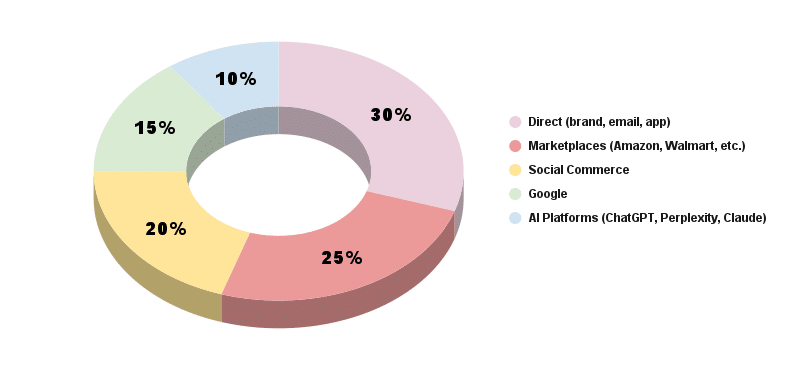
30% Direct Traffic (Your Unshakeable Foundation)
- Email Renaissance: Brands seeing 40%+ open rates by treating email like a media channel, not a promo blast
- SMS + WhatsApp: companies report 80% plus open rates on SMS. That’s not a typo.
- Mobile Apps: Push notifications convert 3x better than email. Starbucks gets 25% of revenue from their app.
- Loyalty Programs: Sephora’s Beauty Insider drives 80% of their sales. Build addiction, not transactions.
- Branded Search: If they’re not searching “[Your Brand] + product,” you don’t really own the customer
25% Marketplaces (The Necessary Evil)
- Amazon Optimization: 34% of sellers use AI for listings. If you’re not, you’re already behind.
- Walmart Marketplace: Growing 30% YoY. Less competition than Amazon, higher margins.
- Niche Marketplaces: Etsy for handmade, Faire for wholesale, Whatnot for live selling
- International: Mercado Libre (LATAM), Rakuten (Japan), Flipkart (India)—go where Amazon isn’t dominant
- Pro Tip: Use marketplaces for discovery, then retarget customers to your owned channels
20% Social Commerce (Where Attention Lives)
- TikTok Shop: 150M+ US users. Brands seeing 5-10x ROAS on live shopping events
- Instagram Shopping: Stories ads with product stickers get 20% higher CTR
- Pinterest: 450M monthly users, 80% make purchase decisions here (especially home, fashion, food)
- YouTube Shopping: Product shelves below videos, affiliate program paying creators to sell
- Facebook Shops: Yes, Facebook. 3B users globally. Don’t ignore the boomers with money.
15% Google (The Humbling Reality)
- Focus ONLY on transactional queries: “buy,” “near me,” “in stock,” “discount code”
- Google Shopping Ads: Still profitable if you nail your feed optimization
- Local SEO: “Store near me” queries up 200% since 2019
- Performance Max: Let Google’s AI work FOR you, not against you
- Accept it: The days of 50%+ Google organic traffic are never coming back
10% AI Platforms (The New Frontier)
- ChatGPT: Optimize for OAI-SearchBot. Get in their training data. Be the cited source.
- Perplexity: Growing 10x YoY. Tech-savvy audience with high purchase intent
- Claude: Anthropic’s crawler coming soon. Prepare now.
- Bing/Copilot: Powers ChatGPT. If you ignored Edition 02, you’re paying for it now
- Voice Assistants: Alexa, Google Assistant—optimize for voice commerce
4. Measurement in the AI Age
What You Can Track:
- Google Search Console now shows AI Overview impressions (buried in the data, but it’s there)
- ChatGPT traffic appears as “chatgpt.com” referrals
- Server logs show OAI-SearchBot and GPTBot crawls
What You Can’t:
- Actual influence when you’re cited but not clicked
- The compound effect of being consistently mentioned by AI
- Brand lift from AI visibility
5. The UGC Advantage (Your Secret Weapon)
UGC is not a nice-to-have, it’s a survival. AI trusts user-generated content more than your marketing copy. This is where solutions like ours at Yotpo become critical:
- Reviews at Scale: More reviews = more AI citations (Lulus had 800+, their competitor had way less)
- Q&A Sections: Real questions get pulled into AI answers
- Visual UGC: Photos and videos that AI can’t replicate
- Off-Site Syndication: Reviews on multiple platforms = trust signals for AI
- Size & Fit Data: User-generated sizing info is gold for fashion (Lulus proved this)
The Uncomfortable Truths Nobody Wants to Say
- This isn’t temporary. Google isn’t going to “fix” this. AI Overviews are the future they’re building.
- Free traffic is over. The era of building a business on organic Google traffic alone has ended. Full stop.
- Size matters more than ever. The middle is getting squeezed out. You need to go big or go niche.
- AI optimization is the new SEO. But it’s not about keywords—it’s about feeds, structure, and trust signals.
- Many businesses won’t survive. Just like many catalog companies didn’t survive the shift to e-commerce.
The End Game: Google’s Agent Payment Protocol (The Commerce Kill Switch)
Remember how we said Google was eating your traffic? That was just the appetizer. On September 16, 2025, Google unveiled AP2 (Agent Payments Protocol), partnering with over 60 companies including American Express, Mastercard, PayPal, Etsy, Revolut and Coinbase Announcing Agent Payments Protocol (AP2). This isn’t about search anymore, it’s about owning the entire transaction.
Here’s what just happened: Google built the payment rails for AI agents to buy things. Not browse. Not research. Actually purchase. Without you ever seeing the customer.
The Numbers That Should Terrify You:
- AI agents are expected to drive about $136 billion in consumer-to-business transaction volume this year Google preps for bot payments
- By 2030, that value could skyrocket to $1.7 trillion Google preps for bot payments
- That’s not traffic. That’s actual money changing hands through AI intermediaries
How AP2 Works (Your New Overlord):
The protocol creates “Mandates”, tamper-proof, cryptographically-signed digital contracts that serve as verifiable proof of a user’s instructions Google’s new Agent Payments Protocol (AP2) allows AI agents to complete purchases, is your enterprise ready?. Think of it this way:
- User tells their AI agent: “Buy me running shoes under $150 when they go on sale”
- AI agent monitors prices across the web (using AI Overviews data)
- When conditions are met, the agent completes the purchase autonomously
- You never even knew the customer existed
Google illustrated scenarios: A shopper might direct an agent to monitor a jacket in a specific color and buy if the price falls below a threshold. A traveler can set a budget and let the agent coordinate flights and hotels, then approve both bookings at once
From Search to Purchase: The AI Overview-to-Agent Pipeline
Connect the dots and the strategy becomes crystal clear. AI Overviews aren’t just stealing your traffic, they’re training Google’s commerce agents on your inventory, pricing, and customer preferences. It’s a three-act tragedy for traditional e-commerce:
Act 1: The Data Harvest (2024-2025)
- AI Overviews scrape product information from across the web
- Google learns pricing patterns, inventory levels, customer reviews
- Your structured data feeds directly train their models
Act 2: The Trust Transfer (2025-2026)
- Users get comfortable with AI Overviews answering product questions
- “Best running shoes under $150” stops sending traffic to review sites
- Consumers trust Google’s AI recommendations over individual websites
Act 3: The Commerce Takeover (2026-2027)
- AI agents make purchases based on AI Overview recommendations
- AP2 handles the transaction seamlessly
- Merchants become invisible suppliers to Google’s AI marketplace
→ Your brand? Just another SKU in Google’s database
What This Means for Your Business:
The traditional funnel is dead:
- Old Model: SEO → Traffic → Website → Conversion
- New Model: AI Overview → Agent Decision → Automated Purchase
- Your Role: Wholesale supplier to Google’s AI
The Strategic Implications:
- Direct relationships become everything. If customers never visit your site, your email list and app are your only defenses
- Brand strength is your moat. When agents are choosing between commodities, brand preference is all that’s left
- Google Merchant Center is mandatory. Your product feed isn’t just for ads anymore—it’s how agents will find you
- Price competition intensifies. Agents optimize for value. Can you compete when margins compress to nothing?
The Bottom Line
This is all the early warnings coming true at once.
The merchants who survive won’t be the ones waiting for Google to “fix” AI Overviews. They’ll be the ones who saw the pattern, from Bing to ChatGPT to Google AI, and adapted before the cliff.
Google’s AI transformation isn’t killing e-commerce. It’s killing e-commerce’s addiction to free traffic. And honestly, maybe that’s not entirely bad. The brands that survive this will be stronger, more diversified, and actually own their customer relationships.
Just like Lulus owned their product data. Just like Zara owns their backend structure. Just like the smart brands are already owning their feeds, their reviews, and their customer relationships.
The question isn’t whether you’ll adapt. It’s whether you’ll adapt fast enough.
— Tomer
P.S. If your traffic hasn’t dropped yet, don’t get comfortable. You’re not immune; you’re just not first. Use this time to prepare, not to celebrate. And if you’re still not on Bing? Edition 02 is going to haunt you.













 Laura Doonin, Commercial Director







 Join a free demo, personalized to fit your needs