



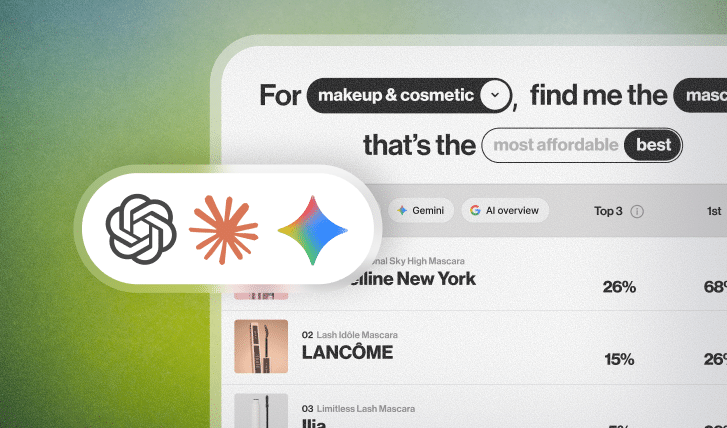






When a buyer asks a digital assistant for a product recommendation, you want your brand to be the definitive answer. Answer Engine Optimization (AEO) makes that possible. As generative tools become a primary discovery channel, e-commerce leaders have a unique opportunity to capture high-intent shoppers natively.
This guide explores how AEO redefines top-of-funnel attribution, shifting the focus from sheer click volume to securing authoritative citations. By structuring your catalog and leveraging authentic reviews, you can help AI models autonomously understand and recommend your products.
Key Takeaways: What is AEO
-
Attribution requires a new framework: E-commerce metrics should evolve beyond traditional click-through rates, measuring top-of-funnel success through AI citation frequency and Share of Voice (SoV) within generative responses.
-
AI traffic drives higher intent: While overall organic click volume may decrease, visitors sourced from AI engines demonstrate remarkable purchase readiness, boasting an average conversion rate of 14.2% compared to traditional search baselines.
-
Data should be machine-transactionable: To capture the decision-ready buyer, brands can optimize by structuring their catalogs, authentic reviews, and pricing data so that Large Language Models (LLMs) can easily extract, synthesize, and recommend their products autonomously.
-
Bring Strategy to Execution: AI visibility metrics only reveal half the picture. By using an execution-focused tool like
Yotpo Discover .
The Evolution of Discovery: From Digital Librarians to AI Assistants
The internet’s fundamental retrieval system is undergoing a profound structural change. For nearly three decades, search engines functioned as digital librarians—cataloging information and handing users a curated list of blue links to explore. Today, AI engines act as digital assistants, synthesizing vast amounts of data to provide immediate, context-rich responses directly on the results page.
This transition from a link-based retrieval system to an answer-based synthesis ecosystem is the foundation of Answer Engine Optimization (AEO). AEO is the strategic discipline of structuring your brand’s digital footprint so that generative engines reliably extract, cite, and recommend your products.
It is important to understand that AEO does not replace traditional search strategies; rather, it adapts them for a zero-click reality. In many scenarios, a generative snapshot provides enough comprehensive information to satisfy the user’s intent entirely, meaning the traditional website visit is bypassed. E-commerce brands are encouraged to shift their mindset from fighting the zero-click environment to recognizing it as a direct extension of their conversion funnel.
Historically, these generative snapshots were reserved primarily for top-of-funnel informational queries. However, consumer behavior has rapidly matured. Shoppers now actively prompt AI agents to compare product specifications, evaluate brand reputation, and recommend specific items. AI-generated responses now appear on 18% of commercial queries and 14% of transactional queries, representing a massive realignment in how high-intent buyers discover products.
Understanding the Mechanics of Answer Engine Optimization
To effectively implement an AEO strategy, it helps to first understand the underlying technology powering these generative responses: Retrieval-Augmented Generation (RAG).
Traditional search algorithms evaluate and rank entire web pages based on keyword density, backlink profiles, and overall site authority. RAG systems operate differently. Instead of ranking whole pages, they extract specific, verified facts and data points from multiple sources across the web to synthesize a single, cohesive answer. The AI engine is looking for the most accurate, concise piece of information, regardless of whether it lives on a primary category page, a detailed blog post, or within a verified customer review.
This extraction is powered by a mechanism known as “query fan-out.” When a shopper asks a complex question—such as comparing the durability and fit of two different running shoes—the AI model does not execute a single, simple search. Instead, it performs dozens of parallel background searches to cross-reference specifications, aggregate user sentiment, and verify pricing before generating the final text.
Because AI engines pull fragmented information (a process often called sub-document extraction) rather than analyzing the page as an indivisible whole, evolving how content is formatted becomes highly advantageous.
“To capture visibility in generative engines, e-commerce brands have to rethink how they present information,” notes Davis Belcher, Content Marketing Manager. “You have to modularize your content structure. Adopting a ‘Bottom Line Up Front’ (BLUF) formatting approach ensures that the most critical, machine-transactionable facts are immediately accessible, making it effortless for an LLM to extract and cite your product during a fan-out process.“
By breaking down complex product descriptions into easily digestible, highly structured modules, brands significantly increase their likelihood of being selected as a primary citation when AI engines compile their answers.
How AEO Reshapes the Top-of-Funnel Experience
For years, the standard e-commerce buyer journey followed a predictable, linear path: a consumer searched for a broad category, clicked through a series of blue links, and spent time manually browsing various brand category pages to compare options. Generative AI fundamentally collapses this top-of-funnel experience.
Today, research, comparison, and initial evaluation increasingly occur entirely within the AI interface. When a shopper asks an AI engine for “the best hydrating overnight masks for sensitive skin,” the engine does not merely return a list of skincare websites. It curates a bespoke, conversational response that evaluates specific products, summarizes ingredient benefits, and synthesizes aggregated customer sentiment. By the time a consumer actually clicks a link to visit an e-commerce store, they have already bypassed the traditional category browsing phase. They are arriving at the product page pre-educated and ready to make a decision.
This compression of the discovery phase is expanding rapidly across commercial search environments. Generative AI snapshots now appear on 14% of all shopping queries, marking a massive surge from just 2.1% in late 2024. As AI engines become more adept at handling complex, multi-layered transactional questions, this penetration rate is expected to climb, making AEO an essential strategy for any brand looking to capture early-stage buyer intent.
The impact of this shift extends far beyond organic visibility; it is actively reshaping the economics of paid acquisition. As generative results occupy more prominent visual real estate at the top of the search engine results page (SERP), they naturally displace traditional paid placements. This top-of-funnel compression directly impacts paid channels, resulting in a 21.27% drop in traditional paid click-through rates (CTR) for queries dominated by generative responses.
For e-commerce executives, this highlights a critical pivot point. Rather than continuously increasing paid budgets to combat declining traditional CTRs, forward-thinking leaders can consider reallocating resources toward Answer Engine Optimization. By securing authoritative citations within the AI snapshot itself, brands capture high-intent shoppers natively, often at a significantly lower long-term acquisition cost than traditional paid search.
5 New Attribution Metrics for the Generative Era
Because AEO operates in an environment where a user’s query may be fully satisfied without a website visit, relying exclusively on traditional traffic volume or link-level CTR is no longer sufficient. To accurately gauge the success of an Answer Engine Optimization strategy, e-commerce leaders can benefit from adopting a new framework of attribution metrics designed specifically for the generative era.
Consider tracking these five critical metrics to evaluate your brand’s performance within AI engines:
1. Citation Rate
Citation Rate measures the absolute frequency with which your brand, product, or specific content modules are included as sourced links within AI-generated responses for your target category queries. This is the foundational metric of AEO. It is not about ranking “number one” on a page; it is about being consistently recognized as a factual authority by the LLM.
Brands that actively optimize their content structure for Generative Engine Optimization (GEO) are seeing substantial early returns; early GEO adopters are discovered up to 10x faster by AI engines compared to those relying solely on legacy SEO structures.
2. Share of Voice (SoV) in Answers
While Citation Rate tracks your own visibility, Share of Voice in Answers contextualizes that performance against your direct market competitors. If an AI engine recommends five different coffee machines in a generative snapshot, SoV measures how often your product is featured versus the alternatives. Tracking this allows marketing teams to understand which entities the AI models currently trust the most, highlighting areas where structured data or review syndication might need enhancement.
3. Citation Prominence
Not all citations carry equal weight in a zero-click environment. Citation Prominence analyzes the specific placement and visual hierarchy of your brand’s inclusion within the AI’s response. Metrics should differentiate between:
- Inline Text Mentions: The brand is named directly in the synthesized paragraph (highly influential for brand recall).
- Primary Source Buttons: Highly visible, clickable citation cards located at the top or immediately following a specific claim.
- Sidebar/Footnote Links: Less prominent links that function as secondary references. Higher citation prominence directly correlates with higher click-through rates from the decision-ready buyers who do choose to leave the AI interface.
4. Answer Drift and Hallucination Monitoring
Unlike a static blog post, generative answers are dynamic. As LLMs continuously ingest new data, the way they describe your product can shift—a phenomenon known as “Answer Drift.” An operational metric for AEO is tracking the consistency of your brand’s value proposition within these models.
Are the AI agents accurately reflecting your latest pricing? Are they summarizing your core product benefits correctly, or are they hallucinating outdated features? Regularly monitoring answer drift ensures that your brand narrative remains accurate in automated environments.
5. Answer-Led Opportunities (ALOs)
One emerging metric for executive buy-in is Answer-Led Opportunities (ALOs). This metric connects AI citations directly to high-intent site sessions and eventual revenue. By utilizing specific tracking parameters on citation links and analyzing referral data from recognized AI platforms, brands can isolate the cohort of users arriving via generative responses. Because these users have already bypassed the research phase, ALOs typically boast significantly higher engagement and conversion metrics than standard organic traffic.
“To truly understand the ROI of generative search, executives have to stop tracking vanity traffic and start measuring Entity Trust and Share of Voice within LLMs,” advises Ben Salomon, Growth Marketing Manager. “When an AI engine consistently cites your brand, it signals a level of digital authority that traditional clicks simply cannot measure. That trust is what ultimately drives the decision-ready buyer to your checkout page.“
Analyzing the Value of AI-Sourced Traffic
As generative snapshots intercept top-of-funnel searches, overall website traffic volume may naturally decrease. However, e-commerce marketers should not view this as a negative trend. Instead, consider the distinct shift from traffic volume to traffic value. AI engines effectively act as a highly sophisticated filter, resolving the queries of casual window shoppers directly on the results page. The consumers who actually click through to your site are uniquely qualified.
These visitors arrive pre-vetted, having already consumed synthesized reviews, pricing comparisons, and feature benefits. As a result, engagement metrics are shifting dramatically. Users navigating from generative interfaces spend 68% more time on sites, with platforms like ChatGPT generating average session durations of nearly 10 minutes. Furthermore, AI-referred sessions are 1.7x to 2x longer with 27% lower bounce rates compared to traditional search traffic.
This depth of engagement yields a staggering impact on revenue. While the traditional organic search baseline conversion rate hovers around a modest 2.8%, traffic sourced directly from AI engines boasts an average conversion rate of 14.2%. For e-commerce leaders, optimizing for this hyper-qualified cohort is essential for maximizing return on investment.
“When an AI agent sends a user to your product page, that user has essentially completed their comparative shopping phase before they even load your site,” explains Mira Talisman, Growth CRO Team Lead.
“This fundamentally shifts our baseline expectations for conversion rate optimization. The traffic is pre-qualified and highly motivated, meaning our on-site experiences must pivot from convincing them why they need the product to seamlessly facilitating the transaction.“
Platform Breakdown: Google AI Overviews, OpenAI, and Perplexity
To build an effective Answer Engine Optimization strategy, it is helpful to recognize that the generative landscape is not monolithic. Different AI engines serve distinct user intents, process data uniquely, and require tailored optimization approaches. Understanding the nuances of the major platforms is crucial for capturing comprehensive visibility.
Google AI Overviews (AIO)
Google’s AI Overviews represent the intersection of legacy search infrastructure and generative synthesis. Because Google layers its LLMs directly on top of its existing Knowledge Graph and indexing systems, traditional technical health remains paramount. There is a 99.5% correlation between high organic ranking and inclusion in AI Overviews. For e-commerce brands, this means that robust product schema, fast page speeds, and authoritative backlinks are still foundational requirements to be considered for an AIO citation.
OpenAI and ChatGPT Search
ChatGPT has officially transitioned from a conversational chatbot into a real-time, web-connected search platform. Currently holding an 81.84% share of the AI chatbot market, OpenAI represents a massive top-of-funnel discovery engine. A crucial technical consideration for brands is crawler access. E-commerce sites that block the OAI-SearchBot via their robots.txt file to protect proprietary data should be aware that doing so limits their visibility within ChatGPT’s product recommendations.
Perplexity AI (The Truth Engine)
Perplexity positions itself as an academic and research-heavy search engine, attracting bottom-of-funnel buyers who demand deep verification before making a purchase. It currently commands a 15.10% global share of AI traffic with industry-leading session times.
Interestingly, because Perplexity prioritizes authentic human experiences over branded marketing copy, it relies heavily on community platforms and user-generated content, with 46.7% of its citations originating from sites like Reddit. For brands, this highlights the value of cultivating genuine brand advocates and syndicating authentic customer reviews across the web.
The Rise of Agentic Commerce and UCP/ACP Protocols
The evolution of generative search is actively paving the way for a more autonomous shopping experience, frequently referred to as Agentic Commerce. Looking toward 2026 and beyond, we are seeing a shift where AI agents—such as specialized shopping LLMs or integrated digital assistants like Amazon Rufus—will increasingly act as direct proxies for the consumer. Rather than simply providing links or comparative summaries, these advanced agents are being designed to evaluate products, verify specifications, and seamlessly complete checkouts on behalf of human users.
To facilitate this level of autonomous purchasing, the underlying digital infrastructure of e-commerce is adapting. We are witnessing the early development and implementation of new data frameworks, notably the Universal Commerce Protocol (UCP) and the Agentic Commerce Protocol (ACP). These protocols serve as standardized, machine-readable languages that allow a brand’s backend catalog to communicate seamlessly with external AI agents.
The absolute core requirement for both UCP and ACP integration is machine-transactionable data. An AI agent cannot visually interpret a beautifully designed lifestyle banner, nor can it manually click through a complex dropdown menu to check if a specific size is in stock. It requires pristine, perfectly structured data feeds. E-commerce brands are encouraged to ensure that real-time inventory levels, accurate pricing schemas, shipping timelines, and granular product attributes are continuously accessible via structured markup (such as comprehensive Product Schema) or emerging AI-specific formats like llms.txt files. By prioritizing this technical foundation, leaders can ensure their catalogs remain highly actionable for the next generation of AI shopping assistants.
E-E-A-T and the Trust Deficit in AI Synthesis
While the technology behind Answer Engine Optimization is highly technical, the fundamental currency of organic visibility remains deeply human. There is a growing consumer preference for generative discovery, with 44% of consumers preferring AI search for buying decisions, funneling an estimated $750 billion in US revenue by 2028. However, this heavy reliance on automated synthesis creates a unique challenge: the trust deficit.
Consumers demand verifiable facts before making a purchase, and Large Language Models are acutely programmed to recognize this requirement. Because AI models are designed to synthesize the most accurate and reliable information available, they apply the principles of Experience, Expertise, Authoritativeness, and Trustworthiness (E-E-A-T) rigorously. Generative engines inherently understand that branded marketing copy is biased. To verify a brand’s claims about a product’s quality, durability, or fit, LLMs actively seek out independent, third-party validation.
This is precisely why customer reviews and User-Generated Content (UGC) have become the critical training data for LLMs. When an AI engine evaluates a product during a query fan-out process, it crawls the web for authentic entity signals—specifically, the aggregate sentiment of actual buyers. A robust portfolio of verified, high-quality reviews provides the objective consensus that an LLM needs to confidently recommend your product in a generative snapshot.
The impact of this authentic content on the buyer journey is substantial. Shoppers who interact with reviews and UGC convert 161% higher than those who do not. Furthermore, generating this volume does not require an insurmountable effort; accumulating just 10 reviews on a product page can drive a 53% uplift in conversion. To ensure that these reviews contain the specific keywords and product features that AI engines are looking to extract, brands can utilize AI-powered review requests. Implementing smart prompts makes shoppers 4x more likely to capture high-value, descriptive topics that directly feed into LLM training data.
“Transparent customer loyalty and authentic UGC create the ultimate E-E-A-T signals that AI engines trust over branded marketing copy,” explains Eli Weiss, VP Retention Advocacy. “When you build a dedicated community of advocates who consistently generate detailed, honest reviews, you are essentially providing the raw, verifiable data that answer engines require to cite your brand as the definitive authority in your category.“
By continuously feeding the AI ecosystem with fresh, structured, and authentic customer experiences, brands can bridge the trust deficit and secure their position as the cited authority at the top of the generative funnel.
Reallocating Your Organic Strategy Budget for AEO
Historically, organic strategy budgets were heavily skewed toward acquiring raw backlink volume and producing long-form, keyword-dense blog content designed solely to manipulate standard search algorithms. In the era of AEO, continuing to fund these legacy tactics yields diminishing returns. Because generative engines prioritize factual extraction over link profiles, e-commerce leaders can consider pivoting their investments.
One approach to consider breaks this organic strategy down into four distinct pillars designed explicitly for generative visibility:
- 40% Entity & Schema (Deep Technical Structuring): The largest portion of your budget should shift from traditional on-page SEO to deep technical architecture. This involves implementing robust, error-free Product and Review Schema across your entire catalog. Furthermore, this budget allocates resources for developing and maintaining AI-specific data structures, such as llms.txt files, which act as highly optimized markdown directories designed exclusively to feed core business facts directly to AI crawlers.
- 30% Citation Equity (Digital PR & Community Presence): Since models like Perplexity rely heavily on human consensus, brands are well-served by investing in authentic, third-party validation. This involves transitioning from standard link-building to Digital PR, ensuring your brand is organically discussed on trusted community forums (like Reddit) and authoritative industry publications. The goal is to maximize the frequency and positive sentiment of brand mentions across the web.
- 20% Content Operations (Answer-Ready Formatting): Traditional content creation should adapt. Resources can be directed toward reformatting existing product pages into “Bottom Line Up Front” (BLUF) capsules. This involves creating concise Q&A blocks, clear specification tables, and multimodal assets (like structured imagery) that LLMs can instantly parse and extract without navigating complex site code.
- 10% Auditing & QA: Generative responses are dynamic and prone to unannounced shifts. Dedicated budget is helpful for continuous monitoring of your AI Share of Voice (SoV). This includes utilizing emerging software tools to track citation prominence, monitor how LLMs are framing your value proposition, and immediately correct any instances of answer drift or hallucinated product features.
By aligning financial resources with the actual mechanics of Retrieval-Augmented Generation, e-commerce brands can proactively construct the specific digital footprint that automated assistants are trained to prioritize.
How Yotpo Discover Helps Secure Your Brand’s AI Engine Visibility

Relying on traditional SEO strategies to combat zero-click search logic leaves e-commerce brands exposed to citation losses. Most generative visibility dashboards simply look at the surface, providing a performance score that merely leaves digital marketing teams with endless homework
Instead of presenting you with analytics homework
-
The Onsite Agent: Guarantees technical machine-readability by continuously scanning and optimizing your digital storefront to fix poor internal linking, missing structured data, and unstructured PDP parameters that prevent AI crawlers from parsing your catalog
. -
The Content Agent: Rapidly scales informational authority off-site by generating AEO-ready blog posts and strategic outreach briefs for third-party publisher sites, structuring all assets around your real customer reviews and order history
. -
The Activation Agent: Secures social proof across decentralized communities by identifying the exact Reddit threads, forums, and retail marketplaces that AI models cite, mobilizing your verified reviewers and loyalty members to engage on those exact platforms
.
The fundamental engine behind Discover is an unshakeable data moat built from over a decade of authentic shopper voices via Yotpo Reviews and Yotpo Loyalty
E-commerce leaders like Beekman 1802 and David Protein are already leveraging this agentic approach to command multi-LLM visibility
Conclusion
The era of chasing raw click volume is giving way to a more sophisticated model of digital attribution. Answer Engine Optimization is not merely a technical pivot; it is a strategic approach for capturing the decision-ready buyer in a generative ecosystem. By transitioning your focus from vanity traffic metrics to concrete business value—such as citation frequency and Answer-Led Opportunities (ALOs)—you align your brand with how modern consumers actually shop.
Moving forward, e-commerce leaders are encouraged to prioritize machine-transactionable data and authentic UGC to ensure their catalogs remain the trusted authority for the next generation of AI assistants.
FAQs: What is AEO
What is the core difference between AEO and traditional SEO?
Traditional SEO focuses on optimizing entire web pages to rank on a list of blue links, relying heavily on keyword density, site architecture, and backlink profiles. AEO (Answer Engine Optimization) is about structuring specific facts and data points so that Large Language Models (LLMs) can easily extract and synthesize them into a direct generative answer. Ultimately, traditional SEO generates clicks, whereas AEO secures authoritative citations within a zero-click environment.
How do AI engines determine which brands to cite?
AI engines utilize a process called Retrieval-Augmented Generation (RAG). When a user submits a query, the engine performs multiple background searches—known as a query fan-out—to find the most accurate, concise, and trustworthy information available. Citations are awarded to brands that offer highly structured, machine-readable data (like comprehensive schema markup) backed by strong E-E-A-T (Experience, Expertise, Authoritativeness, and Trustworthiness) signals. These trust signals are heavily derived from authentic user-generated content and verified customer reviews.
Is schema markup still relevant for Answer Engine Optimization?
Yes, it is more critical than ever. AI models do not visually browse or experience a website like a human; they parse code to extract technical attributes
What is an llms.txt file and why do e-commerce sites need it?
An llms.txt file is an emerging, highly optimized markdown directory designed specifically to communicate with AI crawlers. Similar in placement to a traditional robots.txt file, it lives in a website’s root directory but serves a proactive purpose: it feeds core business facts, structured product catalogs, and primary brand narratives directly to AI agents. Implementing this file can help LLMs ingest more accurate, up-to-date information without having to navigate complex site architecture or heavy javascript.
How does Agentic Commerce impact top-of-funnel metrics?
Agentic Commerce—where AI assistants actively evaluate products and complete purchases on behalf of human users—compresses the traditional top-of-funnel discovery phase. Instead of tracking how many humans manually browse a category page, e-commerce metrics are evolving to track how often your product data is successfully queried, retrieved, and recommended by these autonomous agents. Visibility metrics shift from session counts to machine-driven citation rates.
Why is traditional click-through rate (CTR) declining in generative search?
Traditional click-through rates are dropping because generative AI snapshots now frequently satisfy user intent directly on the search results page. Shoppers no longer need to click through multiple links to compare products, evaluate features, or read summary reviews; the AI engine does the synthesis for them. Consequently, actual site visits are increasingly reserved for users who are already pre-educated and decision-ready.
How can brands measure Answer-Led Opportunities (ALOs)?
Answer-Led Opportunities (ALOs) can be measured by utilizing specific UTM tracking parameters on links that are frequently cited in AI responses and by closely analyzing referral traffic sources in your web analytics platform. By isolating the cohort of traffic originating from AI engines like ChatGPT or Perplexity, brands can track the distinct behavior of these users and tie high-intent AI sessions directly to eventual revenue.
What role do customer reviews play in feeding LLM training data?
Customer reviews serve as the objective, third-party training data that LLMs require to verify brand claims. Because AI models are programmed to synthesize the most trustworthy information available, they prioritize the aggregate sentiment of actual buyers over branded, inherently biased marketing copy. A high volume of fresh, verified reviews provides the objective consensus an AI engine needs to confidently recommend your product in a generative snapshot.
How does “Bottom Line Up Front” (BLUF) formatting aid AEO?
“Bottom Line Up Front” (BLUF) formatting structures content so that the most critical, actionable facts are presented immediately at the top of a section or page. By using concise Q&A blocks, clear specification tables, and bulleted summaries, brands make it mathematically easier for an AI model’s extraction algorithms to identify and pull the exact information needed to generate a rapid citation during a query fan-out process.
Can I opt out of AI crawlers without losing search visibility?
While you technically can block specific AI crawlers (like the OAI-SearchBot) using your robots.txt file to protect proprietary data, doing so directly removes your brand from their index. In an ecosystem where generative platforms hold a massive and growing share of digital discovery, opting out means effectively forfeiting product visibility and recommendations for millions of high-intent, active buyers who rely entirely on AI assistants for their shopping research.











 Join a free demo, personalized to fit your needs