



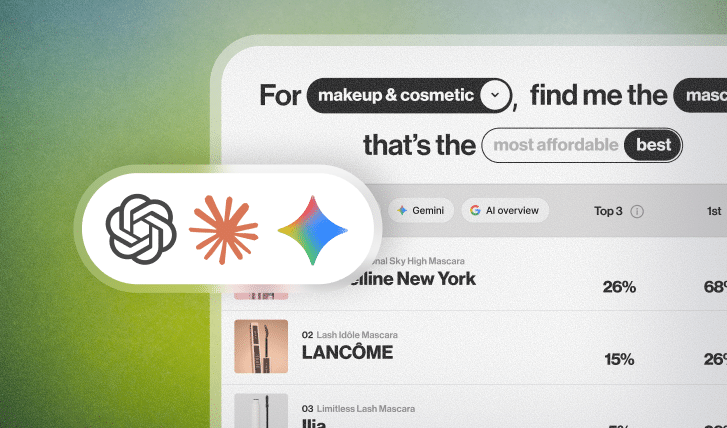






Imagine trying to navigate a new city with an outdated map. That is essentially what happens when e-commerce brands rely solely on legacy keyword tracking to understand their organic performance today. Buyers now expect immediate, synthesized answers delivered right at the top of their screens via AI engines.
To effectively manage Generative Engine Optimization (GEO) and see the full picture, brands are increasingly turning to a dedicated search engine visibility tool. This software acts as a reliable guide, empowering you to measure your true digital footprint, catch critical on-page SEO errors, and capture high-intent traffic by adapting to modern search behaviors.
Key Takeaways: Search Engine Visibility Tool
- Track your Share of AI Voice: Consider transitioning from legacy keyword rank metrics to measuring your visibility across multiple LLMs (like ChatGPT, Claude, and Perplexity).
- Diagnose technical roadblocks: Utilize a search engine visibility tool to identify on-page SEO errors and schema validation issues that might prevent AI from reading your site.
- Leverage authentic signals: High-quality user-generated content and robust E-E-A-T signals provide the fresh, reliable context that generative engines tend to favor for their recommendations.
- Rethink your analytics: Shifting toward first-touch attribution can help you accurately measure how top-of-funnel AI visibility ultimately impacts your downstream revenue.
The Evolution of Search: Why Traditional Tactics Require an Upgrade
The Shift from Keyword Matching to Semantic Reasoning
Search behaviors are gradually moving away from fragmented phrases and ten blue links. Today’s search engines increasingly function as synthesis engines, relying on semantic reasoning to understand the nuanced context and intent behind a query. Rather than simply matching exact keywords, these large language models (LLMs) parse conversational language to deliver synthesized answers.
This shift is driven by natural changes in consumer behavior. In fact, 58% of consumers now use AI tools to research products. Furthermore, generative AI traffic to retail sites has surged by an astounding 4,700% year-over-year. To capture this growing audience, brands can greatly benefit from a search engine visibility tool capable of navigating this complex, intent-driven ecosystem.
Understanding Generative Engine Optimization (GEO)
Adapting to this environment involves expanding beyond traditional SEO to embrace Generative Engine Optimization (GEO). While legacy SEO focused heavily on backlink volume and keyword density, GEO prioritizes a concept known as “retrievability.”
Retrievability measures how effectively your content is structured so that AI models can easily interpret, extract, and confidently cite it as a reliable source. AI engines favor high-quality, authoritative content that answers questions directly. Utilizing a dedicated search engine visibility tool helps you align your site’s architecture with these GEO principles, ensuring your brand is well-positioned for AI references.
How AI Engines Alter the Discovery Funnel
The traditional e-commerce funnel—where a user searches, clicks a website link, browses, and buys—is evolving into a new model: Discovery, AI Refinement, and Agentic Purchase. Shoppers are increasingly utilizing AI summaries to help evaluate products right on the search results page. Recent data shows that AI Overviews now appear on 14% of all shopping queries, representing a growing portion of top-of-funnel discovery.
“Adapting to the generative search ecosystem requires a subtle shift in how we present product information,” notes Amit Bachbut, Director of Growth Marketing. “It is becoming less about just getting a user to click a link, and more about ensuring the AI engine understands your product’s value well enough to feature it in a synthesized summary.“
What Exactly is a Search Engine Visibility Tool?
Beyond Traditional Keyword Rank Tracking
A modern search engine visibility tool expands upon the capabilities of legacy rank trackers. Historically, tracking software simply reported your domain’s position for a specific keyword on a static search engine results page. In an AI-driven landscape, that single metric provides an incomplete picture.
A generative search engine visibility tool acts as a comprehensive intelligence platform, tracking brand mentions, citation frequency, and your positioning within AI-generated answers. It helps you understand how often your brand is actively recommended as a valuable solution.
Multi-LLM Coverage and Share of AI Voice
Because shoppers use a variety of tools to discover products, it helps to expand your tracking strategy accordingly. A sophisticated search engine visibility tool monitors your presence across multiple platforms, including ChatGPT, Claude, and Perplexity.
This multi-engine tracking introduces a valuable metric: “Share of AI Voice.” Share of AI Voice measures how frequently your brand is cited in AI responses compared to other options in your market. By tracking this citation intelligence, brands can systematically target the publications and earned media sources that influence LLM training models. With 61% of marketing executives actively rethinking their marketing to optimize for AI engines, understanding this area offers a strong advantage for sustainable growth.
Generative Sentiment Analyzers
It is helpful to know not just if you are mentioned by an AI engine, but the context of that mention. A high-quality search engine visibility tool includes generative sentiment analysis to evaluate exactly how an LLM frames your brand.
Is the AI engine recommending your product as a premium option, or listing it with notable caveats? These tools analyze the tone, praise, and perceived weaknesses within synthesized answers. Reviewing this data allows you to refine your content strategy, address product messaging gaps, and ensure the AI accurately reflects your brand’s true value.
10 Best Strategies to Maximize Your Search Engine Visibility Tool
-
Deploy Yotpo Discover for Autonomous ActionLegacy visibility dashboards leave the heavy lifting to your team
. By implementing a commerce-native tool like Yotpo Discover . -
Optimize for Retrievability with Answer BlocksLarge language models are designed to extract clear, concise facts. By breaking down long-form narratives into easily digestible “answer blocks,” you can significantly improve your retrievability. Use your search engine visibility tool to identify the most common questions in your niche, and answer them directly using clean heading structures (H2s and H3s) followed by short, objective paragraphs.
-
Implement Modular Content StructuresGenerative engines process information efficiently in chunks. Implementing modular content structures—such as dedicated FAQ sections, step-by-step guides, and comparative data tables—allows AI to parse your product specifications with ease.
-
Transition to First-Touch AnalyticsAs zero-click searches rise, last-touch attribution models may not capture the full consumer journey. Reports indicate that 80% of consumers rely on AI summaries for at least a portion of their discovery phase. Transitioning to first-touch analytics helps you connect those early-stage organic AI citations to downstream revenue, providing a clearer picture of your top-of-funnel efforts.
-
Leverage Citation Intelligence for Earned MediaAI engines frequently pull their answers from authoritative third-party publishers. You can utilize your visibility software to identify which external publications are most frequently cited by LLMs for your target keywords. Once identified, consider aligning your PR and outreach efforts to secure earned media on those specific domains, feeding positive signals back to the AI models.
-
Execute High-Level AI Audits for Content GapsThink of an AI Audit as a strategic conversation about your brand’s digital footprint. A robust search engine visibility tool will reveal topics where competitors are being recommended by ChatGPT or Perplexity while your brand is omitted. Use these insights to identify content gaps and prioritize the creation of helpful resources that address those missing conversations.
-
Map the Impact of AI Overviews on Branded QueriesNavigational queries are increasingly mediated by generative summaries that display product details, reviews, and pricing directly on the results page. Monitor these branded queries closely to ensure the AI’s summary is factually accurate and presents your brand in an ideal light to prospective shoppers.
-
Optimize Schema Markup for AI-ReadinessSchema markup acts as a direct, semantic language for AI. Error-free structured data explicitly defines your product specs, availability, and pricing, removing guesswork for the LLM. Using a search engine visibility tool to validate your schema ensures you are providing the unambiguous context AI models require to confidently feature your products.
-
Resolve NAP Inconsistencies for Local VisibilityFor e-commerce brands with physical retail locations or local distribution networks, Name, Address, and Phone number (NAP) consistency remains highly important. AI engines frequently cross-reference directory data to recommend local options. Keeping this data clean and consistent ensures the AI maintains confidence in your brand’s operational details.
-
Bridge the Gap to Agentic CommerceA growing trend in search is “Agentic Commerce,” where AI agents may assist in completing purchases on behalf of the user. Forecasts suggest that agentic shoppers could represent up to $385 billion in U.S. e-commerce spending by 2030. To prepare, consider standardizing your product data feeds so they are easily readable by autonomous systems.
Identifying Critical On-Page SEO Errors with Visibility Analytics
Uncovering Technical Roadblocks
Expertly crafted content requires a solid technical foundation to achieve generative visibility. A dedicated search engine visibility tool acts as a helpful diagnostic layer, highlighting technical flaws that might disrupt semantic understanding.
Consider prioritizing improvements to site speed, mobile responsiveness, and clear URL structures. Generative models favor a positive user experience; if a page is difficult to parse, the AI may look elsewhere. Regular technical audits ensure your site architecture supports your content efforts.
Overcoming Content Cannibalization
Content cannibalization occurs when multiple pages on your domain compete for the exact same semantic intent, which can confuse AI models and dilute your brand’s authority.
Visibility analytics help you identify these overlapping assets. Once pinpointed, you can take practical steps to consolidate redundant content, utilize proper canonical tags, and establish a clear site hierarchy. By presenting a single, authoritative page for a specific topic, you provide AI engines with a definitive source to reference.
The Role of E-E-A-T and User Experience in Modern Search
Building Unshakeable Brand Authority
While the mechanics of search are changing, the foundational principles of quality remain. Generative AI models are trained to synthesize information from sources that exhibit E-E-A-T: Experience, Expertise, Authoritativeness, and Trustworthiness. In a digital space filled with generic text, verifiable human insight is incredibly valuable.
Research shows that 86% of marketing leaders are actively increasing budgets for proprietary research and original data collection. By publishing unique insights and fact-checked information, a brand establishes itself as a reliable entity that LLMs can confidently recommend.
How Authentic User-Generated Content Fuels Visibility
The “Experience” pillar of E-E-A-T heavily relies on authentic, first-hand accounts—making user-generated content (UGC) a vital asset. While review widgets themselves are not directly crawled or indexed by LLMs as raw text, the consistent influx of customer photos, Q&As, and written reviews provides fresh, dynamic signals for AI engines to interpret live data and gauge overall brand sentiment.
“AI models are designed to seek out verifiable human experiences,” explains Amit Bachbut, Director of Growth Marketing. “When your product pages are rich with authentic user reviews, you provide the exact kind of trustworthy context that generative engines look to cite.“
This authenticity positively impacts the shopper experience. Shoppers who engage with UGC convert 161% higher than those who do not, and displaying customer photos results in a 137% purchase likelihood lift. Modern visibility is a natural byproduct of establishing trust with your audience.
How Yotpo Discover Helps Brands Dominate AI Visibility

Monitoring your digital footprint across generative engines is only half the battle. Legacy monitoring software hands you a visibility score and leaves you with a massive to-do list
Instead of giving you more homework,
-
The Onsite Agent: Eliminates technical blind spots by continuously scanning your digital storefront to resolve poor internal linking, missing structured data, and unstructured PDP data that blocks AI crawlers from parsing your catalog
. -
The Content Agent: Rapidly scales authority by generating AEO-ready blog posts and strategic outreach briefs for third-party publishers, building all content around your real order history and customer reviews
. -
The Activation Agent: Drives authentic off-site signals by identifying the exact Reddit threads, forums, and retail marketplaces that AI engines cite for social consensus, then mobilizing your verified reviewers and loyalty members to engage on those platforms
.
Discover is backed by an unshakeable data moat built from over a decade of authentic shopper voices via Yotpo Reviews and Yotpo Loyalty—signals that LLMs inherently trust
E-commerce innovators like Beekman 1802 and David Protein are already using this platform to command search engine visibility
Conclusion
Adapting to the generative search ecosystem is a forward-thinking strategy for e-commerce brands looking to sustain long-term growth. Utilizing a comprehensive search engine visibility tool is a highly effective way to measure your Share of AI Voice, identify technical roadblocks, and maintain a competitive edge. By embracing modular content, carefully building your E-E-A-T signals, and optimizing for AI retrievability, brands can cultivate robust organic growth and capture high-intent traffic directly from the modern discovery funnel.
FAQs: Search Engine Visibility Tool
How does a search engine visibility tool differ from traditional SEO software?
Traditional SEO software tracks keyword rankings and backlink volume to see how high a domain sits in a list of blue links. A modern search engine visibility tool measures a brand’s presence, citation frequency, and sentiment across conversational engines like ChatGPT, Gemini, and Google AI Overviews
What metrics should I prioritize when analyzing my Share of AI Voice?
When analyzing Share of AI Voice, it helps to focus on your citation rate (how often your brand is mentioned), generative sentiment (whether the context is positive), and your visibility across varying prompt structures in tools like ChatGPT, Claude, and Perplexity.
Can a visibility tool help recover traffic lost to AI Overviews?
Yes. By utilizing a visibility tool, you can identify which third-party publishers and data sources are feeding the AI Overviews for your target keywords. This allows you to adjust your outreach strategy, earn media on those domains, and optimize your own content to become a cited source.
How often should e-commerce brands conduct AI audits?
Given the rapid pace of algorithmic updates, many e-commerce brands find it beneficial to conduct deep-dive AI audits on a quarterly basis. This can be paired with continuous, real-time tracking using a search engine visibility tool to monitor ongoing LLM citations.
Why are navigational queries increasingly affected by generative engines?
AI models are attempting to provide comprehensive brand summaries, product details, and aggregate reviews directly within the search interface. This gives users immediate context, sometimes reducing the need to click through to a brand’s homepage for basic navigational information.
How does structured data influence visibility in AI summaries?
Structured data (schema markup) acts as a universal translator for AI models. It provides explicit context regarding your product specifications, pricing, and availability, allowing the LLM to feature your details clearly and accurately.
What is the difference between crawlability and retrievability?
Crawlability refers to the technical ability of a search engine bot to access and index the pages on your website. Retrievability measures how effectively your content is structured and formatted so that an AI model can easily synthesize and cite the information.
How can modular content improve my chances of being cited by LLMs?
Generative models process information efficiently in chunks. Breaking your content down into modular formats—such as specific answer blocks, dedicated FAQs, and clear data tables—aligns well with how AI retrieves factual information.
What role does first-touch attribution play in modern search tracking?
As AI Overviews provide direct answers, users may discover your brand without immediately clicking a link. First-touch attribution helps properly credit these initial AI recommendations, tying top-of-funnel visibility to your eventual downstream results.
Will traditional keyword matching become irrelevant?
While exact-match keyword density is less of a focus, the underlying user intent those keywords represent will always be important. A search engine visibility tool helps you transition from targeting literal words to addressing the holistic semantic intent of your prospective customers.











 Join a free demo, personalized to fit your needs