



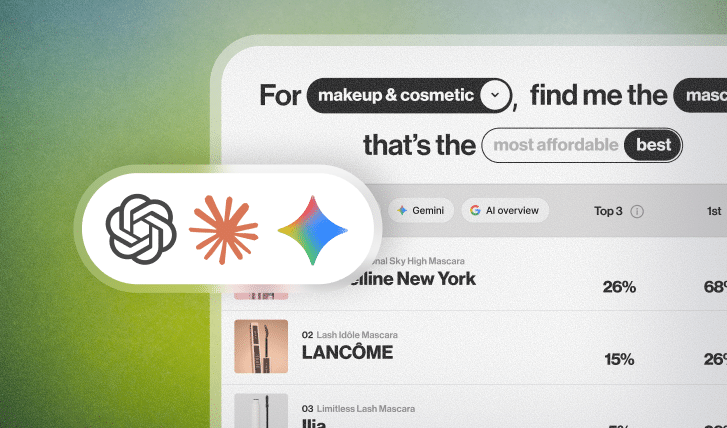






If you’ve noticed a shift in your top-of-funnel traffic lately, don’t panic. You are likely witnessing the impact of generative AI in real time. Instead of scrolling through standard search results, shoppers are letting tools like ChatGPT and Google’s AI Overviews summarize features, compare prices, and make direct recommendations.
Securing your spot in these AI responses, a strategy known as Answer Engine Optimization (AEO), is the next logical step for your growth. The good news? It simply requires structuring the rich data you already have so language models can easily read, verify, and cite your brand.
Key Takeaways: Ecommerce AEO
-
Answer Engine Optimization (AEO) is the new standard: Focus on structuring your content and product data so LLMs can easily extract and summarize it for conversational discovery
. -
Implement the CSQAF framework: Utilize Strategic Citations, Original Quotations, and Fluency to build visibility and trust within generative AI engines
. -
Agentic commerce changes the buyer journey: With AI agents conducting initial product research, brands must prioritize clear, accurate pricing and machine-readable data over visual aesthetics alone
. -
Reviews fuel AI visibility: Fresh, authentic user-generated content provides the continuous, verified data stream that language models require to validate and recommend your brand
. -
Bring Strategy to Execution: Merely monitoring visibility scores leaves your marketing team with endless homework
. Implementing an execution platform like Yotpo Discover .
Understanding the Shift to the Generative Synthesis Layer
The fundamental architecture of how consumers discover products is evolving. For decades, the digital shopping experience relied on a simple exchange: a user types a query, and a search engine provides a list of indexed links for the user to evaluate. Today, that process is rapidly moving toward a generative synthesis layer.
Instead of presenting ten blue links, AI engines like Perplexity, ChatGPT, and Google’s AI Overviews read those links on behalf of the user, synthesize the information, and generate a direct, conversational answer.
For e-commerce brands, this means optimization is no longer just about driving traffic to a landing page. It is about structuring your product information so seamlessly that an AI model confidently selects your brand as the definitive answer.
The Compression of the Modern Buyer Journey
The traditional e-commerce funnel—awareness, research, consideration, and purchase—is compressing into a single, seamless interaction. Shoppers now ask complex, multi-layered questions, expecting AI to conduct the heavy lifting of product comparison.
This compression creates a streamlined path to purchase, but it fundamentally changes top-of-funnel web traffic. Shoppers receive comprehensive answers within the AI interface, contributing to a “zero-click” reality for 58% of product and service searches.
When an AI Overview is present, users get the information they need immediately. Consequently, organic click-through rates for informational queries have plummeted 61%, dropping from 1.76% to a mere 0.61%.
Brands that continue to optimize solely for top-of-funnel clicks will find their metrics declining. The strategic adjustment involves optimizing for inclusion within the AI’s response itself, ensuring your brand is part of the synthesized answer rather than a bypassed link.
Analyzing Category-Specific Disruption Levels
The transition to AEO does not impact all e-commerce sectors equally. AI models excel at processing text, specifications, and structured data, meaning products that rely heavily on factual comparisons are experiencing the fastest shift toward generative search.
Recent data indicates that AI Overviews now appear on 14% of all shopping queries, representing a massive 5.6-fold increase in just a few months. However, the disruption varies significantly by product category:
- High-Synthesis Categories: Verticals like Grocery and Food have seen AI Overview presence surge to 49%. Similarly, the Electronics sector, which relies heavily on technical specifications and feature comparisons, sits at 24%. AI engines can easily digest and summarize screen resolutions, battery life, or ingredient lists.
- Low-Synthesis Categories: Conversely, highly subjective or visually dependent categories see far less AI intervention. Furniture, for example, triggers AI Overviews on roughly 2% of queries. Shoppers still need to visually confirm aesthetics, spatial fit, and fabric textures.
E-commerce teams can adapt their AEO strategy based on these nuances. If you sell highly technical items, prioritizing structured technical data is paramount. If you sell lifestyle products, combining accurate product schema with rich, easily crawlable user-generated content (like customer photos) helps bridge the gap between machine readability and human aesthetic preference.
The Strategic Value of the Citation Premium
In traditional SEO, ranking in the number one spot was the ultimate goal. In the generative era, the ultimate goal is becoming the source citation. When an AI engine generates a response, it appends citations to the websites it used to build that answer.
Earning these citations provides a massive strategic advantage. It shifts the brand’s role from a participant in a crowded marketplace to an endorsed authority.
How AI Citations Act as Trust Filters
Consumers are increasingly treating AI-generated answers not just as search results, but as curated recommendations. In fact, 64% of customers express readiness to purchase products directly suggested by AI.
When a shopper asks, “What are the best sustainable running shoes for flat feet?” and the AI synthesizes an answer that highlights your product, it acts as a powerful trust filter. The AI effectively vouches for your brand, separating you from competitors who were not cited. Users view brands cited by AI as vetted experts, which fundamentally elevates brand perception before the shopper even lands on your product page.
Earning this “Citation Premium” requires publishing high-density, factual information—such as durability statistics or verified customer outcomes—that AI models prioritize for extraction.
Capitalizing on Increased Click-Through Rates and Conversions
While overall top-of-funnel traffic might decrease due to zero-click searches, the traffic that does click through from an AI citation is incredibly valuable. These are highly qualified, bottom-of-funnel shoppers. The AI has already answered their preliminary questions, compared their options, and guided them to a decision.
Because the AI has pre-qualified the shopper’s intent, the resulting business impact is substantial. Brands that successfully secure citations in generative summaries earn a 35% higher organic CTR for those specific placements. Furthermore, the halo effect of AI endorsement leads to 91% more paid clicks, and users arriving via AI citations are up to 23 times more likely to convert.
The logic is simple: by the time the user clicks the citation link, they are not looking to browse. They are clicking to buy. Structuring your content to be the definitive, citable source ensures you capture this high-intent, conversion-ready audience.
15 Best Strategies for Ecommerce AEO in 2026
-
Deploy Yotpo Discover for Agentic Execution: Tracking your baseline metrics is only step one. By adopting a dedicated platform like
Yotpo Discover . The platform channels deep SKU-level insights into purpose-built agents that actively fix structural gaps, scale review-backed content, and build off-site authority . -
Integrate Strategic Citations and Verified Data: AI engines are fundamentally programmed to verify information before presenting it to users. Including strategic outbound citations to non-competitor, high-authority domains proves to the AI that your content is rooted in verified facts. Princeton University research revealed that adding hard statistics to content increases its citation visibility in AI models by up to 40%.
-
Leverage Original Expert Quotations: Generative engines process vast amounts of repetitive, generic information. To determine which source is the most valuable, they look for original insights that cannot be found elsewhere on the web
. Expert quotations provide exactly this. -
Build Topic Clusters for Entity Authoritativeness: In the AEO landscape, AI models evaluate your brand as a complete entity. Interconnected topic clusters—where a central pillar page links out to highly specific sub-topic pages—signal to the LLM that your brand owns the semantic space, making you the safest choice to recommend.
-
Optimize for Fluency and Direct Context: Optimizing for fluency means writing with clear, direct, and unambiguous sentence structures
. Avoid using vague pronouns like “it” at the start of paragraphs . Clear noun-verb associations allow AI crawlers to parse your claims with perfect accuracy . -
Utilize Question-Based Headers and Direct Answers: Frame your subheadings as conversational questions consumers actually ask. Follow that header immediately with a concise, 30-to-50-word direct answer capsule
. AI models extract the first sentence following a header to determine quick relevance . -
Format with Lists and Comparison Tables: AI engines frequently synthesize information into tables or bulleted lists to make answers digestible. Providing this clean formatting natively on your product pages yields 30% to 40% higher visibility in AI responses compared to pages containing only paragraph text.
-
Design Storefronts for Machine Extraction: AI agents do not appreciate visual aesthetics; they prioritize data accuracy, transparent pricing, and structured technical specifications
. E-commerce teams must ensure their digital storefronts are optimized for raw data extraction by maintaining perfect schema and explicit product attributes . -
Adapt to Platform-Specific Assistants: Product descriptions can no longer be static lists of features. Incorporate conversational, context-rich answers directly into your page architecture to increase the likelihood of retail AI assistants selecting your product as the most relevant match.
-
Optimize for Needs-First Recommendation Engines: Platforms like Perplexity use automated features to analyze user reviews, filter for the best options, and process checkouts directly. To capitalize on these end-to-end shopping environments, brands must supply deep, verified product data and real shopper signals
. -
Mitigate Targeted Negativity at Point of Consideration: ChatGPT concentrates its product criticisms 13 times more heavily near the exact point of purchase. To mitigate this, brands must proactively address known product limitations within their own content, providing the AI with balanced data to prevent third-party complaints from dominating the model’s narrative.
-
Prioritize Merchant Center and Schema Accuracy: Implementing flawless JSON-LD schema markup acts as a direct translation layer for AI
. When your backend structured feeds perfectly align with your visible on-page text, AI models gain the confidence required to recommend your products . -
Maintain Open AI Crawlability: Blocking AI search bots via your robots.txt file to protect proprietary data removes your brand entirely from the modern discovery layer. Ensure your technical infrastructure remains completely open to reputable crawlers so your catalog data can actively participate in agentic commerce
. -
Supply Continuous Review Data to LLMs: Customer reviews provide the long-tail data points—like fit, material quality, or real-life performance—that AI models extract to resolve specific user queries
. Maintaining a continuous stream of fresh customer reviews ensures that LLMs always have up-to-date data to synthesize . -
Redefine Success via AI Citation Frequency: If top-of-funnel clicks decline due to zero-click AI summaries, brands must pivot to new measurement frameworks. Tracking your AI Citation Frequency and Share of Voice (SOV) within generative responses provides a highly accurate indicator of true organic presence
.
How Yotpo Discover Helps E-Commerce Brands Optimize for AI Engines

Chasing raw traffic volume through legacy content workflows does not protect an e-commerce catalog from algorithmic invisibility
Instead of creating manual lists of technical fixes,
-
The Onsite Agent: Ensures technical machine-readability by continuously scanning your digital storefront to resolve poor internal linking, missing structured data, and unclear PDP data that blocks AI crawlers from parsing your catalog
. -
The Content Agent: Bridges off-site authority and citation gaps by generating AEO-ready blog posts and strategic outreach briefs for third-party publishers, building all content directly from your real customer reviews and order history
. -
The Activation Agent: Drives authentic off-site signals across decentralized platforms by identifying the exact Reddit threads, retail marketplaces, and forums that AI engines actively cite, prompting your verified reviewers and loyalty members to share authentic shopper voices directly on those platforms
.
The underlying data moat powering this optimization engine is the authentic shopper voice already flowing through Yotpo Reviews and Yotpo Loyalty—signals that LLMs inherently trust
E-commerce growth innovators like David Protein and Beekman 1802 are already utilizing this agentic architecture to capture the citation premium
Conclusion
The transition to Answer Engine Optimization is not a trend to fear; it is a profound opportunity to refine how you communicate your brand’s value. As shoppers increasingly lean on AI assistants and generative summaries for product discovery, your strategy must pivot from simply chasing clicks to establishing verifiable, machine-readable authority.
By implementing the CSQAF framework, organizing your product schema, and consistently fueling AI models with rich, authentic user-generated content, you position your brand as the definitive answer in your category. Embrace this generative layer, and you will capture the highest-intent shoppers of the modern e-commerce era.
FAQs: Ecommerce AEO
What is the primary difference between traditional SEO and AEO?
Traditional SEO focuses on optimizing web pages to rank as blue links on a search engine results page, driving traffic based on keyword matching. Answer Engine Optimization (AEO) focuses on structuring data and content so that Large Language Models (LLMs) can easily read, verify, and synthesize it into a direct, conversational answer within an AI interface.
How does agentic commerce impact the traditional buyer journey?
Agentic commerce compresses the traditional buyer journey by having AI agents conduct the research, comparison, and evaluation phases autonomously on behalf of the consumer. This means brands must optimize for machine-readable data, clear pricing, and accurate schema, as AI agents prioritize these factual elements over visual website aesthetics.
Why is it recommended to allow AI crawlers access to an e-commerce site?
Blocking AI crawlers via your robots.txt file effectively removes your brand from the generative discovery layer. Because conversational search relies on continuous, real-time crawling to serve accurate answers to users, restricting access guarantees that AI engines will bypass your products and recommend your accessible competitors instead.
How do customer reviews influence a brand’s visibility in LLMs?
Customer reviews provide the continuous stream of fresh, authentic, and specific data that AI models crave. They offer “Information Gain” by answering nuanced situational questions (like fit, durability, or real-life performance) that static product descriptions lack, thereby grounding the AI’s recommendations in verified, real-world sentiment.
What role does Merchant Center data play in generative search summaries?
Generative AI engines rely on established data graphs to pull real-time, factual information into their summaries. A clean, accurate Google Merchant Center feed ensures that AI models can confidently verify your product’s current pricing, availability, and variations, preventing them from hallucinating out-of-stock items.
Why is structural formatting like markdown tables important for AI extraction?
AI models are designed to scan web pages sequentially, looking for distinct visual blocks and logical data structures. Formatting comparisons into markdown tables or utilizing concise bulleted lists provides ready-made “answer blocks” that LLMs can effortlessly extract and present to users, increasing your likelihood of citation.
How do AI engines evaluate brand sentiment differently?
Different AI platforms utilize varied training architectures and environments. For example, Google’s AI often leverages existing social proof from forums and local listings, surfacing broader controversies early in the research phase. Conversely, standalone interfaces like ChatGPT rely on text synthesis and often surface specific product criticisms right at the point of consideration.
What is the CSQAF framework in relation to generative optimization?
The CSQAF framework stands for Citations, Statistics, Quotations, Authoritativeness, and Fluency. It serves as a tactical baseline for Generative Engine Optimization, ensuring your content features verified metrics, unique human insights, and clear language that large language models prioritize for extraction
How can e-commerce brands measure success if traditional click-through rates decline?
If top-of-funnel clicks decline due to zero-click AI summaries, brands should shift their KPIs to measure AI Citation Frequency, Share of Voice within the generative layer, and Pixel Ownership (how much screen real estate your citations occupy). Additionally, monitoring the high conversion rates of post-synthesis navigational traffic is essential.
Why is outbound linking to authoritative sources necessary for AEO?
AI engines are programmed to seek “grounding”—evidence that a claim is factual. By including strategic outbound links to non-competitor, highly authoritative domains, you prove to the AI that your content is meticulously researched and validated, which significantly boosts the model’s confidence in citing your brand.











 Join a free demo, personalized to fit your needs