









Black Friday lands on November 27, 2026. Cyber Monday follows three days later, on November 30. In between, shoppers now bounce between search, social feeds, and AI chat assistants before they settle on a store, often within the same browsing session. AI-referred traffic to ecommerce sites jumped 752% year over year during BFCM 2025, according to Yotpo’s BFCM 2026 AI Visibility Guide. That climb is worth planning around now. This guide covers 25 sale structures built to protect margin, move real inventory, and earn a review once the box arrives.
Key takeaways
- Black Friday lands on November 27, 2026, and Cyber Monday follows on November 30. Lock in launch dates and inventory around that window now.
- Tiered discounts, bundles, and gift-with-purchase offers tend to protect margin better than one flat, sitewide percent off.
- Offers that prompt a shopper to leave a review after purchase can compound. Those reviews become exactly the kind of content AI answer engines can draw on later.
- Shoppers who arrive from AI answers tend to convert well once they land on a product page. Getting product content ready for AI assistants matters just as much as the usual search push.
- Small businesses can run most of these structures at a smaller scale. A tight bundle or a loyalty-only early window often beats a broad discount that a small catalog simply can’t sustain.
- AEO and SEO work together during BFCM. Neither one replaces the other, and both lean on the same clean product data.
1. Build a tiered “spend more, save more” ladder
A tiered discount ladder rewards bigger baskets without cutting the price on every item equally. Picture three simple steps: 15% off at $75, 20% off at $150, 25% off at $250. Shoppers watch the next tier get closer as they shop. That nudges them toward one more item instead of checking out early. Smaller orders keep their margin intact, while the ladder still pulls in the bigger baskets that make BFCM worth running.
Put the ladder where shoppers actually see it: the cart page, a sticky banner, never the footer. Watch what happens when a shopper sees their savings climb in real time. They’ll often grab one more item just to clear the next threshold.
2. Open a members-only preview window
Give loyalty members and email subscribers a 24- to 48-hour head start before the sale opens to everyone, since it rewards your most engaged shoppers and thins out the crowd on launch day. Your best customers get first pick of limited stock too, which cuts down on frustrated messages once doors open wide. Frame the window as a members-only perk, every time you promote it.
3. Run hourly doorbuster deals on hero products
Run a doorbuster on one or two hero products, live for a set hour or two. It gives shoppers a reason to check back throughout the day. Pick items with healthy margin and strong stock, so a sellout doesn’t turn into a support headache. Post the schedule in advance, so shoppers plan around it instead of missing it.
4. Bundle slow movers with bestsellers
Bundle a slower-moving item with a bestseller at a combined discount. That clears inventory without discounting your top seller on its own. The bundle price should still beat buying both items separately, but the blended margin usually holds up better than a flat percent off across the board. It works especially well for apparel sizes and colors that didn’t move earlier in the season.
5. Add a gift-with-purchase at a spend threshold
A free gift at a spend threshold, say a travel size or an accessory at $100, often lifts average order value more than an equivalent discount. It also costs less to fulfill than it looks. Shoppers tend to value a tangible extra more than a few dollars off the price. Keep the threshold close to your current average order value, so it feels reachable, not like a stretch.
6. Set a free shipping threshold above your typical cart
Nothing beats free shipping as a BFCM perk. Shoppers expect it now. Set the threshold just above what a typical cart already spends, not below it, so the offer pulls the basket up instead of just covering a planned purchase. Skip vague banner copy. A running counter on the cart page works better: it ticks down the dollar amount left before shipping goes free. Shoppers watch that number drop, and most grab one more item just to hit zero.
7. Structure a BOGO on complementary categories
BOGO offers work best across paired categories, not identical items. Most shoppers don’t want two of the same thing anyway. A skincare brand might pair a cleanser purchase with a discounted moisturizer, for instance, which introduces shoppers to a second product line while the anchor item stays at full price.
8. Run a loyalty points multiplier weekend
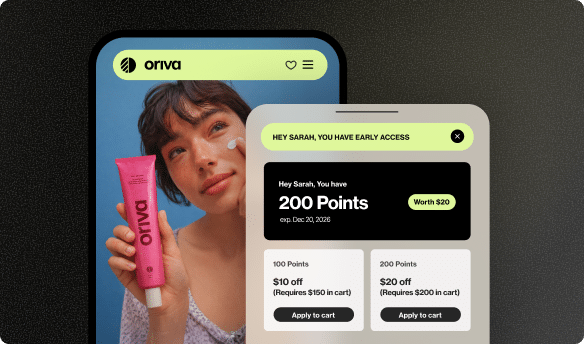
A points multiplier weekend, three or five times the usual earn rate, gives loyalty members a reason to shop now instead of waiting for a lower price. It also builds a points balance that pulls members back for a repeat purchase once the multiplier ends. Pair the multiplier with a reminder of exactly how close each member sits to their next reward tier.
9. Offer referral-triggered discount codes
A referral program unlocks a discount code for both the sender and the friend. That turns BFCM traffic into new customers, not just deeper discounts for shoppers who were buying anyway. Keep the code simple: a flat percent off, no minimum, easy to drop into a text message or a group chat during the exact week shoppers are comparing options.
10. Turn post-purchase reviews into a small reward
Offer a short-term reward, a few loyalty points or a small discount code, for leaving a review after a BFCM order. It gives shoppers a reason to write one while the purchase is still fresh. This matters long after the sale ends. Moving a product page from 0 to 100 reviews is associated with a 106.5% lift in conversion, per Yotpo’s BFCM 2026 AI Visibility Guide.
Reviews also tend to live on third-party pages, forums, and marketplaces, not just your own site. Roughly 85% of AI brand mentions tend to come from third-party pages rather than a brand’s own site, according to the same guide. A steady flow of real reviews is exactly the kind of content an AI assistant can draw on later, not just a conversion booster today.
11. Deep-discount a curated set of bestsellers
Skip the full-catalog discount. Pick ten to twenty bestsellers instead, and give that curated set a deeper discount than your sitewide rate. Your promotional budget lands where it moves the most volume, and margin stays intact everywhere else. Feature the set front and center on the homepage, so it reads as a highlight, not a clearance bin.
12. Cap a sitewide percent off to protect margin
A sitewide discount looks simple on paper. Then a shopper drops a single item over $200 in the cart, and an uncapped percentage quietly wipes out the margin on that one line. Set a dollar cap instead of a flat rate. Twenty percent off, capped at $50, still pulls shoppers in without turning a $500 order into a loss you eat at checkout. Few shoppers even clock the cap, unless their own cart happens to cross it.
13. Give top loyalty tiers an exclusive bundle
Reserve one bundle, a set that isn’t sold separately anywhere else, just for your top loyalty tier. That gives your highest-value members a real reason to stay in the program instead of shopping around. It also signals that tier status carries weight beyond points alone. Announce it weeks ahead of BFCM, as a tier benefit, not as a surprise sprung on the day.
14. Pair Small Business Saturday with a local or story-driven offer
Small Business Saturday sits between Black Friday and Cyber Monday, and for independent brands it works best as a story, not a straight discount. Try a portion of proceeds to a local cause, or a limited run tied to the brand’s origin. Among Black Friday sale ideas for small business, this one tends to build loyalty rather than just move units, since shoppers are actively looking to support smaller retailers that day.
15. Reserve one bundle for Cyber Monday only
Save one bundle, or one discount tier, strictly for Cyber Monday. Some shoppers miss Black Friday entirely. Others are still comparing five open browser tabs when the weekend ends. Either way, they need a real reason to come back three days later instead of assuming the sale already closed. Position Cyber Monday as the online-only extension of the weekend. Make it read as a distinct offer, not a rerun of Friday’s.
16. Start a countdown campaign weeks before Black Friday
Around 75% of shoppers research Black Friday deals before mid-November, and roughly 40% begin buying in October, according to Yotpo’s BFCM 2026 AI Visibility Guide. A countdown campaign, teaser emails plus early landing pages, puts a brand in front of that research phase instead of showing up only on the day itself.
Timing matters for AI visibility too. ChatGPT can start showing new content within about 1 to 3 weeks, per the same guide, so a page published the week of Black Friday may not get indexed in time to help.
17. Add a gamified mystery discount
A spin-to-win or scratch-off mystery discount, with a set minimum like 10% off, turns checkout into a small moment of play instead of a plain, flat click-through. Weight the outcomes so most shoppers land near the middle of the range. This works well as a pop-up on category pages during your highest-traffic days.
18. Build a BFCM-specific abandoned cart flow
Standard abandoned cart emails often wait a full day before following up. That’s too slow during BFCM. Shorten the delay to an hour or two, and add a small time-limited incentive, since carts fill up fast this week with shoppers comparing several tabs at once. A short, direct reminder tends to beat a longer email during this specific window.
19. Match a portion of sales to a cause
A donation match, a fixed amount per order or a percent of sales to a chosen cause, gives price-sensitive shoppers a reason beyond the discount to pick your store over a competitor’s. Keep the cause visible on the product page and at checkout, not tucked into a footer banner, so the commitment reads as genuine, not an afterthought.
20. Offer a first-box discount for subscriptions
Does the brand sell a subscription or refill product? A steep first-box discount during BFCM can lock in a relationship that outlasts the holiday weekend by months. Margin on that first box matters far less than the lifetime value of the subscriber it creates. Make it easy to find how to cancel, so the offer reads as generous, not as a trap.
21. Extend the returns window through January
Push the returns window out to mid-January instead of the standard 30 days. That one change removes a common objection to gift purchases bought during BFCM, and it costs almost nothing to offer. Shoppers notice anyway. The extension often shows up in reviews, named as the exact reason someone trusted the purchase in the first place. Pair it with clear messaging on the product page. Shoppers should see the policy before they add an item to cart, not after.
22. Run a “thank you” extension sale for existing customers
Run a short sale open only to current customers, the week after Cyber Monday. It keeps momentum going without opening a second public discount to everyone. Frame it as a thank-you, not a second Black Friday, and pair it with a request for feedback or a review on the item they bought during the main event.
23. Run a photo-review contest tied to BFCM purchases
Offer a small prize for the best photo review submitted within two weeks of a BFCM order. It encourages the kind of detailed, media-rich reviews that plain star ratings never produce. Syndication can also help a brand gather up to 20x more reviews within 30 days, according to Yotpo’s BFCM 2026 AI Visibility Guide, when reviews get pushed to retailer and marketplace listings. Announce winners in public, so the incentive stays credible next time.
24. Let onsite recommendations do the cross-selling
Static “you might also like” blocks show the same handful of products to every single visitor, right during the highest-traffic week of the year. Picks that actually adjust to what’s in the cart and what’s in stock keep cross-sell relevant, even as inventory shifts hour to hour. It’s a narrower fix than a full AI-visibility platform. But it closes a real gap, and it matters most during BFCM.
25. Make sure your offers show up when shoppers ask AI for deals
More shoppers now ask an AI assistant to compare Black Friday deals before they ever open a retailer’s site. Often, only the brands an assistant can find and cite make it into that answer. This is the gap Yotpo Discover, a purpose-built AI-visibility platform for ecommerce, is built to close.
The average brand shows up in about 17.2% of relevant AI answers, while top-performing brands reach roughly 56.7%, per Yotpo’s BFCM 2026 AI Visibility Guide.
Brands that start early can see about 3.4x more AI visibility than late entrants, according to the same guide. That’s one more reason to pair these 25 sale structures with a check of how a catalog currently reads to ChatGPT, Gemini, and Google AI Mode, well before November 27.
Frequently asked questions
When are Black Friday and Cyber Monday in 2026?
Black Friday falls on November 27, 2026, and Cyber Monday follows on November 30, 2026. Plan promotional emails, inventory, and any AI-visibility work well ahead of that window. Content published the week of the sale may not have time to get indexed.
Which Black Friday sale ideas work best for a small business?
A tiered spend ladder, a loyalty-only early window, and a story-driven Small Business Saturday offer all tend to work well for smaller catalogs. None of them need the deep inventory a doorbuster or a wide bundle strategy demands. A tight, well-timed offer usually beats a broad discount that a small team can’t sustain across every item.
Is AI visibility a substitute for SEO during BFCM?
No, it isn’t. AEO and SEO complement each other; they don’t compete. Clean product data, clear category pages, and a steady base of reviews tend to help both a traditional search ranking and an AI-generated answer. A solid BFCM plan keeps both in scope instead of swapping one for the other.
Which AI engines does Yotpo Discover track?
Discover tracks ChatGPT, Gemini, and Google AI Mode.
These 25 structures give a starting point for the discount, bundle, and loyalty mechanics that carry a store through November 27 and 30. The reviews and real shopper voices these offers generate can also become material an AI assistant can draw on, next time a shopper asks it for deals. Want to see where your catalog stands? Get a free AI visibility score, or learn more and request a demo at yotpo.com/discover to see how Discover fits your BFCM plan.












 Join a free demo, personalized to fit your needs