







Black Friday and Cyber Monday still anchor the shopping calendar. This year, the dates are November 27 and 30. A strong loyalty offer turns one-time shoppers into repeat buyers, but only if those shoppers find your brand first. That discovery moment is changing. Increasingly, it starts inside an AI answer, not a page of blue links. Here’s how to build Black Friday loyalty promotions that pull people back and keep your brand visible right where they’re now searching.
Key takeaways
- Mark your calendar: Black Friday falls on November 27, 2026, and Cyber Monday follows three days later, on November 30. Build, test, and get loyalty offers live before shoppers start researching in October.
- A storewide discount treats every shopper the same. A member-only promotion doesn’t. Try points multipliers, VIP preview windows, tiered rewards, or a referral push instead.
- During BFCM 2025, AI-referred traffic to ecommerce sites grew 752% year over year, per Yotpo’s BFCM 2026 AI Visibility Guide.
- Reviews and loyalty data both build the third-party proof AI engines can draw on when they answer a shopping question. That’s why the two work best run side by side.
- New content can take anywhere from a few weeks to a few months to show up regularly in AI answers. That’s one reason loyalty promotion pages need to go live early.
- Yotpo Discover can help track how loyalty and review content shows up across ChatGPT, Gemini, and Google AI Mode. It sits right alongside the loyalty and reviews programs it’s already built on.
Why Black Friday loyalty promotions need an AI-visibility layer in 2026
Loyalty promotions used to fight for attention in two places: a search results page or an inbox. That’s changing fast. Shoppers now open a chat window instead. They ask an AI assistant to compare Black Friday deals, find a loyalty program worth joining, or name a brand that treats repeat customers well. If your offer never shows up in that answer, the good terms behind it won’t matter.
The scale of that shift is hard to miss. AI-referred traffic to ecommerce sites grew 752% year over year during BFCM 2025, according to Yotpo’s BFCM 2026 AI Visibility Guide. Shoppers who arrive from AI answers tend to convert about 31% higher than non-brand organic traffic. They also tend to spend around 45% more time comparing products before they buy. That’s a more informed shopper: ready to weigh terms and likely to buy once they land on-site.
That same traffic sticks around, too. AI-referred visitors bounce roughly 33% less than visitors from other channels, per the same guide. The guide also projects that AI-influenced ecommerce spend will hit $595 billion by 2028. Loyalty teams mapping out BFCM budgets a year or two ahead should read that one way. Treat AI visibility as a real line item, not a passing trend.
None of this means discounts stop working. Paid offers still move product, plain and simple. What changes is the second piece: a loyalty promotion now also needs visible proof behind it, like reviews, mentions, program details. An AI engine can find and cite that proof when a shopper asks about your brand. Good terms alone won’t earn the repeat purchase. They’re only half the job.
Loyalty promotion types built for Black Friday and Cyber Monday
A storewide discount treats every shopper the same, whether they bought once or bought ten times. Loyalty-specific promotions flip that script. They reward the relationship, not the transaction. The formats below work well for a short, heavily promoted window like BFCM. Each one gives members a clear reason to act now, not later.
Points multipliers
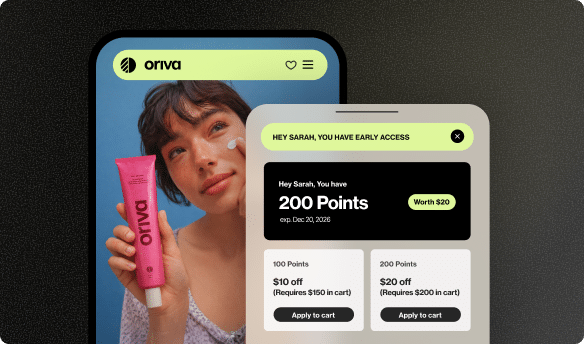
Doubling or tripling points during Black Friday and Cyber Monday is one of the simplest promotions to run. Members get it right away. A limited-time multiplier gives them a reason to buy now instead of waiting for a future sale. It also costs less upfront than a matching percent-off deal, since the reward is deferred spend, not a markdown today. Set a clear start and end time, and say so on the page, so nobody wonders if it already ended.
VIP preview windows
Let loyalty members shop your Black Friday deals a day or two before the general public. It’s a low-cost way to make membership feel worth having. A VIP preview window also spreads order volume across a longer stretch, instead of piling everything onto one Friday. That eases fulfillment pressure during your busiest week of the year.
Tiered milestone rewards
Members in higher loyalty tiers can unlock deeper BFCM discounts, free gifts, or exclusive products that lower tiers never see. That gives shoppers a real reason to climb tiers before the holidays hit. It also backs up a bigger idea: loyalty status is worth building all year, not just for one sale weekend. Show members exactly how close they sit to the next tier. More of them will chase it before the sale starts.
Referral pushes
Black Friday is a natural moment to ask happy members for a favor: bring a friend. Most shoppers are buying gifts for someone else anyway, so the ask fits the moment. Pair a referral bonus with your BFCM offer, and the mechanics sell themselves. The referrer banks points, the friend gets a welcome discount. Nobody has to be talked into it twice. During the single busiest week of the year, existing members turn into a free growth channel.
Gamified challenges
Short challenges add momentum fast. Members might unlock bonus points after a few purchases across Black Friday weekend, or bank a reward for referring a friend before Cyber Monday hits. Treat this as a layer on top of one of the formats above, never a replacement for a genuine reward. Keep the rules simple. A member should be able to track their own progress without opening a dashboard or hunting through fine print.
Timing your Black Friday loyalty calendar for 2026
Black Friday falls on November 27, 2026, and Cyber Monday follows three days later on November 30. Wait until Thanksgiving week to build and publish loyalty promotions, and you’ll fall behind on two fronts at once. Shoppers and AI engines both move faster than that.
On the shopper side, research starts early. Around 75% of shoppers research Black Friday deals before mid-November, and roughly 40% already start buying in October, according to Yotpo’s BFCM 2026 AI Visibility Guide. A promotion that only goes live during sale week misses shoppers who made up their minds weeks earlier.
On the AI side, new content doesn’t show up instantly either. Per the same guide, ChatGPT can begin surfacing new content within about 1 to 3 weeks, longer for lower-traffic pages, roughly 4 to 8 weeks. Google AI Overviews tends to reflect new content within about 14 to 45 days.
Building a steady AI share of voice for a loyalty page usually takes 3 to 6 months, not days. That’s why loyalty pages for BFCM should publish and promote in September or October, well ahead of late November.
Turning loyalty members into reviews AI engines can find
Loyalty and reviews solve different problems on their own. Run together, they compound. A loyalty program gives you a steady base of repeat customers who already trust the brand. Reviews give those same customers a public, citable place to say so. That’s the third-party proof AI engines tend to draw on when a shopper asks which brand to trust for Black Friday shopping.
The relationship shows up in Yotpo’s own numbers, too. Moving a product page from 0 to 100 reviews is tied to a 106.5% lift in conversion, and syndication can help a brand gather up to 20x more reviews within 30 days, according to Yotpo’s BFCM 2026 AI Visibility Guide.
That matters heading into BFCM. Roughly 85% of AI brand mentions tend to come from third-party pages rather than a brand’s own site. About 80% of AI citations tend to come from high-authority sources, too. A loyalty program that nudges members to leave a review after a Black Friday purchase does double duty. It builds the same review base that AI-visibility content depends on.
Brand visibility inside AI answers isn’t evenly split today. The average brand shows up in about 17.2% of relevant AI answers, while top-performing brands reach roughly 56.7%. Brands that start early can see about 3.4x more AI visibility than late entrants, according to the same guide. That’s one more reason to treat loyalty and review work as BFCM preparation, not a job for after the sale ends.
None of this settles the exact mechanism behind any single citation. Nobody has published how an AI engine weighs one review against another, or weighs one source against a competitor’s. One pattern does hold up, though. Brands with a deeper, more consistent base of real reviews tend to give an AI engine more raw material to draw on.
Where Yotpo fits
You can run every promotion above by hand. That means a spreadsheet of tier rules, a manual review-request campaign, and a project plan for publishing loyalty pages ahead of BFCM. Yotpo brings loyalty, reviews, and AI-visibility tracking into one picture instead. Yotpo Discover is a purpose-built AI-visibility platform for ecommerce. It’s built on Yotpo’s base of authentic reviews, verified purchase data, and loyalty signals. That includes native review, loyalty, and order data, all built into the same platform from the start.
Discover tracks how a brand and its loyalty program show up across ChatGPT, Gemini, and Google AI Mode. Its Content Agent turns review data and order history into review-backed content and outreach briefs. That’s useful groundwork for a BFCM loyalty push: it draws on the same reviews your loyalty members are already leaving.
Yotpo’s BFCM 2026 AI Visibility Guide also found that 98% of CMOs are investing in answer-engine optimization for 2026. That’s a strong signal: this work is turning into a standard line item in holiday planning, not a side project.
None of this replaces search engine optimization, and it shouldn’t try to. AI visibility and SEO share a lot of the same groundwork: clean product data, truly useful content, real reviews. Many teams manage the two under one budget instead of splitting it in two. Loyalty programs sit at the center of both. They generate the reviews and repeat-purchase data that feed AI visibility. They also drive the retention numbers a BFCM promotion exists to protect.
A BFCM loyalty launch checklist
Most of the work above comes down to sequencing. Treat loyalty promotions and AI visibility as one September-to-November project. BFCM tends to go easier that way. Bolt AI visibility on the week of the sale instead, and you’re playing catch-up before you even start. The checklist below is a reasonable starting order, not a rigid script. Adjust it to fit your own catalog size and team capacity.
- Decide which promotion formats you’re running: points multiplier, VIP preview window, tiered reward, referral push, or some mix of these. Confirm your loyalty platform can support them without manual workarounds, and loop in whoever manages that platform early.
- Draft and publish the loyalty promotion page and any supporting content early. AI engines then have time to index it before shoppers start researching in October.
- Email last year’s BFCM buyers and ask for a review. A fresh, dated review gives shoppers, and AI engines, something current to point to.
- Check your program terms everywhere they appear: on your site, in your email footer, and on any third-party page that names your program. Tier names and reward values need to match, too.
- Brief customer support and any affiliate or influencer partners on the exact offer. Nobody should repeat last year’s terms by mistake.
- Plan a lightweight recap after Cyber Monday: which formats drove repeat purchases, which pages picked up outside mentions, and what to adjust for next year.
None of these steps require new tools, not if you already run a loyalty program and collect reviews. What separates a strong BFCM from an average one usually comes down to timing. Start early enough. The promotion, the reviews behind it, and the AI-visibility work around it then get time to build on each other. That head start matters before shoppers start asking questions.
Frequently asked questions
When should we launch Black Friday loyalty promotions in 2026?
Build and publish your loyalty offers well before Black Friday on November 27, 2026. September or early October works best. Around 75% of shoppers research Black Friday deals before mid-November, and roughly 40% already start buying in October, according to Yotpo’s BFCM 2026 AI Visibility Guide. Wait until sale week, and you miss shoppers who already made up their minds. Publishing early also gives AI engines more time to index the page.
Is AI visibility a substitute for SEO on loyalty program pages?
AI visibility isn’t a substitute for SEO. The two rely on much of the same groundwork, including clean product data and truly useful content. Together they work best run as one program rather than two separate budgets. A loyalty promotion page still needs solid on-page SEO first. AI-visibility work builds on that foundation. It doesn’t replace it.
What’s the difference between a Black Friday discount and a loyalty promotion?
Anyone can grab a storewide discount. It treats every shopper the same, whether they’re a first-time buyer or a ten-time repeat customer. A loyalty promotion works differently. Take a points multiplier, a VIP preview window, or a tiered reward: each one is reserved for members. Loyalty-specific offers tend to do more for retention, and give existing members a real reason to stick around once the sale ends.
Which AI engines does Yotpo Discover track?
Yotpo Discover tracks how brands and products show up across ChatGPT, Gemini, and Google AI Mode.
Ready to make this year’s Black Friday loyalty program promotions easier to find, both for shoppers and for the AI engines more of them ask first? You can learn more and request a demo at yotpo.com/discover, or start with a free AI visibility score to see where your brand stands today.











 Join a free demo, personalized to fit your needs