











“Yotpo is a fundamental part of our recommended tech stack.”
 Laura Doonin, Commercial Director

Here's What That Actually Means for Brands.

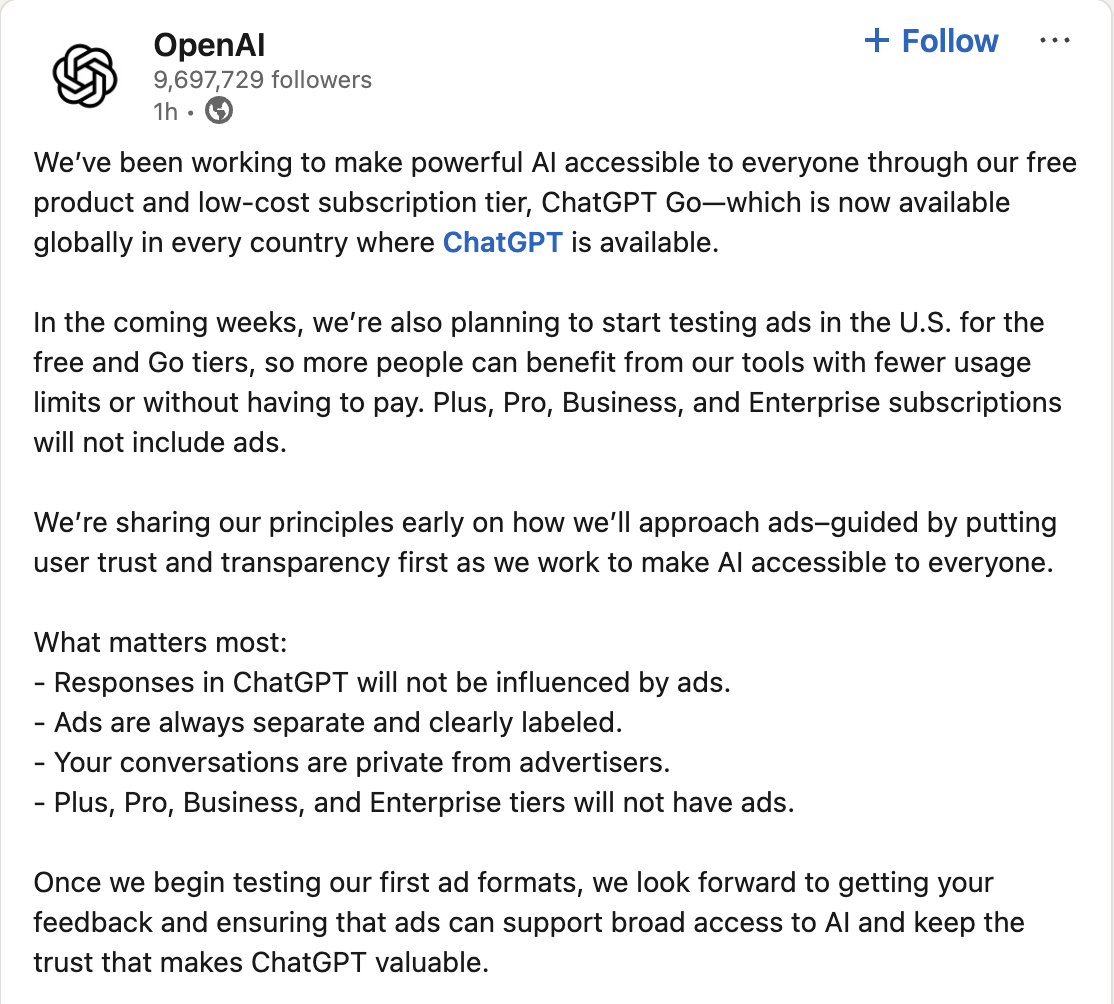
Big news today from the AI world. OpenAI announced what we all knew was coming from a company that has hundreds of millions of users and far too many on a free plan that costs real money to run: ads are coming to ChatGPT.
The announcement outlined their approach: testing ads in free and Go tiers starting in the coming weeks, while keeping Plus, Pro, Business, and Enterprise ad-free. They shared their ad principles upfront (answer independence, conversation privacy, user control, long-term value), which tells you they know this is going to be scrutinized heavily.
What does this mean for ecommerce brands? We’ll get right into it.
TL;DR:
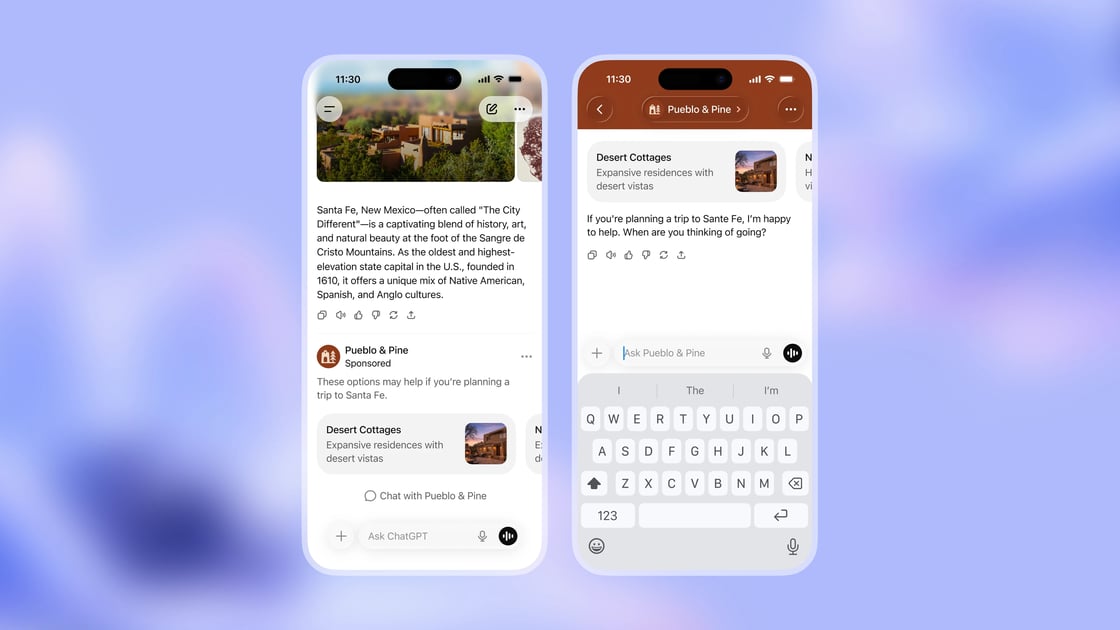
OpenAI shared mockups of how ads will appear in ChatGPT, and they’re more integrated than you might expect. The ads show up at the bottom of ChatGPT’s responses, clearly labeled as “Sponsored,” with relevant product or service recommendations based on your conversation.

|
 |
A few things to notice:
The ads are contextual. Ask about Santa Fe travel, get lodging recommendations. Ask about dinner recipes, get ingredient suggestions. They’re not random display ads, they’re recommendations that fit the conversation.
They’re labeled but integrated. There’s a “Sponsored” tag, but the format looks native to the ChatGPT interface. It’s not a banner you scroll past, it’s a suggestion that feels like part of the response.
They include product details. Price, availability, quick actions. This isn’t just awareness advertising, it’s conversion-focused from the start.
When Google Shopping transitioned from free product listings to paid, brands learned that organic signals (product feed quality, review volume, site authority) still mattered for paid campaign performance. The brands with strong organic foundations got better ad performance at lower costs.
ChatGPT will likely work similarly. Organic visibility in recommendations isn’t something that gets replaced by ads, it’s something that influences how effective your paid campaigns will be when you run them.
The brands ChatGPT already recommends organically will have advantages:
This is why treating ads as a replacement for organic visibility misses the point. They work together. Strong organic presence makes paid more efficient. Weak organic presence makes paid more expensive.
OpenAI spent the last year building shopping infrastructure: partnerships with Shopify and Etsy, the Agentic Commerce Protocol, training users to ask for product recommendations. They’ve demonstrated that conversational commerce works and people trust ChatGPT’s suggestions.
Now they’re introducing a way to monetize it. That’s a logical business progression for a company with OpenAI’s cost structure.
For brands, the timing creates an interesting dynamic. If you’re already visible in ChatGPT recommendations (scoring 90+ on visibility assessments), you’ve built organic authority before auction mechanics exist. When ads launch, you’ll have the data and signals that likely influence both organic rankings and paid campaign performance.
If you’re not visible yet, you’re entering a market where you’ll need to compete on two fronts: building organic presence while also potentially bidding for paid placement against brands that already have momentum.
There’s one critical difference between ChatGPT ads and Google ads that brands need to understand: context persistence.
On Google, each search is mostly independent. You search, you see ads, you click or don’t, you move on. ChatGPT is conversational. If you ask about standing desks, then follow up with questions about dimensions, warranty, assembly difficulty, the context carries through.
That changes how ads work. An ad impression in the first response of a shopping conversation could influence the entire subsequent thread, even if additional ads don’t appear. OpenAI’s “answer independence” principle will be tested here.
If I see a paid placement for Brand X early in the conversation, does that bias ChatGPT’s later responses when I ask follow-up questions?
They say no. We’ll see.
The bigger issue isn’t what OpenAI will charge for ad impressions. It’s what happens to organic reach once paid placements exist.
Look at Instagram. When they introduced ads, organic reach for business accounts plummeted. The algorithm didn’t explicitly penalize organic content, but paid content got prioritized, which meant organic content got less distribution. Then brands had to pay to reach their own followers.
ChatGPT could do the same thing. Not because they’re being malicious, but because the economics demand it. If they can monetize a query through an ad, why give that impression away for free?
For eCommerce brands, this means the ROI of AI visibility optimization you’re doing now (better product feeds, stronger review programs, off-site brand mentions) will decrease over time. Not to zero, but enough that you’ll eventually need paid to maintain your current position.
Here’s the thing most people are getting wrong: they think ads launching means organic doesn’t matter anymore. The opposite is true.
When ChatGPT becomes pay-to-play, the brands with strong organic fundamentals will win the auctions. Better engagement signals, higher conversion rates, lower cost per acquisition. The brands that show up organically are the ones that trained the AI to trust them. That authority doesn’t disappear when ads launch, it compounds.
The brands treating this as “organic OR paid” are missing the point. In a pay-to-play world, organic fundamentals matter more, not less. They’re what separate efficient paid acquisition from throwing money at a platform and hoping something sticks.
Track your visibility for free here: Commerce GPT Visibility Tool
OpenAI launching ads isn’t surprising. Most platforms with large free user bases eventually introduce advertising to balance costs and revenue. What matters for brands is being realistic about the dynamics that creates.
When paid placement exists alongside organic recommendations, brands need visibility in both. The brands that already show up organically are in a better position because they’ve built the signals (engagement data, relevance, trust) that likely influence both sides of the equation.
The brands that aren’t visible yet face a more expensive path because they’re building from zero while competing against brands with established presence.
The strategic question isn’t whether to focus on organic or paid. It’s whether your organic fundamentals (product feed, reviews, structured data, off-site presence) are strong enough that when you do run paid campaigns, you’re amplifying something that already works.
The brands that understand their current AI visibility have better information to plan for what comes next when ads go live in the coming weeks.
Tomer
P.S. If you’re wondering how this will actually play out, nobody knows yet. OpenAI is testing in the coming weeks, which means the format, placement, and mechanics will evolve based on what they learn. What brands can control is making sure they’re visible in organic recommendations now, so they have options when paid launches. The brands caught off guard will be the ones who didn’t realize they were invisible until it was expensive to fix.

“Yotpo is a fundamental part of our recommended tech stack.”
Laura Doonin, Commercial Director




 Join a free demo, personalized to fit your needs