


The ecommerce landscape in 2025 is defined by a relentless pursuit of speed, flexibility, and deeply personalized customer experiences.
Brands are no longer content with one-size-fits-all solutions. They demand the ability to craft unique digital storefronts, innovate rapidly, and connect with customers across an ever-expanding array of touchpoints.
In this demanding environment, a robust architectural approach has emerged as a key enabler for ambitious brands: headless commerce.
You’ve likely heard the term, often discussed in tandem with omnichannel strategies, API-first development, and a desire to break free from the constraints of traditional platforms. But “headless commerce” can sound like a complex, technical buzzword, leaving many merchants wondering what it truly means and if it’s the right path for their business.
This guide is here to demystify headless commerce. We’ll break down what it is, how it differs from traditional e-commerce setups, explore its significant benefits, identify who it’s best suited for, and, critically, discuss how to ensure your customer experience and retention strategies thrive in a decoupled world.
Understanding the Monolith: How Traditional Ecommerce Platforms Work
To grasp what headless commerce is, it first helps to understand what it isn’t. For many years, the dominant model for ecommerce platforms has been what developers often refer to as a “monolithic” or “coupled” architecture.
In a traditional, monolithic setup, the frontend (the “head” – what your customer sees and interacts with, like your website design, product pages, and checkout) and the backend (the “body” – the commerce engine that handles things like product information, inventory, orders, and payments) are tightly intertwined and managed as a single system.
Think of it like a traditional department store.
The building itself (the platform), the way products are displayed on shelves (the frontend design), the cash registers (the checkout), and the stockroom (the backend, which handles inventory and order management) are all part of one integrated, physical unit.
If you want to change the window displays, you’re working within the constraints of that existing building.
Limitations of Traditional Monolithic Architecture:
- Less Frontend Flexibility: Customizing the look and feel beyond what your theme allows often requires complex coding or can be severely restricted by the backend logic.
- Slower Updates to the Frontend: Making significant changes to the user experience can be slow and cumbersome, as frontend changes might inadvertently affect backend processes.
- Content Delivery Constraints: It can be challenging to deliver product information and content to new channels (such as mobile apps, IoT devices, or social commerce platforms) because the content is tightly coupled to the website’s frontend.
- “One-Size-Fits-All” Experience: Delivering truly unique experiences for different customer segments or different devices can be difficult when everything is managed through a single, rigid frontend.
While many successful businesses operate on traditional platforms (and they offer simplicity for many), brands that push the boundaries of customer experience and omnichannel reach often find these limitations restrictive.
Enter Headless Commerce: Decoupling for Flexibility
Headless commerce fundamentally changes this paradigm by decoupling the frontend presentation layer from the backend commerce engine.
The Core Concept: Separating the “Head” from the “Body”
In a headless architecture:
- The “head” refers to any frontend touchpoint where a customer interacts with your brand. This could be your main website, a mobile app, a Progressive Web App (PWA), a kiosk in a physical store, a smart mirror, a voice assistant, or even a social media shopping interface. You can have multiple “heads.”
- The “body” refers to your backend e-commerce platform. This is where all your core commerce logic resides: product information management (PIM), inventory, pricing, promotions, customer accounts, order processing, and payment integration.
The key is that these two layers operate independently.
The backend commerce platform doesn’t dictate what the frontend looks like or how it functions. Instead, it exposes all its data and functionality through APIs (Application Programming Interfaces).
Think back to our restaurant analogy:
- The backend is the kitchen – it has all the ingredients (product data), recipes (business logic), and chefs (commerce engine) to prepare any dish (process an order).
- The frontends are the various ways customers can get that food – the main dining room (your website), a takeaway counter (a mobile app), a delivery service partnership (a marketplace).
- The APIs are like the waiters and order tickets – they take requests from the different frontends, deliver them to the kitchen, and then bring the finished dishes (data and confirmations) back to the appropriate frontend.
The kitchen doesn’t care if it’s serving a customer in the fancy dining room or one ordering through an app; it just efficiently processes orders via the API.
This allows for immense flexibility in how and where you present your products and engage with customers.
Key Components of a Headless Architecture:
A typical headless setup involves several key pieces of technology working together:
- Backend Commerce Platform: This is the engine that powers the operation. Many established e-commerce platforms, such as Shopify Plus and BigCommerce, offer robust APIs that enable them to function as the backend for a headless setup.
There are also “headless-first” commerce platforms, such as Commercetools, designed from the ground up for API-driven commerce. These platforms manage core commerce functionalities, including product data, inventory, cart, checkout logic, and order management, and expose them via APIs. - Front-end Presentation Layer(s): This refers to what your customer sees and interacts with. It could be a custom-built website using modern JavaScript frameworks (such as React, Vue.js, or Angular), a native mobile app (for iOS or Android), a Progressive Web App (PWA) for app-like experiences in a browser, or any other digital touchpoint.
- Headless CMS (Content Management System) – Optional but Common: While your commerce platform manages product data, a headless CMS manages your marketing and informational content (blog posts, landing pages, banners, etc.). Systems like Contentful, Strapi, or Sanity allow you to create content once and deliver it via API to any frontend.
- APIs: These are the crucial messengers that enable backend systems (such as commerce platforms and CMS) to communicate with various frontend applications.
The “Why”: Key Benefits of Adopting Headless Commerce in 2025
Why are so many forward-thinking brands embracing the complexity of headless commerce?
The benefits are substantial, particularly for businesses that focus on delivering unique experiences and future-proofing their technology stack. The global headless commerce platform market is projected to reach $1.74 billion by 2025, indicating a rapid rate of adoption.
Unparalleled Frontend Flexibility & Customization
This is often the primary driver.
With headless, your frontend developers are free to build any user experience imaginable, using any technology they choose, without being constrained by the limitations of a traditional platform’s theme or backend logic. You can create truly unique, branded, and highly interactive experiences.
Faster Performance & Site Speed
Because the frontend is decoupled, it can be built using modern, lightweight frameworks optimized for speed and performance. This can lead to significantly faster page load times. This is critical because, as studies consistently show, a 1-second delay in mobile page load can impact mobile conversions by up to 20%. Faster sites lead to better user experience, lower bounce rates, and improved SEO.
Omnichannel Delivery at Scale
Headless architecture makes it far easier to deliver your products and content consistently across multiple channels.
Once your product data and content are managed in the backend and accessible via APIs, you can quickly develop new “heads” – such as a mobile app, an in-store kiosk, a voice commerce interface, or a social shop – without having to re-platform or duplicate content.
Omnichannel customers have a 30% higher lifetime value than those who shop on only one channel.
Improved Developer Agility & Faster Time-to-Market
Frontend and backend development teams can work independently and in parallel.
Frontend developers can iterate on the user experience without waiting for backend changes, and vice versa. This separation of concerns can significantly accelerate development cycles and enable you to introduce new features and experiences to the market much faster.
Enhanced Scalability & Security
Your backend commerce engine can be scaled independently of your frontend.
If you have a traffic surge on your website, you can scale your frontend infrastructure without necessarily needing to scale your entire backend. Similarly, security concerns can be managed more effectively at the backend API layer.
The “Who Is It For?”: Is Headless Right for Your Business?
While the benefits are compelling, headless commerce is not a one-size-fits-all solution. It represents a significant strategic, technical, and financial investment.
Prime Candidates for Headless:
- Enterprise-Level Businesses: Large companies with complex product catalogs, multiple brands, international operations, and the need for highly customized experiences often benefit most.
- Brands Prioritizing Unique, Content-Rich User Experiences: If your brand differentiation relies heavily on a unique digital experience, storytelling, and rich content interwoven with commerce, headless provides the freedom to build that.
- Businesses Needing True Omnichannel Reach: Companies that want to sell and engage across a wide array of existing and emerging digital touchpoints (websites, apps, IoT, AR/VR, etc.).
- Companies with Strong In-House Development Resources (or the Budget to Hire Them): Building and maintaining a custom headless frontend requires skilled developers.
When Headless Might Be Overkill:
- Startups and Small Businesses: For businesses with straightforward needs, limited product catalogs, and tight budgets, traditional SaaS platforms like Shopify (standard plans) or BigCommerce often provide more than enough functionality and a much faster, more affordable path to market.
- Brands Needing to Launch Very Quickly with Limited Technical Resources: The development time for a custom headless setup is significantly longer than configuring a theme on a traditional SaaS platform.
The Challenge: Managing Customer Experience in a Decoupled World
While headless architecture offers immense freedom for crafting unique frontend user interfaces, it also introduces a new layer of complexity when it comes to delivering consistent and engaging customer experiences related to trust, loyalty, and ongoing communication.
Your headless CMS manages your marketing content. Your backend commerce platform handles the transactions. But what systems are responsible for:
- Collecting and displaying authentic product reviews and visual user-generated content (UGC) across all your custom frontends?
- Managing a sophisticated, engaging loyalty and referral program that works seamlessly whether a customer is on your website, your mobile app, or another touchpoint?
If you’re not careful, you could end up needing to custom-build these critical retention-driving functionalities for each “head,” or trying to stitch together multiple disparate third-party tools via APIs, re-creating some of the very complexity headless aims to solve.
This is where the “frontend freedom” can become a “frontend management headache” if not approached strategically.
Yotpo: The API-first Solution for Reviews and Loyalty for Your Headless Architecture

Yotpo isn’t a headless commerce platform builder — it’s a leading API-first provider of product reviews and loyalty programs that work beautifully in a headless environment.
Our solutions are designed from the ground up to integrate into any custom frontend via powerful, well-documented APIs.
Why Yotpo Excels in a Headless Environment
Yotpo’s architecture and philosophy are perfectly aligned with the principles of headless commerce:
- API-first architecture — All core capabilities (collecting/displaying reviews, managing loyalty points and tiers) are accessible via APIs, so you can integrate them into any frontend.
- Customizable widgets & SDKs — Get up and running faster with prebuilt components you can fully style to match your brand, or go deeper with SDKs for complete control.
- Best-in-class specialization — In a headless stack, the best tool wins. Yotpo focuses on delivering market-leading engines for reviews and loyalty — nothing extra, nothing diluted.
Powering Key Customer Experiences on Your Headless Store with Yotpo
By integrating Yotpo into your headless setup, you can deliver rich, engaging, and trust-building experiences across all your customer touchpoints:
Dynamic Social Proof with Yotpo Reviews on Any Frontend
Your custom-built headless website, mobile app, or PWA can leverage Yotpo Reviews to:
- Fetch and display product reviews and star ratings via API, ensuring this critical social proof is presented beautifully within your unique design. This is vital, as integrating reviews can boost conversion rates by up to 270%.
- Showcase visual UGC like customer photos and videos, which can be pulled from Yotpo and displayed in custom galleries or on product pages. Visual UGC can increase conversion by as much as 80% in some cases.
- Use Yotpo’s AI-powered Smart Prompts during the review submission process (even if that form is custom-built on your headless site and interacts with Yotpo via API) to gather richer, more detailed feedback.
Engaging Headless Loyalty Experiences with Yotpo Loyalty
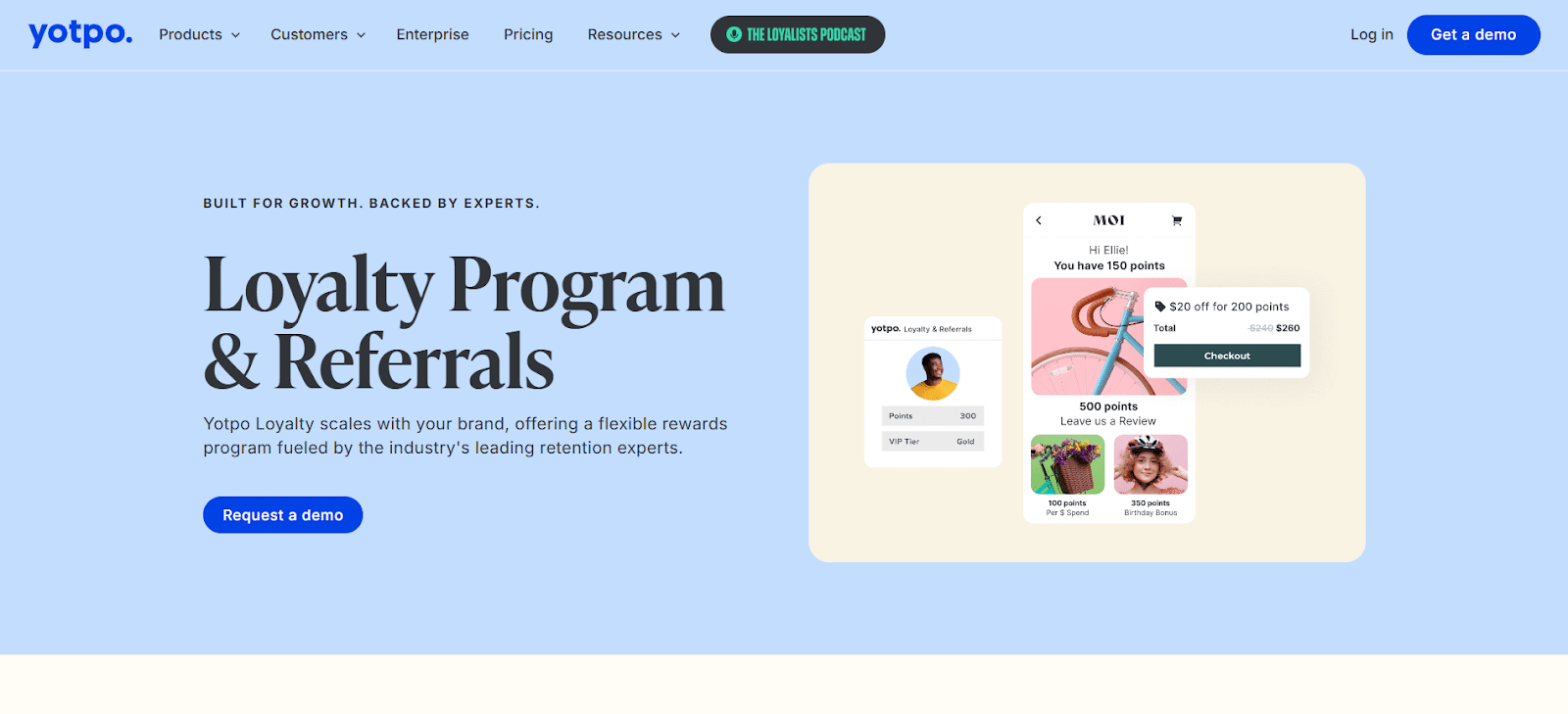
With Yotpo Loyalty, you can design loyalty programs that integrate seamlessly into your custom user account pages or mobile app interfaces:
- Display points balances, VIP tier status, and available rewards by fetching data via API.
- Allow customers to redeem points for rewards directly within your headless experience.
- Trigger loyalty actions and reward points for engagements that happen on any headless frontend (e.g., writing a review, referring a friend via your app). This is key because loyalty program members spend, on average, 12-18% more annually than non-members.
Key Considerations & Potential Challenges of Going Headless
While powerful, headless commerce isn’t without its hurdles.
- Higher Upfront Development Costs & Complexity: Building custom frontends and integrating multiple APIs requires significant initial investment in development time and expertise.
- Need for Skilled Developers & Ongoing Maintenance: You’ll need a team (in-house or agency) capable of building and maintaining modern frontend applications and managing API integrations.
- Managing Multiple Vendor Relationships: A typical headless stack comprises a backend commerce platform, a frontend framework or hosting, a content management system (CMS), and various API-driven services (such as Yotpo for customer retention). Managing these different pieces requires coordination.
- Longer Initial Time-to-Market: Launching your first headless frontend typically takes longer than setting up a store on a traditional SaaS platform with pre-built themes.
Conclusion: Headless Commerce – The Future of Flexible Ecommerce (When Done Right)
Headless commerce represents a significant architectural shift, offering e-commerce brands unprecedented freedom to craft unique, high-performance customer experiences across any imaginable channel.
For businesses aiming to truly differentiate themselves, deliver content-rich commerce, and future-proof their technology stack, 2025 presents an increasingly compelling path forward.
However, this flexibility comes with increased complexity and requires a strategic approach, particularly when it comes to managing the customer-facing elements that build trust and drive retention.
The beauty of your custom frontend is truly realized only when it’s populated with compelling social proof, engaging loyalty mechanics, and personalized communications.
For brands embracing the power and flexibility of headless commerce, ensuring a rich, engaging, and trust-building customer experience on those custom frontends is paramount. Integrating API-first solutions, such as Yotpo, is no longer just an option; it’s a strategic imperative.
Yotpo provides the specialized engines for reviews and loyalty — delivered via APIs to any “head” you build. This lets you pair your custom frontend vision with proven, high-impact customer engagement tools, turning your headless setup into a powerful driver of trust, conversion, and long-term brand loyalty.











 Join a free demo, personalized to fit your needs