


For many e-commerce brands, the quest for more customer reviews often boils down to a simple equation: offer an incentive, get a review. While discounts, loyalty points, or contest entries can certainly boost submission rates, our latest research reveals a more profound truth: the genuine motivations behind customer feedback go far deeper than mere transactional benefits. The act of leaving a review is frequently a personal, emotional, and intrinsically purposeful endeavor.
Understanding what truly motivates your customers to leave reviews is not just an academic exercise; it’s absolutely essential for any e-commerce brand striving to optimize its review collection strategy. By delving into the “why” behind review behavior, brands can construct smarter, more effective strategies that not only drive higher review volumes but also cultivate deeper trust, enhance content quality, and ultimately, maximize the value extracted from every single customer voice.
This deep dive into the fascinating psychology of customer feedback is a core finding from Yotpo’s comprehensive 2025 AI Shopper Behavior Report, “To Buy or Not to Buy.” This pivotal report uncovers how modern shoppers are making confident purchasing decisions and highlights the pivotal role of feedback in reducing uncertainty. You can explore the full data-driven insights here: Yotpo 2025 AI Shopper Behavior Report
The Untapped Potential: A Willingness to Speak Up
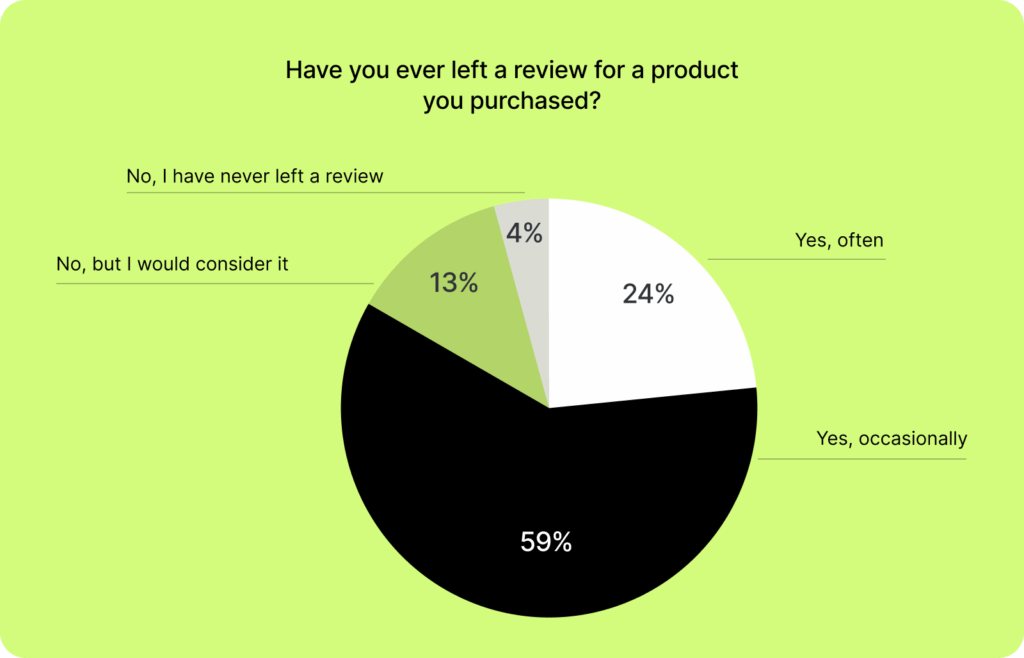
Before diving into motivations, it’s crucial to acknowledge the sheer potential for review collection. Our report clearly indicates a widespread willingness among consumers to provide feedback: 83% of shoppers have left a review at least once. This statistic is a powerful affirmation that the vast majority of your customer base is predisposed to share their experiences. The challenge, therefore, is not convincing them to want to leave a review, but rather understanding what triggers them to do so and then making the process effortless.
What Really Sparks Post-Purchase Feedback? Beyond the Incentives
The impulse to write a review often originates from a strong emotional response. Whether it is the sheer delight of a product exceeding expectations, the frustration of a purchase falling short, or the simple satisfaction of receiving precisely what was promised, emotions run high post-delivery. But what transforms that feeling into concrete action – the decision to sit down and write a review?
For a significant portion of shoppers, leaving a review is fundamentally an act of contribution. It is about more than just their personal experience; it’s about paying it forward. It is about:
- Helping Others Make Smarter Decisions: Many feel a sense of civic duty within the online shopping community. They want to prevent others from making a mistake or guide them towards a truly beneficial product. They have relied on reviews themselves, and now they want to reciprocate.
- Sharing Firsthand Insights: They possess unique, real-world knowledge about the product that a brand’s official description simply cannot convey. This might be about sizing nuances, the true feel of a material, or specific use-case scenarios.
- Giving Credit Where It’s Due: When a product genuinely impresses, customers often feel a sincere desire to publicly commend the brand and the product. They want to recognize excellence.
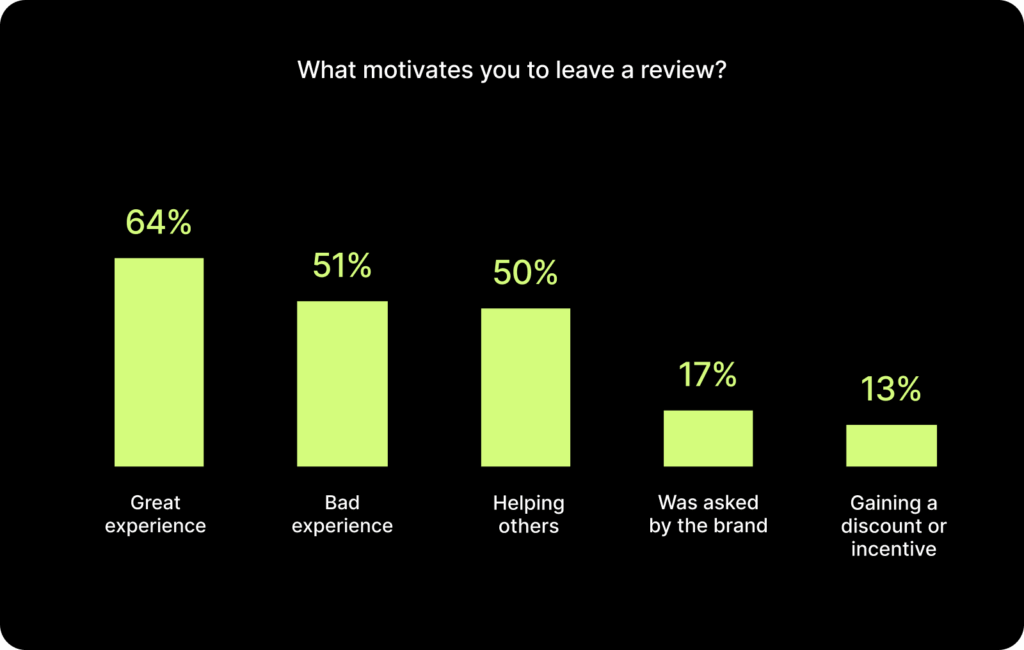
In fact, a positive experience frequently outweighs any tangible desire for incentives when it comes to review submission. The report highlights this powerfully: 64% of shoppers state that a positive experience is their primary motivation for leaving a review. This underscores that a product that truly exceeded expectations, arrived unexpectedly early, or successfully solved a genuine problem for the customer, is often a sufficient catalyst on its own.
Digging deeper into the “helping others” motivation: 50% of shoppers explicitly state they leave reviews specifically to help others. This altruistic impulse is a goldmine for brands. It means that framing your review requests as an opportunity for customers to contribute to a helpful community can be far more effective than a mere transactional appeal.
The Double-Edged Sword: When Negative Experiences Drive Reviews
While positive emotions are a powerful driver, it is equally important to acknowledge that negative experiences are also a potent trigger for review submission. When something goes wrong—a late delivery, a product that fails to live up to its hype, or a significant customer service mishap—reviews often become a public record of disappointment. Shoppers turn to reviews as a means to voice their grievances, express frustration, and hold the brand accountable.
The data confirms this: 51% of shoppers report that a bad or negative experience directly led them to leave a review.
However, here’s the most surprising and crucial insight: the negative review is not always the final word. A remarkable 90% of shoppers who were motivated to leave a review due to a bad experience state they might reconsider or even change their review depending on how the brand responds.
- Beth, 45, from Los Angeles, US, expressed this opportunity: “It would be really impactful if they were to reach out and ask why I gave that review of the product, and if there was anything they could do to change my mind.”
- Alexander, 29, from Sydney, Australia, echoed a sentiment of forgiveness: “I don’t judge a brand by the mistakes, but by what they do to make it right by the customer.”
This represents a massive window of opportunity for brands. A thoughtful, human, and empathetic response that acknowledges the issue and offers a meaningful resolution can not only repair a damaged customer relationship but also fundamentally reshape how that shopper perceives your brand. A negative experience, when handled expertly, can be transformed into a moment of brand triumph, fostering deeper loyalty than might have existed without the initial misstep. As Louise, 39, from New York, US, advised, “Just be honest, if you get a negative review don’t just use the standard, ‘We are sorry,’ but actually respond.”
This means a well-executed service recovery can lead to the removal or amendment of a negative review, or even a future positive one, turning a potential detractor into an unexpected advocate.
The Art and Science of the Ask: How and When to Solicit Reviews Effectively
Understanding why people leave reviews is the crucial first step. The next is mastering the when and how to ask for them. Timing and the framing of your request can make all the difference between a glowing five-star submission and complete silence.
Timing Is Everything: Seizing the Emotional Moment
Few things bring as much immediate satisfaction as a newly arrived package, especially if it arrives ahead of schedule or perfectly solves a problem. This initial “review-worthy glow” is potent, but it fades quickly if not captured in the moment. Similarly, if the product sparks disappointment rather than delight, post-delivery emotions run high—and that’s precisely when you want to solicit feedback.
While the exact optimal timing can vary by industry and product type, the sweet spot for sending review requests is typically within 2 weeks of delivery. At this point:
- The product is still fresh in the customer’s mind.
- Their opinion is fully formed based on initial use.
- The feelings (whether positive or negative) are still vivid and immediate.
Waiting too long allows that crucial emotional window to close, significantly diminishing your chance of collecting a review that is either brimming with praise or ripe with actionable feedback.
Strategic Follow-Ups for Long-Term Insights
It’s important to note that not all value or insights come from the first impression. For products where longevity, durability, or extended performance are key considerations (e.g., electronics, furniture, appliances, or long-term consumables), a single, immediate review request might not capture the full picture.
In these cases, consider a second check-in weeks or even months later. These follow-up requests are invaluable for capturing the “how’s it holding up?” insights that other shoppers crave when assessing if a product is truly a worthwhile long-term investment.
- Early reviews often speak to initial excitement, unboxing experience, or first impressions.
- Later reviews speak to durability, reliability, long-term results, and sustained satisfaction (or lack thereof).
Brands need both perspectives to build a truly comprehensive and helpful review ecosystem that drives conversions for a wide array of products.
Addressing Negative Experiences Strategically
If a customer’s initial experience did not go perfectly, the opportunity for a positive review is not necessarily lost. In fact, swiftly and thoughtfully resolving an issue can trigger even stronger loyalty and a willingness to provide positive feedback about the service recovery.
- Prioritize Resolution First: If you identify an unhappy customer (e.g., through a post-purchase survey, direct complaint, or customer service interaction), the first step is not a review request. It is dedicated problem resolution.
- Time the Ask Post-Resolution: Once an issue has been resolved—a refund issued, a replacement sent, or a service problem definitively addressed—then is the opportune moment to seek feedback. Do not rush the ask; allow the positive resolution to fully resonate with the customer.
- Frame the Ask Around the Recovery: Invite the customer to “share their story,” specifically highlighting how the brand went above and beyond to make things right. This shifts the focus from the initial negative event to the positive resolution, encouraging a review that reflects the full customer journey.
The Key to Perfect Framing: Inspire Contribution, Not Obligation
It is not just when you ask for a review; it is critically how you ask. The way you frame your review request can be the difference between resounding silence and a thoughtful, detailed response. Shoppers, as our report highlights, are not leaving reviews as a favor to your brand. They are doing it to help others, to share an experience, or to call out where a brand may have fallen short.
This understanding should fundamentally shape your messaging:
- Position as an Opportunity to Contribute – Your request should feel less like you are asking for praise and more like an invitation for them to contribute valuable insights to a community. Frame it as an opportunity to “pay it forward.”
- Craft Compelling CTAs – Instead of generic “Leave a Review,” use calls to action like:
- “Share your experience to help other shoppers find their perfect match!”
- “Help others make informed decisions – tell us about your purchase!”
- “Your feedback guides future shoppers: What did you think?” When you position review writing as an act of guidance, connection, and community building, you tap into shoppers’ intrinsic motivations to help, inform, and engage.
The Role of Incentives (Used Strategically)
While intrinsic motivations are powerful, a well-placed incentive can be the gentle nudge that converts willingness into action. Most customers are willing to leave a review, but “willingness” does not always translate to “action.” That’s where incentives come in.
- Strategic, Not Transactional – Used strategically—and not transactionally—incentives can significantly boost review volume and encourage follow-through. The goal is not to buy praise, but to encourage richer, more thoughtful, and more complete feedback.
- Position as a “Thank You” – Crucially, position incentives as a genuine “thank you for contributing valuable insights,” rather than a bribe for a positive review. Be explicit that the incentive is for the act of providing feedback, regardless of the star rating. This maintains the authenticity and credibility of the review.
Reducing Friction: Making Review Submission Effortless
Even the most highly motivated customer will abandon a review if the process is cumbersome or clunky. To maximize completion rates and ensure you receive thoughtful, comprehensive reviews, you must relentlessly reduce friction wherever possible.
- Mobile-First Design – A vast majority of online Browse and interacting happens on mobile devices. Ensure your review submission forms are perfectly optimized for mobile, with large, easy-to-tap buttons and intuitive navigation.
- In-Email Forms – Allow customers to submit star ratings and even short text reviews directly from within their email inbox. This removes the need to click through to a separate landing page, eliminating a significant point of friction.
- One-Click Star Ratings – Make the initial star rating process as simple as a single click within the email. This captures at least some feedback, even if the customer does not complete a full written review.
- Pre-filled Product Details – Automatically pre-fill the review form with details about the product the customer purchased. This saves them time and ensures the review is correctly attributed.
- Personalization – Make the process feel personal. Include the customer’s name, reference the specific product they bought, and consider a prompt relevant to that item (e.g., “How did the sizing work out for you?”, “Was it easy to assemble?”). This makes the request feel less generic and more relevant.
Proactive Customer Service to Catch Negative Sentiment
It is crucial to identify and address unhappy customers quickly, before their dissatisfaction escalates into a public negative review. Not every customer is ready to leave a public review, and that is perfectly okay, especially if their experience was poor.
- Post-Purchase Surveys/Satisfaction Check-ins – Implement simple, short surveys or satisfaction check-ins immediately after delivery. A simple question like “Did everything meet your expectations?” with two clear buttons – “Yes” (which triggers a review request) and “No” (which routes them directly to customer support) – can be incredibly effective.
- Route to Support, Not Review – This system allows you to intercept negative sentiment early, guide unhappy customers to a resolution pathway, and prevent a public negative review. It demonstrates that you care about their experience and are proactive in solving problems.
By meticulously aligning your review request strategy with the genuine emotions and motivations that drive customers to leave feedback, you will collect not just a higher volume of reviews, but reviews that are richer, more believable, and significantly more influential. When the ask feels timely, authentic, and effortless, shoppers are far more likely to answer the call, transforming their experiences into invaluable social proof for your brand.
Conclusion: Reviews as the Voice of the Modern Shopper
Reviews are far more than mere feedback; they are the contemporary embodiment of a timeless human instinct: the need to consult others before making a significant decision. Whether it was knocking on a neighbor’s door in the 1950s, calling a friend in the ’70s, or posting in an online forum in the ’90s, the fundamental question has always been, “Should I buy this?” While the tools and channels evolve, the underlying human behavior remains constant.
In 2025, reviews are the trusted voices that resonate deeply with shoppers. They are the essential signals that AI amplifies to provide personalized recommendations. And, crucially, they are the authentic content that transforms a tentative “maybe” into a confident “add to cart.” As shopper expectations and behaviors continue to evolve at a rapid pace, so too must the way brands collect, display, and, most importantly, learn from their reviews. The opportunity is clear and immense: truly understand what today’s consumers trust, meet them precisely with the authentic content they are actively searching for, and leverage reviews not just as social proof, but as a dynamic, strategic advantage that drives both sales and lasting customer loyalty.
What insights will you leverage from customer motivations to refine your review collection strategy?











 Join a free demo, personalized to fit your needs