


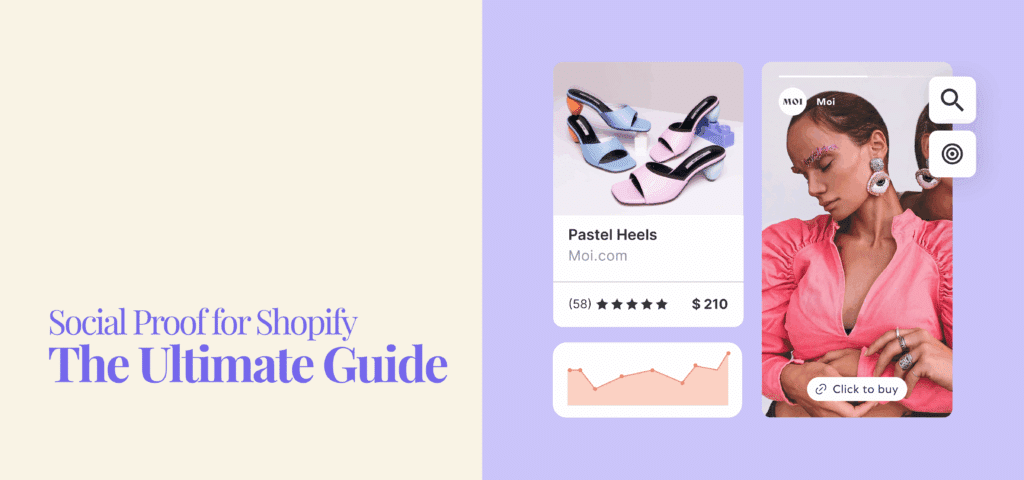

Social proof is a simple but powerful concept. It describes the psychological phenomenon where people look at what others are doing, buying, and saying before they make their own choices. For a Shopify store, this means asking a customer to trust you with their money. Effective social proof can be the difference between a visitor who clicks “back” and one who clicks “buy now.”
This guide explores each type of social proof, covering implementation on your Shopify store, the underlying principles, and how to build a strategy that turns visitors into loyal customers.
Key Takeaways: Social Proof for Shopify
- Reviews Are Your Foundation: The most important social proof is authentic customer reviews. Shoppers trust other shoppers. We will cover how to collect and display reviews that drive sales, focusing on best-in-class tools.
- Loyalty Builds Community: Social proof is not just for new customers. A loyalty program shows that you have a community of happy, repeat buyers. This creates a powerful sense of belonging.
- “Crowd” Tactics Create Urgency: Showing “best-sellers” or low stock levels taps into a shopper’s fear of missing out (FOMO). This encourages them to act now instead of later.
- Authority Builds Instant Trust: “As Seen In” logos, expert quotes, and security badges show that you are a legitimate and safe business.
- Strategy is Everything: Adding one review widget is not a strategy. You need to layer different types of social proof across your entire store. This guide will show you how.
Part 1: The Core of Social Proof: Customer Reviews & UGC
Customer reviews are the bedrock of eCommerce social proof. Few shoppers will purchase a product that has no reviews.
Recent data shows just how critical this is. Shoppers are doing their research. Data from 2024 shows that 72% of shoppers rely heavily or moderately on reviews to confirm fit, quality, and style. Reviews function as a 24/7 sales team, answering questions and handling objections before a customer even thinks of them.
What Makes a “Good” Review?
Not all reviews are equal. A review that simply says “it’s great” has limited impact. But a review that says, “I’m 5’10” and the size Large fits perfectly, with plenty of room in the shoulders,” is the kind of detail that drives a conversion.
You need reviews that have:
- Detail: Specific comments about the product.
- Photos (UGC): Customers showing the product in their real lives. This is User-Generated Content (UGC), which is incredibly valuable.
- Videos (UGC): Video reviews are even more powerful. They show the product in action.
- Q&A: Shoppers asking questions and getting answers from you or other customers.
How to Implement Reviews on Shopify
You have several options for adding reviews to your Shopify store.
Shopify’s Native App
Shopify offers a free app called “Product Reviews.” It is a functional starting point. It lets you add a simple review form and display star ratings on your product and collection pages.
However, its functionality is basic. Merchants often find they soon require more powerful features, such as automatic review requests, photo collection, and more advanced display options.
Using a Best-in-Class Solution: Yotpo Reviews

When you are ready to strategically leverage reviews, you need a specialized tool. Yotpo Reviews helps brands turn customer feedback into conversion-driving assets. It’s built to collect high-quality reviews and display them in ways that build trust and drive sales.
Yotpo provides key capabilities that basic applications lack.
- Collect Reviews That Convert
Getting the review is the first step. Yotpo helps you collect high-impact reviews full of detail.
- Smart Prompts: Rather than the generic “How was it?”, Yotpo uses AI-powered prompts. It might ask a customer reviewing a shirt, “How was the fit?” or “What was the fabric quality like?” This guides the customer to leave a more detailed, helpful review.
- Photo & Video Collection: The request forms streamline the process for customers to add photos and videos from their phones.
- Automatic Requests: Yotpo automatically sends review requests after a purchase. You can time these perfectly. For example, you can wait three weeks for a skincare product to give the customer time to see results.
- Display Reviews to Boost Sales
Once you have the reviews, Yotpo gives you powerful ways to show them.
- Customizable Widgets: You can add beautiful, on-brand review widgets to your product pages. This includes carousels, Q&A sections, and photo galleries.
- AI Reviews Summary: This is a particularly powerful feature. Yotpo uses AI to read all the reviews for a product and write a quick summary. It might say, “85% of shoppers loved the ‘easy setup’ and ‘long battery life’ of this product.” This gives new customers an instant overview.
- Smart Filters: Shoppers can filter reviews. For example, they can filter fashion reviews by “height” and “body type” to see reviews from people just like them.
- Gain Insights to Improve Your Business
Yotpo Reviews also helps you learn from your customers.
- Reviews Atlas: This tool gives you a “health score” for your reviews. It shows you how you stack up against competitors and gives you actionable tips.
- Insights Dashboard: You can see what topics customers are talking about. Are they all mentioning “fast shipping”? Great! Are many mentioning “confusing instructions”? That’s a problem you can now fix.
- Get Discovered Everywhere
Yotpo has strategic partnerships with major platforms like Google. This means your star ratings can show up directly in Google search results and on Google Shopping ads. This builds trust before someone even clicks on your site.
Other Review Solutions for Shopify
Yotpo is a best-in-class solution, but there are other tools in the Shopify ecosystem.
- Okendo: Okendo is a customer marketing platform. It offers tools for collecting reviews, user-generated content, and customer Q&A.
- Bazaarvoice: Bazaarvoice is a large, enterprise-level solution. It’s often used by major, global retailers and provides a wide network for review syndication.
- Klaviyo Reviews: For stores already using Klaviyo for email, the platform has a reviews feature. It allows you to collect and display reviews as part of its broader marketing suite.
- Reviews.io: This platform collects and displays reviews, with a strong focus on video reviews and integrations with many social platforms.
- Stamped.io: Stamped is a platform that offers several tools, including product reviews and loyalty programs, in one suite.
In summary, for reviews, your goal is to collect authentic, detailed feedback and display it effectively. A basic app can start this, but a specialized tool like Yotpo Reviews gives you the power to make reviews a central part of your sales strategy.
Part 2: Building Long-Term Proof: Loyalty & Referrals
Social proof is not just for attracting new customers. It is also for customer retention. A thriving loyalty program is a powerful form of social proof. It sends a message: “So many people love this brand, they are part of an exclusive club.”
VIP tiers, point systems, and exclusive rewards create a community. When a shopper sees “VIP Gold Member,” it shows that person has a long-term, trusted relationship with your brand. Data from 2024 supports this. For many shoppers, loyalty programs, points, and early-access perks influence their purchase decisions.
Referral programs are an even more direct form of social proof. They are the digital version of “word-of-mouth.” There is no stronger signal of trust than one friend telling another, “You have to try this.”
How to Implement Loyalty on Shopify
Like reviews, you can start small, but a dedicated tool is necessary to build a strategic program.
Using a Best-in-Class Solution: Yotpo Loyalty

Yotpo Loyalty is a powerful solution designed to foster repeat purchases and customer engagement. It’s about more than just giving discounts. Yotpo helps you build a structure for engagement that encourages repeat purchases and builds a true brand community.
What makes a tool like Yotpo Loyalty stand out is its strategy and flexibility.
- Strategy and Support
This is a key differentiator. Yotpo Loyalty provides more than just software. It comes with a team of eCommerce loyalty experts. They have launched thousands of programs and can guide you. They help you build a program that matches your business model, whether you want to reward high-value purchases or frequent, small ones.
- Flexibility and Customization
A loyalty program should integrate seamlessly with your brand’s identity. Yotpo Loyalty is highly flexible.
- Build Your Program: You can create a simple points-for-purchase program. Or you can build a complex VIP program with multiple tiers (e.g., Bronze, Silver, Gold).
- Reward Many Actions: You can give points for more than just purchases. Reward customers for leaving reviews, following you on social media, or on their birthday.
- Customization: You can easily create on-site loyalty pages and widgets that match your brand’s unique style.
- Segmentation and Reporting
Effective loyalty programs are not one-size-fits-all. Yotpo lets you segment your customers. You can create special offers just for your “VIP Gold” tier. Or you can run a “win-back” campaign for members who have not shopped in a while.
The reporting dashboards provide clear insights into your program’s performance. You can see how many customers are joining, redeeming rewards, and how much more your loyalty members spend than regular shoppers.
The Synergy: Connecting Reviews and Loyalty
This is one area where you can see the value of using integrated, best-in-class tools. While Yotpo Reviews and Yotpo Loyalty are powerful separate products, they can be used to create a great customer experience.
For example, you can use Yotpo Loyalty to automatically give loyalty points to a customer who leaves feedback through Yotpo Reviews. This is a perfect win-win scenario. The customer feels rewarded, and you get the high-quality review you need to power your social proof.
Other Loyalty Solutions for Shopify
The Shopify app store has several other options for building loyalty.
- Loyalty Lion: This is a platform focused on building loyalty programs. It offers points, rewards, analytics, and tools for engaging customers.
- Smile: Smile (or Smile.io) is another popular loyalty provider. It helps brands create points, referral, and VIP programs.
- Okendo: As mentioned in the reviews section, Okendo also offers loyalty features as part of its customer marketing suite.
- Stamped: Stamped also includes loyalty and rewards features alongside its review collection tools.
- Rivo: Rivo (formerly BOLD Loyalty) is a tool that allows merchants to set up points and rewards programs on their Shopify store.
Part 3: “Wisdom of the Crowd” Tactics
This type of social proof leverages the natural human instinct to follow the crowd. The assumption is that if a product is popular, it must be good. You can add these elements all over your Shopify store to create urgency and highlight popular items.
1. “Best-Seller” Tags and Collections
This is one of the most straightforward and effective tactics. When new shoppers land on a site, they often do not know what to buy. A “Best-Sellers” collection guides them to your most popular, trusted products.
How to Implement on Shopify:
- Go to your Shopify Admin and click on Products > Collections.
- Click Create collection.
- Title it “Best-Sellers” or “Most Popular.”
- Under Collection type, select Automated.
- Under Conditions, select Sort order and choose Best selling.
- Add a menu link to this collection in your main navigation.
You can also add “Best-Seller” badges to product images on your collection pages. Some Shopify themes have this feature built-in, or you can use a product badge app.
2. “X People Are Viewing This” Notifications
These are small pop-ups that appear on product pages. They show real-time activity, like “5 people are viewing this product right now” or “Someone in New York just bought this.”
This tactic is very effective because it creates two powerful feelings:
- Popularity: It signals that others are interested.
- Urgency: It implies the product might sell out, encouraging an immediate purchase.
How to Implement on Shopify:
You will need an app from the Shopify App Store for this. Search for “social proof” or “sales pop” to find apps that provide this feature.
A word of caution: Honesty is critical. Shoppers can tell when these numbers are fake. If your store is new and you only get 20 visitors a day, a pop-up saying “30 people are viewing this” will break trust, not build it. Use apps that show real data.
3. Low-Stock Indicators
This is another classic urgency-builder. Showing “Only 3 left in stock!” taps directly into a shopper’s fear of missing out (FOMO).
How to Implement on Shopify:
- Make sure you are tracking inventory in your Shopify admin for each product.
- Many modern Shopify themes (including Shopify’s free “Dawn” theme) will automatically show a “Low stock” message when inventory drops below a certain level (e.g., 10 units).
- You can customize this message in your theme’s code or settings. Go to Online Store > Themes > Customize and check your Product page settings.
4. “Recently Viewed” Sections
This tactic is a bit different. It’s a form of “personal” social proof. It reminds a shopper what they were interested in. When they see a “Recently Viewed” bar at the bottom of the screen, it reinforces their own interest and makes it easy to return to a product.
How to Implement on Shopify:
Many themes have this built in. If yours does not, you can find “recently viewed” apps on the App Store.
Part 4: Expert & Authority Proof
This type of social proof works by “borrowing” trust from a source that is already respected. If an expert or a major media outlet says your product is good, people will believe it.
This is especially useful for new stores that do not have many customer reviews yet.
1. “As Seen In” Media Logos
If a blog reviewed your product, or you were featured in a local news story or a small magazine, get their logos and put them on your homepage.
Create a simple banner that says “As Seen In” followed by the logos of Vogue, TechCrunch, Goop, or other media features. This immediately tells visitors that you are a legitimate and noteworthy brand.
2. Expert Endorsements
An expert endorsement is more powerful than a media logo. If you sell skincare, a quote from a dermatologist is extremely valuable. If you sell hiking gear, a quote from a famous mountaineer is highly effective.
You can even leverage industry experts who are not famous.
“Trust is the most valuable currency a Shopify store has. Social proof isn’t just a ‘nice-to-have’ widget; it’s the core engine for building and scaling that trust. You’re showing new customers that they’re making a safe, popular choice.”
— Ben Salomon, eCommerce Expert
A quote like this, placed on your homepage or “About Us” page, builds your credibility as a business.
3. Trust Badges
Trust badges are small icons that show your site is secure. They are a simple but crucial form of authority proof.
- Payment Logos: Add the logos for Visa, Mastercard, PayPal, and any other payment methods you accept. This shows you use standard, secure payment systems.
- Shopify Secure Badge: Many themes include this. It shows you are powered by Shopify’s secure platform.
- SSL Certificate: This is the little “lock” icon in the browser bar. Shopify includes this on all stores, but it’s good to know that this is a key part of your authority.
Place these badges in your site’s footer and on your checkout page. It reassures customers right at the moment they are about to enter their credit card information.
Part 5: Influencer & Social Media Proof
This is the modern evolution of “celebrity endorsement.” It works by showing that cool, interesting, or influential people are using your products.
1. Influencer Marketing
Hiring a mega-celebrity is not always necessary. In fact, “micro-influencers” (accounts with 5,000 to 20,000 followers) often have a more engaged and trusting audience.
Find influencers in your niche who match your brand’s values. A partnership where they post about your product is powerful social proof. You can then re-post their content on your own social media and website (with their permission).
2. Social Media Feeds on Your Store
You can connect your brand’s social proof directly to your Shopify store. Use a Shopify app to embed your Instagram or TikTok feed on your homepage.
This does two things:
- It shows off your products in real-world settings.
- It shows that you have an active, engaged community on social media. A shopper can see your 10,000 followers and think, “This is a popular, active brand.”
Part 6: Your Shopify Social Proof Blueprint
A successful strategy layers social proof across the entire customer journey.
On Your Homepage
- “As Seen In” Banner: Near the top to build instant trust.
- Best-Sellers Collection: Feature 4-6 of your most popular products.
- Review Carousel: Show off your best 5-star reviews (a Yotpo Reviews widget is perfect for this).
- Instagram Feed: Show your products in the wild.
- Loyalty Program Link: A “Join the Club” or “Get Rewards” link.
On Your Collection Pages
- Star Ratings: Show the average star rating under each product.
- “Best-Seller” Badge: Make your most popular items stand out.
On Your Product Pages (The Most Important Page)
This is a critical page for conversion.
- Above the Fold (Top of Page):
- Clear product photos.
- The average star rating and number of reviews right under the product title.
- Middle of Page:
- Low-stock indicator (“Only 5 left!”) if applicable.
- Sales pop-up (“Someone just bought this”) if you use one.
- Trust badges near the “Add to Cart” button.
- Bottom of Page:
- The full review widget (like Yotpo Reviews). This must include:
- The AI Reviews Summary.
- Photo and video galleries.
- The Q&A section.
- Searchable, filterable reviews.
- The full review widget (like Yotpo Reviews). This must include:
- Floating on the Page:
- Your loyalty program widget (like Yotpo Loyalty). “Earn 50 points for this purchase!” This encourages both the purchase and a future sign-up.
Conclusion
Social proof is not a gimmick. It is a fundamental part of how humans make decisions. By building a smart strategy, you are not creating a gimmick. You are simply making it easier for shoppers to see that your brand is trustworthy, your products are high-quality, and your other customers are happy.
Start with the foundation: a best-in-class reviews solution like Yotpo Reviews. This will give you the content you need to power all your other efforts. Then, build your community with a tool like Yotpo Loyalty.
By layering these elements, you will create a Shopify store that does not just sell products. You will build a store that inspires confidence, creates community, and earns trust.
Frequently Asked Questions: Social Proof for Shopify
1. What is social proof in eCommerce?
Social proof is a psychological idea where people assume the actions of others are the correct behavior. In eCommerce, this means using reviews, ratings, testimonials, and popularity signals to show new visitors that your store and products are trusted, popular, and safe to buy from.
2. Why are product reviews so important for my Shopify store?
Reviews are direct social proof from other shoppers. They build trust, answer specific product questions, and show your product in real-world use (with photos/videos). Data shows a huge number of shoppers rely on reviews before buying. They are one of the biggest drivers of conversion rates.
3. How can I get more reviews for my products?
The most effective way is to ask. Use a tool like Yotpo Reviews to automatically send an email or SMS request after a customer makes a purchase. You can also offer an incentive, like loyalty points (using Yotpo Loyalty), for leaving a review.
4. What’s the difference between Yotpo Reviews and Shopify’s free “Product Reviews” app?
Shopify’s app is a good starting point, but it’s very basic. A best-in-class tool like Yotpo Reviews provides far more powerful tools. This includes AI-guided prompts to get better reviews, AI summaries, advanced widgets, photo/video collection, and official partnerships with platforms like Google to get your stars in search results.
5. What is UGC?
UGC stands for User-Generated Content. This is any content (photos, videos, text) created by your customers instead of your brand. A photo a customer posts in a review is UGC. It’s extremely powerful because it’s authentic and more trustworthy than professional brand photos.
6. Do loyalty programs really count as social proof?
Yes! A visible loyalty program with VIP tiers shows that you have a dedicated community of repeat customers. It’s a strong signal to new shoppers that your brand is worth sticking with for the long term.
7. How does a loyalty program like Yotpo Loyalty work?
Yotpo Loyalty helps you reward customers for actions that grow your business. You can give customers points for making a purchase, leaving a review, or following you on social media. Customers can then redeem those points for discounts or free products. It also lets you create VIP tiers to give your best customers exclusive perks.
8. What are “trust badges” and where should I put them?
Trust badges are small icons that show your site is secure and legitimate. This includes payment logos (Visa, PayPal), security logos (like “Shopify Secure”), or industry certifications. You should place them in your website’s footer and clearly on your checkout page.
9. How can I use social proof if I’m a brand new store with no sales?
This is a common challenge. You cannot show reviews you do not have. Instead, focus on authority proof. Get an expert in your niche to give you a quote. Get featured on a small blog and use their logo in an “As Seen In” banner. Add all your payment and security trust badges. Then, from your very first sale, implement a consistent process for (politely) requesting a review.
10. What is the single best first step to take?
Install a best-in-class review collection tool, like Yotpo Reviews, today. Even if you have no reviews, you need the system in place to capture them from your very first order. Your first 5-10 reviews can significantly impact your business, so be ready to get them.











 Join a free demo, personalized to fit your needs