



Let’s say you’ve done everything possible to improve customer retention. But somehow, your retention rate just isn’t improving. Or maybe a recent bout of recalled items or bad publicity put you at risk for losing hordes of customers.
What are you supposed to do when you’re running out of hope?
Here are the emergency customer retention strategies to keep your hard-won customers.
1) Go old school to find out what’s driving them away
Sometimes emails just aren’t enough. Despite your best attempts at personalization, they can still seem generic and impersonal.
When you really need to understand why customers are leaving, there’s no better way than speaking to them.
If you notice some of your loyal customers haven’t shopped with you in awhile, get on the phone with customers and find out what you can do to get them back.
Ask them why their leaving. If they don’t give you a straight answer, ask them what improvements or changes you can make to keep them. Listen more than you talk and really genuinely understand their concerns.
Tell them you’ll fix the issues as soon as possible and follow up with them after you’ve made the changes to get feedback.
Not only can talking on the phone to customers help you keep them, but it can also help you build stronger relationships for more loyal customers.
The most loyal customers aren’t those who never have any complaints: it’s those who have complaints that were fixed.
2) Use data to understand why they’re jumping ship
When you’re desperate to keep customers, you may be tempted to jump to conclusions.
Everyone hates you!
No one wants your product!
Your marketing stinks!
In reality, it could be something small, like the design of your product pages, turning customers away. Don’t make assumptions – use data to understand why people are leaving.
This tutorial explains how using Google Analytics can allow eCommerce store owners to identify the causes of customer retention loss.
The tutorial walks storeowners through how to find exactly what parts of a site are causing customers to leave, which pages have the highest exit rates, and which have the lowest engagement rates.
Apply data to understand the path customers take to exit to optimize for customer retention.
[Tweet “Apply data to understand the path customers take to exit to optimize for customer retention.”]
3) Use unsubscribe landing pages to re-engage customers
The moment right before your customers choose to unsubscribe from your mailing list is the perfect opportunity to pull out your personality and charm them back into staying.
Check your unsubscribe landing page to see if you’re doing everything you can to get your attention. Look at how Puma cleverly reached out to customers to get them back:
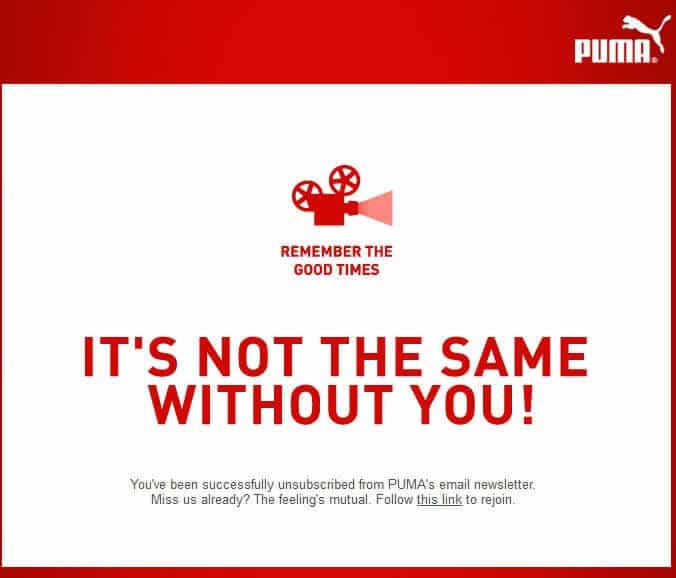
Enforcing positive messaging, “Remember the good times,” reminds customers why they love you, and saying “It’s not the same without you,” shows customers that their loyalty matters.
They also smartly offer a link where customers can easily re-sign up to stay a subscriber.
4) Run a win-back campaign to bring customers back
Win-back campaigns track customers who are right at the point of purchase – most often, after they’ve added items to their shopping cart – and use offers to bring them back to the store.
- Offer a hefty discount or free shipping to entice them to complete their purchase.
- Include the items they put in their shopping cart and make it easy for them to check out from within the email.
- Also, make sure your messaging is friendly and not forceful. Lighthearted, appreciative messaging like the above Puma example makes customers feel appreciated and not pressured.
If you’re already running win-back campaigns but aren’t getting great results, try A/B testing different tactics. Including social proof (“568 of your Facebook friends loved this item!”), is a good way to create a sense of missing out.
You can also include social proof in the form of reviews to show customers how awesome the product is.
Social proof is a powerful strategy for getting customers to make the final step to purchase, so include a few positive reviews of the product to show them they’re missing out if they don’t buy.
5) If all else fails, learn from it
If you absolutely can’t keep the customer, find out what you could change differently for other customers. Find out which pain points caused them to leave. In this case, short and sweet may be better than a personal phone call.
Additionally, keep your questions open ended.
Groove explains how they boosted their exit survey response rate nearly eight times by switching to open-ended questions, like their email below:
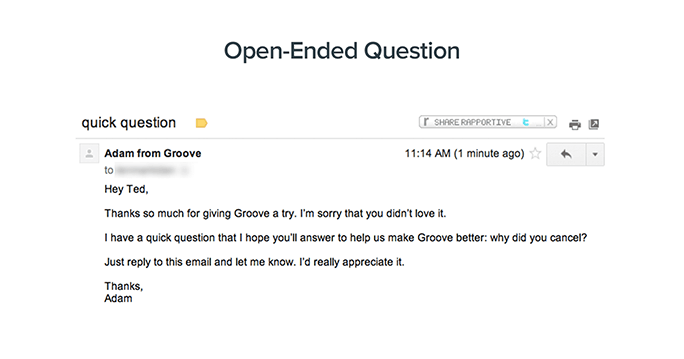
Groove also reveals that they nearly doubled their conversions just switching from “Why did you cancel?” to “What made you cancel?” So, continue to test your language and even design in these post-exit surveys to see how tiny tweaks can garner more results.
Most importantly, learn from customer replies and always leave the door open in case they decide to return to you. Thank them for your response and let them know you will work to fix any issues they may have had.











 Join a free demo, personalized to fit your needs