



Every e-commerce manager confronts the same fundamental challenge: how to drive sustainable growth. For years, the conventional answer was to acquire new customers. But what if the most profitable path to growth isn’t about pursuing new prospects? What if it’s about deepening relationships with the customers you already have?
Key Takeaways: Customer Acquisition vs. Retention
- Acquisition is Costly: Acquiring a new customer is consistently 5 to 25 times more expensive than retaining an existing one.
- Retention Drives Profit: A mere 5% increase in customer retention can boost profits by a staggering 25% to 95%.
- The CLV:CAC Ratio is Crucial: The relationship between Customer Lifetime Value (CLV) and Customer Acquisition Cost (CAC) is the ultimate measure of marketing ROI. A healthy ratio to aim for is 3:1 or higher.
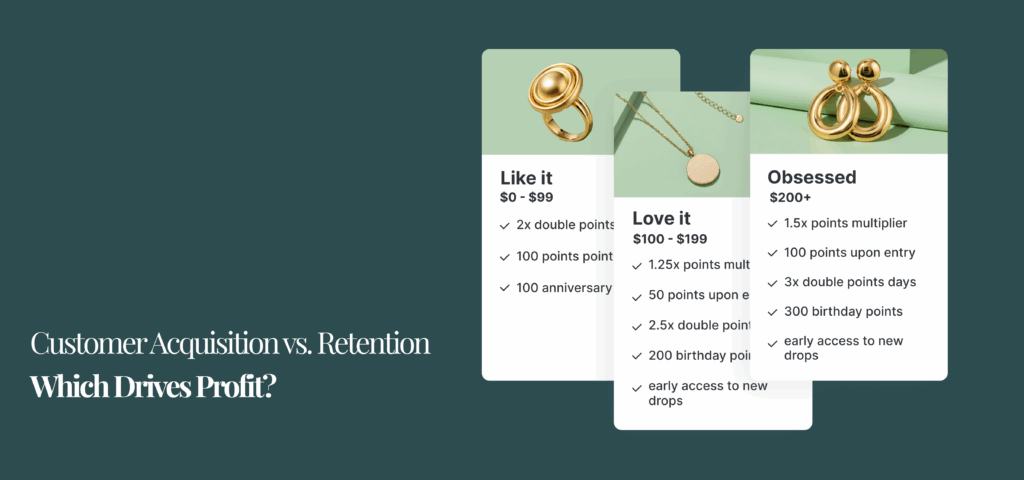
- Loyalty Programs Build Relationships: Strategic loyalty programs do more than offer points; they create a sense of belonging that encourages repeat purchases and emotional connection.
- Reviews Build Trust: Authentic customer reviews and user-generated content (UGC) are the most powerful forms of social proof, directly influencing purchasing decisions and building brand credibility.
The Core E-commerce Dilemma: Balancing Acquisition and Retention
Imagine your business is a bucket. Customer acquisition is the water poured in at the top. It feels like tangible progress as you watch the water level rise. Customer retention, however, is about plugging the leaks in that bucket. While it may lack the glamour of high-spend acquisition campaigns, without it, you are perpetually working just to maintain your current level.
Although a steady stream of new customers is essential for any brand to scale, a singular focus on acquisition is a costly strategic error. True, sustainable growth materializes when you cultivate a loyal customer base that returns to purchase repeatedly. This is where the concepts of Customer Acquisition Cost (CAC) and Customer Retention become the most critical metrics in your strategic arsenal.
In short, while acquisition is how you find customers, retention is how you build a business.
Decoding the Metrics: What Are CAC and Customer Retention?
Before detailing strategy, we must establish clear definitions. These two concepts are the foundation upon which profitable e-commerce businesses are constructed.
What Is Customer Acquisition Cost (CAC)?
Customer Acquisition Cost, or CAC, is the total price you pay to convert a prospect into a new customer. It’s a direct measure of the financial efficiency of your growth engine. To calculate it accurately, you must account for all expenses involved in attracting and converting a prospect.
These costs typically include:
- Advertising Spend: Capital allocated to Google Ads, Facebook/Instagram ads, TikTok campaigns, and other paid channels.
- Team Salaries: The portion of salaries for your marketing and sales teams dedicated to acquisition initiatives.
- Creative Costs: Expenses for graphic design, video production, and copywriting for advertisements and campaigns.
- Technical Costs: The cost of software and tools used for marketing, such as analytics platforms, SEO tools, or your CRM.
- Publishing Costs: Any fees associated with disseminating your marketing message.
Tracking your CAC is vital. A rising CAC can be an early indicator that your marketing channels are becoming less effective or that your market is growing more saturated.
What Is Customer Retention?
Customer retention is the measure of your ability to compel existing customers to continue purchasing from you over a specific period. It is often expressed as a percentage—your customer retention rate.
However, retention is more than a metric; it is a direct reflection of customer satisfaction and brand loyalty. A high retention rate signals that you are delivering a superior product and an excellent customer experience. It is proof that customers who try your brand find sufficient value to remain engaged. This forms the bedrock of sustainable growth by creating a predictable revenue stream and a community of advocates around your brand.
The Hard Numbers: Key Statistics on Acquisition vs. Retention
If you are still deliberating where to focus your budget, the data presents a clear imperative. The debate over the cost of customer acquisition vs. retention ceases to be a debate once you examine the numbers.
Here are some of the most compelling statistics every e-commerce manager should know:
- Acquisition is substantially more expensive. Depending on the industry and study, acquiring a new customer is consistently found to be 5 to 25 times more expensive than retaining an existing one.
- Retention is a direct driver of profitability. Research by Bain & Company revealed that increasing customer retention rates by a mere 5% can boost profits by 25% to 95%. This occurs because repeat customers tend to spend more over time and are less costly to serve.
- Your probability of success is higher with existing customers. The likelihood of successfully selling to an existing customer is approximately 60-70%. For a new prospect, that figure plummets to just 5-20%. Your marketing efforts yield far greater results when aimed at a receptive, established audience.
- Loyal customers spend more and adopt new products faster. Existing customers are 50% more likely to try a new product you launch and spend 31% more on average compared to new customers. They already trust your brand, so the barrier to making an additional purchase is significantly lower.
These statistics all converge on the same conclusion: while you cannot afford to ignore acquisition, your most significant and reliable opportunities for growth lie with the customers you have already won.
How to Calculate Your Brand’s Key Growth Metrics
To make informed strategic decisions, you must be fluent in the language of data. Calculating your CAC and Customer Lifetime Value (CLV) is the first step toward a comprehensive understanding of the financial health of your marketing strategy.
Calculating Your Customer Acquisition Cost (CAC)
The formula for CAC is direct. To calculate it, you divide your total acquisition costs by the number of new customers you gained over a specific period.
The Formula: CAC = (Total Cost of Sales & Marketing) / (Number of New Customers Acquired)
Let’s walk through a practical example:
- An e-commerce store wants to calculate its CAC for the last quarter (Q3).
- Sum Your Acquisition Costs:
- Google & Facebook Ad Spend: $15,000
- Marketing Team Salaries (acquisition portion): $10,000
- Marketing Software Subscriptions: $1,000
- Total Cost: $26,000
- Count Your New Customers:
- Analytics show the brand acquired 1,000 new customers in Q3.
- Calculate CAC:
- CAC = $26,000 / 1,000 = $26
In this scenario, the cost to acquire each new customer was $26. It is a best practice to calculate this metric monthly or quarterly to monitor trends closely.
Calculating Customer Lifetime Value (CLV)
Your CAC tells you what you spend, but Customer Lifetime Value (CLV) tells you what you earn. CLV represents the total revenue you can reasonably expect from a single customer throughout their entire relationship with your brand. It provides the crucial context for evaluating your acquisition spend.
The Simplified Formula: CLV = (Average Purchase Value) × (Average Purchase Frequency) × (Average Customer Lifespan)
Let’s continue our example:
- Calculate Average Purchase Value (APV):
- APV = Total Revenue / Total Number of Orders
- If the store generated $150,000 from 3,000 orders, its APV is $50.
- Calculate Average Purchase Frequency (APF):
- APF = Total Number of Orders / Total Number of Unique Customers
- With 3,000 orders from 1,500 unique customers, the APF is 2 orders per customer.
- Estimate Average Customer Lifespan:
- This is the most complex variable. A good starting point is to analyze historical data to determine how long, on average, a customer continues to purchase from you. Let’s estimate it at 3 years.
- Calculate CLV:
- CLV = $50 (APV) × 2 (APF) × 3 (Lifespan) = $300
Thus, the average customer is worth $300 to your brand over their lifetime.
The All-Important CLV:CAC Ratio
Now, we synthesize the two metrics. The CLV:CAC ratio measures the relationship between a customer’s value and their acquisition cost. It is the ultimate report card on your marketing ROI.
The Ratio: CLV:CAC
Using our examples: $300 : $26, which simplifies to approximately 11.5 : 1.
Here’s a general guide for interpreting your ratio:
- 1:1: You are losing money on every new customer once you factor in the cost of goods sold.
- 3:1: This is widely considered a healthy ratio, indicating a solid return on your marketing investment.
- 5:1 or higher: Your marketing engine is exceptionally efficient. You may even be under-investing and could afford to spend more to accelerate growth.
Monitoring this ratio empowers you to move beyond simple cost-cutting and start making intelligent investments in channels and strategies that attract your most valuable customers.
Actionable Strategies to Optimize Customer Acquisition
Just because retention is more cost-effective does not mean you should cease acquiring customers. Growth requires both. The objective is to make your acquisition efforts as efficient and intelligent as possible.
Refining Your Paid Advertising Spend
For most e-commerce brands, paid advertising constitutes the largest component of CAC. This is also where you have the most direct control.
- Focus on High-ROI Channels: Do not spread your budget thinly across every available platform. Analyze your data meticulously. If Google Search is delivering customers with a higher CLV than Facebook, reallocate your budget to double down on what works.
- A/B Test Relentlessly: Never assume you know what performs best. Continuously test your ad creative, headlines, copy, and calls-to-action. Incremental improvements in your click-through and conversion rates can significantly lower your CAC.
- Leverage Lookalike Audiences: Your existing customer data is a valuable asset. Upload lists of your best customers (those with the highest CLV) to platforms like Facebook and Google to create lookalike audiences. This instructs the platforms to find new people who share key characteristics with your most valuable buyers.
Leveraging Organic and Owned Channels
The most cost-effective customer is one you did not have to pay directly to acquire. Investing in organic channels builds long-term, depreciating assets for your brand.
- Content Marketing & SEO: Create high-value blog posts, guides, or videos that address the questions and pain points of your target audience. Ranking high in search results for relevant keywords delivers a steady stream of highly qualified, low-cost traffic.
- Social Media Marketing: Evolve beyond posting product images and aim to build a genuine community. Engage with followers, run contests, and share user-generated content to cultivate an authentic brand presence that attracts new fans organically.
- Referral Programs: Empower your most satisfied customers to become your most effective sales team. A formal referral program that rewards customers for bringing new buyers to your brand can be a powerful and low-cost acquisition channel.
Optimizing acquisition is a crucial first step. However, the greatest financial leverage comes from mastering the other side of the growth equation.
The Ultimate Guide to Boosting Customer Retention
This is where leading e-commerce brands create their competitive advantage. A sophisticated retention strategy not only increases your CLV but also builds a loyal community that is less susceptible to price competition and competitor advertising. It is about elevating a transaction into a relationship.
Strategy 1: Build a World-Class Loyalty & Rewards Program
A loyalty program is one of the most direct and effective tools for encouraging repeat purchases. A truly exceptional program, however, transcends simple points-for-purchases. It forges an emotional connection by making customers feel recognized, valued, and part of an exclusive group. This sense of belonging increases CLV and builds a formidable moat around your brand.
Yotpo Loyalty excels by offering deep customization and functioning as a strategic partner. It provides access to e-commerce loyalty experts who guide you in building a dynamic program powered by a flexible platform. With robust reporting and segmentation, it helps create unique, branded loyalty experiences that drive measurable business results.

Strategy 2: Leverage the Power of Authentic Reviews and UGC
Trust is the currency of e-commerce. Before customers will purchase from you again, they must trust that your products will deliver on their promise. Nothing builds this trust more effectively than authentic reviews and user-generated content (UGC) from fellow shoppers. This provides the social proof needed to convert consideration into confident action.
The objective is not merely to collect reviews; it is to collect high-quality, conversion-driving reviews and display them strategically. Yotpo Reviews is purpose-built to help brands turn customer feedback into conversion-driving assets.
It focuses on collecting high-impact reviews with photos and videos, displaying them strategically with customizable widgets, and providing AI-powered insights into customer sentiment. With an extensive syndication network including Google, Target, and TikTok, it extends social proof across the entire buying journey.
Conclusion: Shifting Your Focus from Cost to Long-Term Value
The perpetual race for new customers is both exhausting and expensive. The financial calculus is clear: a dollar invested in retaining and delighting an existing customer consistently generates a greater return than a dollar spent acquiring a new one. By shifting your focus from the upfront cost of acquisition to the long-term value of retention, you transition from a mindset of spending to one of strategic investment.
Building a powerful retention engine through best-in-class loyalty programs and authentic reviews is the most reliable and cost-effective path to sustainable growth. It is how you build a brand that people not only purchase from but also feel a genuine connection with.
Frequently Asked Questions
What’s the difference between customer acquisition and customer retention?
Customer acquisition refers to the process of attracting and converting new prospects into first-time buyers. It involves all the marketing and sales efforts aimed at bringing new people to your brand. Customer retention, on the other hand, is focused on encouraging existing customers to make repeat purchases and remain loyal to your brand over time. Acquisition grows your customer count, while retention increases the lifetime value of each customer.
Why is the CLV:CAC ratio so important?
The CLV:CAC ratio is the ultimate measure of your marketing’s profitability and sustainability. It tells you how much revenue you generate from a customer compared to what you spent to acquire them. A low ratio (like 1:1) means you’re breaking even or losing money, while a high ratio (3:1 or more) signals a healthy, scalable business model. It helps you make smarter decisions about where to invest your marketing budget.
What are some common mistakes brands make with customer acquisition?
A common mistake is focusing too heavily on high-spend, low-return channels without analyzing the data. Another is targeting an audience that is too broad, which leads to a high CAC. Many brands also fail to optimize their conversion funnel, losing potential customers at checkout. Finally, neglecting to measure the CLV of acquired customers means you might be acquiring low-value customers who don’t stick around.
How does a loyalty program directly impact profitability?
A loyalty program impacts profitability in several ways. First, it encourages repeat purchases, which increases Customer Lifetime Value (CLV). Second, loyal customers often have a higher average order value (AOV). Third, retaining a customer is far cheaper than acquiring a new one, so you spend less on marketing for the same amount of revenue. Finally, loyal customers are more likely to become brand advocates, driving low-cost referrals.
What makes a VIP tier program effective?
An effective VIP program offers exclusive, aspirational rewards that make customers feel truly valued. Key elements include clear tier entry requirements (e.g., points earned or money spent), increasingly valuable benefits at each level (like free shipping, early access to products, or exclusive gifts), and strong communication that constantly reminds members of their special status and what they can achieve next.
How do customer reviews influence SEO?
Customer reviews provide a constant stream of fresh, relevant content for your product pages. This user-generated content is rich with long-tail keywords that actual customers use, which search engines like Google value. Additionally, review schema (the star ratings that appear in search results) can significantly increase click-through rates, signaling to Google that your page is a valuable result.
What is User-Generated Content (UGC) and why does it matter?
User-Generated Content (UGC) is any content—photos, videos, reviews, social media posts—created by customers rather than brands. It matters because it is highly authentic and acts as powerful social proof. Shoppers trust content from real people far more than they trust polished brand advertising. Displaying UGC on your site builds credibility, increases engagement, and helps convert hesitant shoppers by showing your products in real-world scenarios.
Can small businesses benefit from loyalty and reviews solutions?
Absolutely. Loyalty and reviews are arguably even more critical for small businesses. A loyalty program helps a small brand build a core group of repeat buyers, which provides stable revenue. Positive reviews are essential for building trust when you don’t have the brand recognition of a large corporation. These tools allow small businesses to compete effectively by fostering a strong community and reputation.
How do you measure the success of a retention strategy?
Success is measured through several key metrics. The most important are Customer Lifetime Value (CLV), Customer Retention Rate (the percentage of customers who stay with you over a period), and Repeat Purchase Rate. You can also track redemption rates in your loyalty program and the conversion rate lift from displaying customer reviews on product pages.
What’s the first step to improving customer retention?
The first step is to understand your current performance. Calculate your current customer retention rate and CLV. Then, survey your existing customers to understand why they stay and what might make them leave. This data will give you a baseline and highlight the biggest opportunities, whether it’s improving customer service, launching a rewards program, or enhancing the post-purchase experience.
How does brand community relate to customer retention?
A strong brand community fosters a sense of belonging that goes beyond transactions. When customers feel like they are part of a group with shared values, they are more likely to remain loyal. A community provides a platform for customers to engage with each other and the brand, strengthening their emotional connection and making them less likely to switch to a competitor.
Are points-based loyalty programs outdated?
Not at all, but they have evolved. While simple points-for-purchases systems are still effective, the most successful modern programs combine points with experiential rewards, exclusive access, and tiered VIP benefits. The key is to make the program feel like more than just a discount scheme. It should be an engaging experience that recognizes and rewards customers in multiple ways.
How can I encourage customers to leave visual reviews?
Make it easy and offer an incentive. Use a reviews solution that allows customers to upload photos and videos directly from their phones within the review request email. In your request, explicitly ask for visual content by saying something like, “Show us how you style it!” You can also offer a small reward, like extra loyalty points, for customers who include a photo or video with their review.











 Join a free demo, personalized to fit your needs