






“Yotpo is a fundamental part of our recommended tech stack.”
 Laura Doonin, Commercial Director

What 127 Beauty Brands Reveal About Winning in the AI Age

In Chapter 3, I shared that beauty was leading the way in AI discovery. That 8% of traffic to a toddler sleep brand came straight from ChatGPT.
I just spent three weeks analyzing 127 beauty brands, analyzed one by one.
And the picture is worse than I thought.
We went even deeper than our standard benchmarking on these brands.
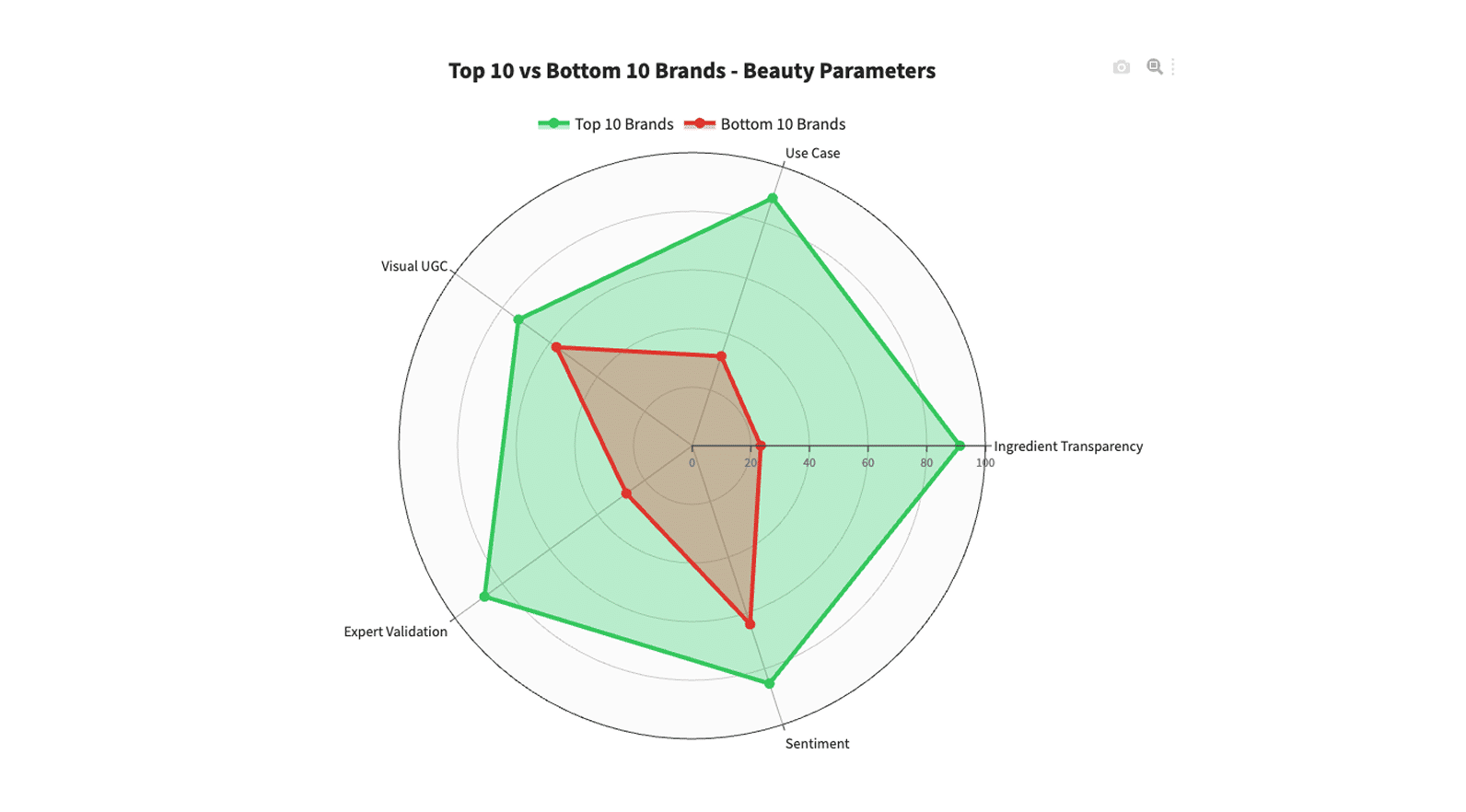
Added five beauty-specific parameters that capture what actually matters in this category: ingredient transparency, use case specificity, visual UGC richness, expert validation, and fragmentation penalties.
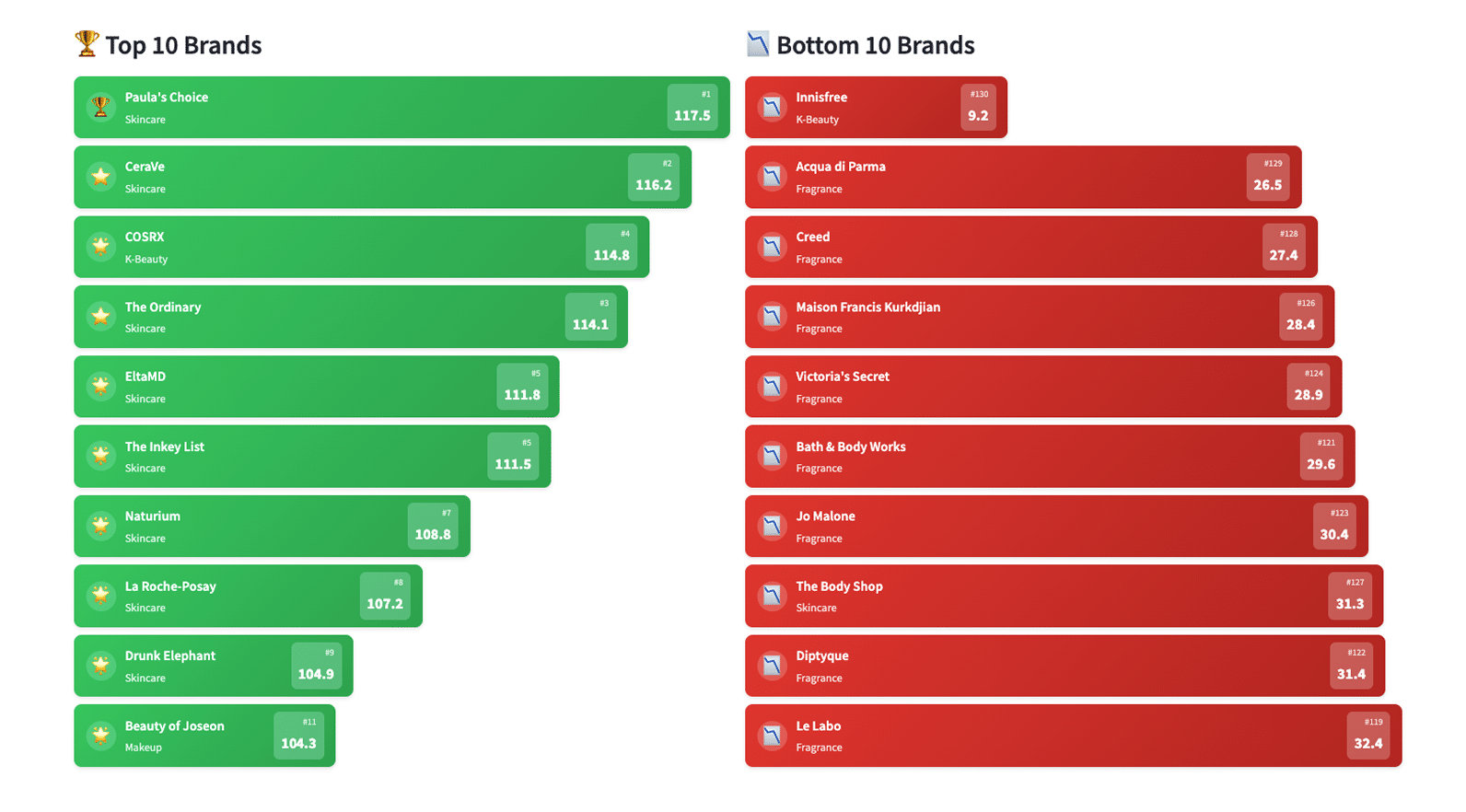
The result? A 101.6 to 12.4 spread. That’s not a gap, it’s a canyon. And the brands at the bottom don’t even know they’re falling.
When we benchmarked the top 100 ecommerce brands, we used broad strokes. For beauty, we needed a scalpel.
These five additional parameters separate the Glossiers from the ghosts:
1. Ingredient Transparency (6 points max)
Listing INCI names at the bottom of your page it’s enough. It’s explaining what each ingredient does, at what concentration, why it’s there, and how it interacts with other ingredients. The Ordinary doesn’t call their niacinamide product “Radiance Serum,” they call it “Niacinamide 10% + Zinc 1%.” That transparency became their moat.
Winners publish molecular weights, pH levels, and delivery systems. Paula’s Choice cites peer-reviewed research for every claim. Naturium shows exact percentages. Here, beauty is in the boring, clinical data that AI can parse, understand, and recommend.
2. Use Case Specificity (6 points max)
“For all skin types” is the kiss of death. AI rewards precision. EltaMD organizes by condition: acne-prone, rosacea, post-procedure. Every product explains exactly who should use it, when, how, and with what else.
The Inkey List’s Recipe Builder creates 10,000+ routine combinations. Paula’s Choice shows five-step routines for different concerns. This captures searches like “vitamin C serum for sensitive skin with melasma”, the long tail that adds up to dominance.
3. Visual UGC Richness (4 points max)
Before-and-afters. Texture shots. Real skin in real lighting. COSRX built a TikTok empire on user transformations. Beauty of Joseon turned “glow” into visual proof.
But here’s the twist, this correlates weakly with overall performance (r=0.34). Why? Because Byredo’s $400 minimalist bottles don’t invite iPhone photography. Clinical brands maintain medical positioning that doesn’t fit Instagram aesthetics. Visual UGC helps but doesn’t determine destiny.
4. Expert Validation (4 points max)
“Dermatologist recommended” is the most valuable phrase in beauty. CeraVe generated $30.1M in earned media value through dermatologist partnerships. La Roche-Posay claims “#1 dermatologist-recommended worldwide.” EltaMD thrives on “dermatologists use it personally.”
Expert opinion builds trust and fuels AI. ChatGPT prioritizes products mentioned in medical journals. Perplexity pulls from dermatology sites. No expert validation = no AI recommendations.
5. Fragmentation Penalty (Up to 15 points)
The silent killer. One fragrance, twenty SKUs: perfume, toilette, lotion, travel size, gift set. Each with its own product page. Same content, no depth. Bath & Body Works has 500+ scent variations, what’s the use case for “Warm Vanilla Sugar” versus “Sweet Vanilla Bean”?
Fragmentation destroys domain authority, cannibalizes keywords, and confuses algorithms. Focused brands with deep content win. Scattered brands with shallow pages lose.
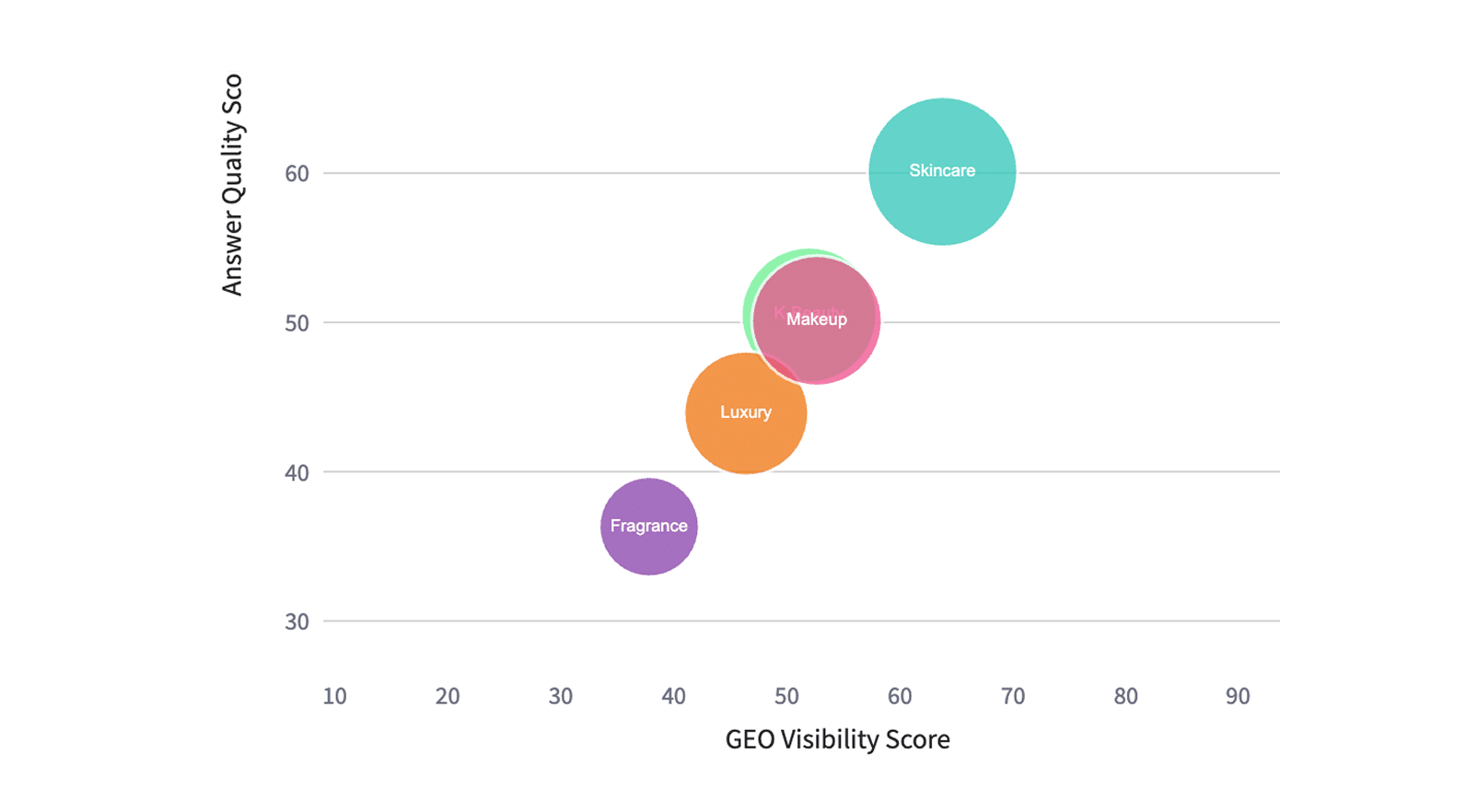
Not all beauty is created equal. The category you’re in determines your ceiling.
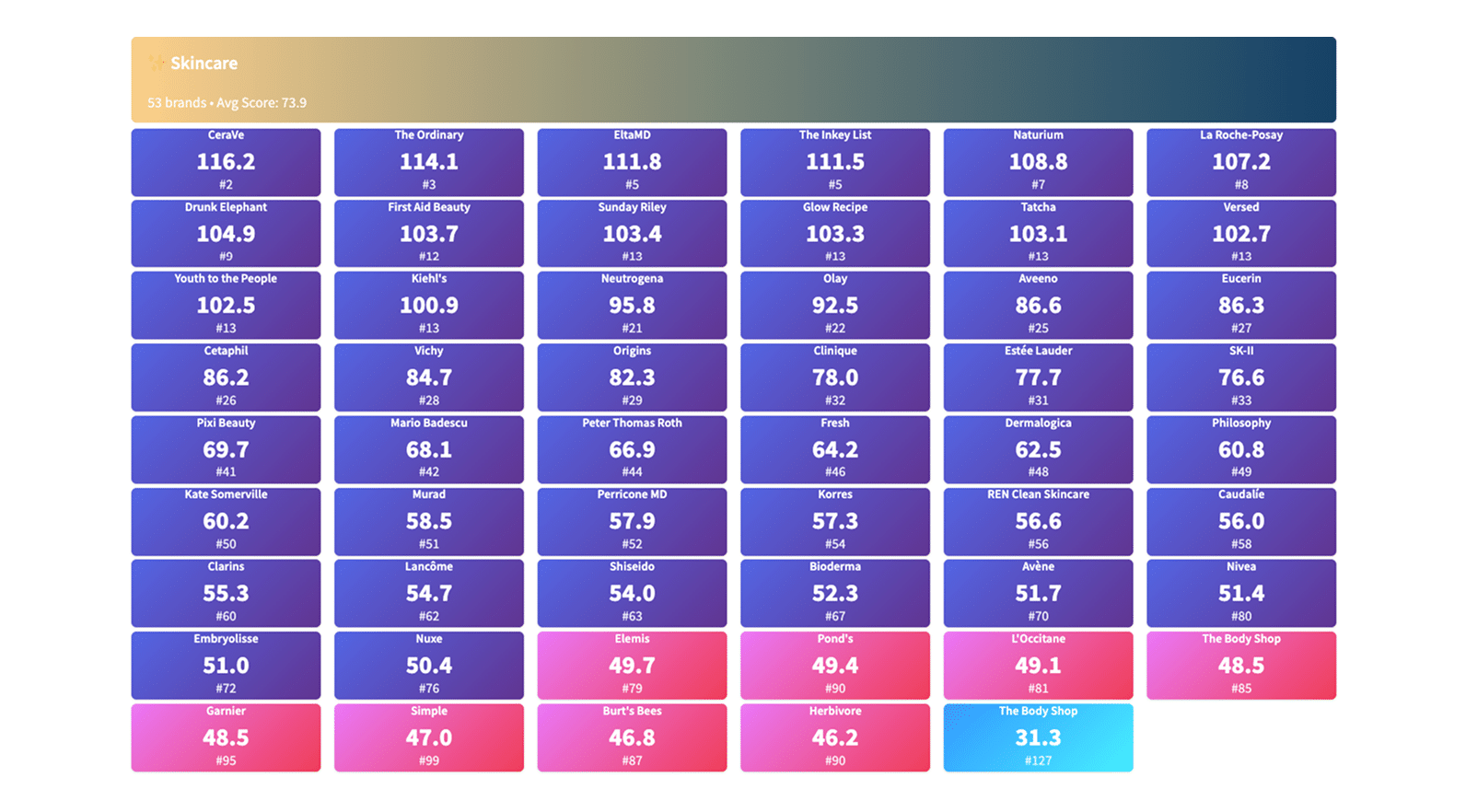
Skincare (Average: 76.2): The undisputed champion. Every ingredient is a content goldmine. Retinol requires education about percentages, buffering, and photosensitivity. Niacinamide needs explanation of benefits at different concentrations. Infinite keywords + endless education = perfect for AI.
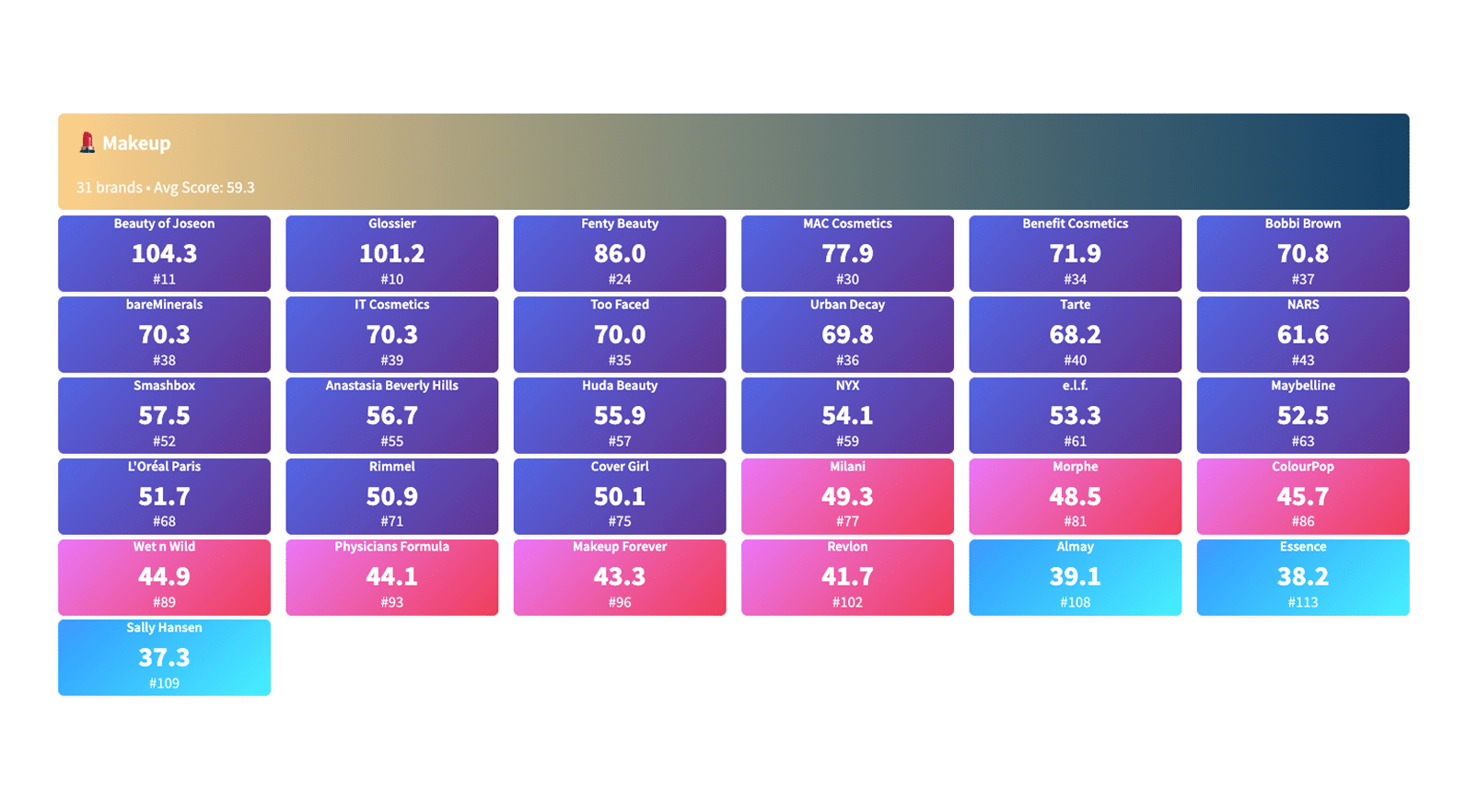
Makeup (Average: 52.8): A red lipstick is a red lipstick. Sure, you can discuss undertones, but there’s no scientific depth. No medical authority. Discovery happens on TikTok (23.2%) and Instagram (30.4%), not Google (18.8%). The visual medium trapped in text-based search.
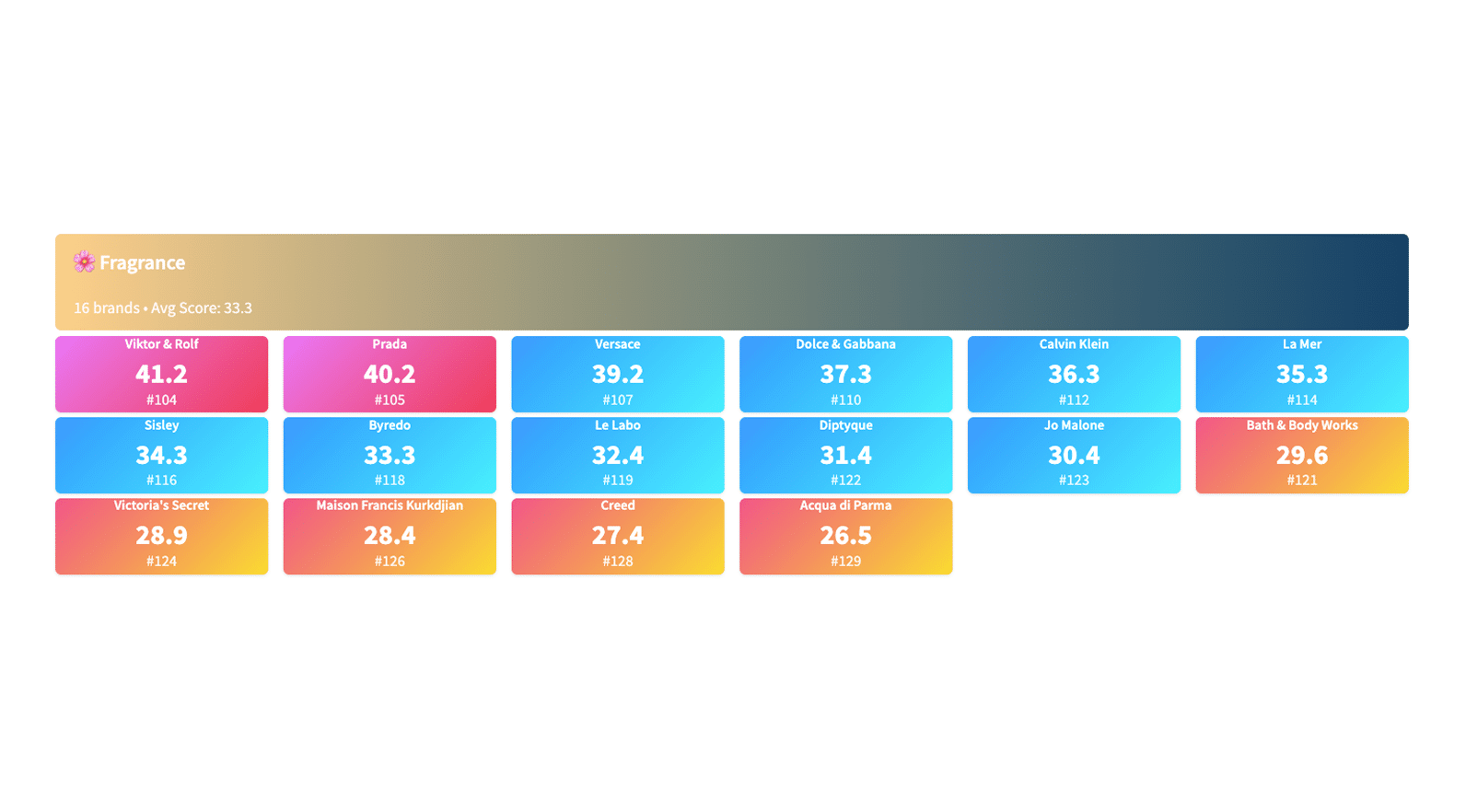
Fragrance (Average: 41.3): Structurally doomed. English has three smell words: stinky, fragrant, musty. Everything else is a comparison, “smells like jasmine.”
Brands end up using the same words. There’s no semantic differentiation. No search edge.
On top of that, fragrance is protected as a trade secret. So ingredient transparency is zero by design. Byredo scored -6.0. Sisley -8.2. Bath & Body Works -10.5. Not bad scores, impossible scores.
Haircare (Average: 68.4): The surprise performer. Ingredients matter (proteins, oils, actives). Specific use cases (curl pattern, porosity, damage level). Expert validation from stylists. Olaplex built an empire on one patented molecule explained properly.
Are you wondering where your brand falls on this 101.6 to 12.4 spectrum? I built the exact 10-parameter testing framework we used to benchmark these 127 brands. You can run it yourself in 30 minutes. No technical skills needed. Just ChatGPT.
Fair warning: it’s brutally honest. But that’s where the work starts.
[Download the Beauty Brand AI Audit Framework here – includes all 10 testing prompts]
Four brands didn’t just win, they rewrote the rules of beauty marketing:
The Ordinary (98.6): Broke beauty’s markup mythology by showing true costs. “Buffet” + Copper Peptides 1% for $31 when competitors charge $200 for mystery serums. Radical transparency became strategy.
Paula’s Choice (101.6): Built 26 years of research-backed content. Domain Rating 75, beauty’s most authoritative domain. Ingredient Dictionary brings 2M+ visits a month. “Whatever we say, we always cite the research.” Every claim cited. Content is a product.
The Inkey List (92.3): Positioned as “beauty recipes” with simple explanations. Their “My Skincare Recipe” tool generates personalized routines from 15,000 combinations. Complexity made simple.
Naturium (89.7): Launched in 2019, and already threatening giants. Shows molecular weights, pH levels, stability data. Has a “Skincare Academy” and ingredient glossary. Built five years of authority in two.
These brands share the same DNA:
They didn’t disrupt the category. They rewrote it.
They pushed L’Oréal to copy CeraVe’s TikTok playbook. Made Estée Lauder acquire The Ordinary’s parent company. Pushed P&G to reformulate with trending activities.
The tail is now wagging the dog.
Let me show you how the mighty have fallen:
Revlon (47.6): Chapter 11 bankruptcy wasn’t just financial. Their digital presence is bankrupt too. Thin product descriptions. No educational content. Zero ingredient transparency. Still advertising like it’s 1990. Their “About” page talks about “glamour” while consumers search for “non-comedogenic.”
Nivea (52.1): A 100-year-old brand with a 10-year-old website. Page load times over 1 second (death above 0.4). Fragmented regional sites. Basic product info. No clinical backing despite pharmaceutical parent (Beiersdorf). They own “moisturizer” mindshare but can’t convert it to search dominance.
Innisfree (12.4): The lowest score in our analysis. Beautiful in Korea, invisible in the West. Why? Korean beauty philosophy doesn’t translate to Western search behavior. “Jeju volcanic clusters” means nothing to someone searching for “clay mask for oily skin.” Cultural authenticity became their algorithmic cage.
Bath & Body Works (39.9): 500+ fragrances, zero use cases. “Japanese Cherry Blossom,” “Sweet Pea,” and “Moonlight Path”, what problem do these solve? Their fragmentation penalty (-10.5) is the worst we’ve seen. Popular in malls, invisible to LLMs.
These aren’t bad brands, but they are brands optimized for a world that no longer exists.
A world where retail shelf space equaled market share, where discovery happened through TV, not TIktok. Where pretty packaging mattered more than pH levels.
That world is gone.
Korean beauty conquered the world, but then forgot to translate the conquest. Our analysis reveals a massive split:
Winners: COSRX (98.0), Beauty of Joseon (91.2) Losers: Innisfree (12.4), Etude House (31.8), Missha (42.3)
What separates them? Language and logic.
COSRX succeeded by treating content as localization, not translation. They don’t mention “K-beauty” on product pages. They explain ingredients in Western clinical terms. Their hero product? “Advanced Snail 96 Mucin Power Essence.” Weird? Yes. Specific and searchable? Absolutely.
Beauty of Joseon launched with English names. Translated traditional concepts into modern terminology. “Ginseng” becomes “anti-aging.” “Rice water” becomes “brightening.” Cultural story for brand building, clinical benefits for discovery.
The losers tried to export culture instead of solutions.
Innisfree’s “Jeju heritage” means nothing to someone searching for “vitamin C serum.” Etude House’s cutesy Korean copy doesn’t parse for English NLP. They’re selling nostalgia for Korea, not solving skin problems, and discovery is built on clarity.
Three brands broke our scoring model by being too exclusive to measure properly:
SkinCeuticals (94.2): Refuses Amazon. Minimal D2C. Sold through dermatologists and medspas. Yet dominates medical-grade skincare searches. Their C E Ferulic has 10,000+ mentions in clinical settings.
EltaMD (91.8): Prescription-only until recently. Dermatologists don’t just recommend it, they use it personally. Scarcity creates demand. Professional distribution elevates efficacy perception.
iS Clinical (86.4): The “Ferrari of skincare” strategy. $200 serums sold through aestheticians. Every customer interaction includes professional education. They built authority through exclusivity.
These brands prove distribution can be a feature, not a bug. By limiting access, they increased authority. By requiring professional consultation, they guaranteed proper education. By avoiding the mass market, they maintained medical positioning.
The irony? Their exclusivity makes them more discoverable. Every medspa website mentions them. Every dermatologist blog recommends them. Professional channels became their SEO strategy.
ChatGPT has 700 million weekly users. 15% of Google searches show AI Overviews. Perplexity is exploding. And beauty brands are optimizing for an algorithm that died two years ago.
GEO (Generative Engine Optimization) rewards different signals than SEO:
L’Oréal now gets it, they test on ChatGPT, Gemini, and Perplexity weekly. CeraVe’s dermatologist network ensures medical sites reference them (LLM training data). Paula’s Choice’s 26 years of citations make them AI-native.
But most brands? Still counting backlinks. Still buying Instagram ads. Still writing product descriptions for Google 2019.
The #ChatGPTGlowUp trend on TikTok shows the future: users upload selfies, get AI skincare routines, receive specific product recommendations. The brands winning those recommendations? The ones we scored 95+. The ones losing? Invisible.
Here’s what our regression analysis revealed:
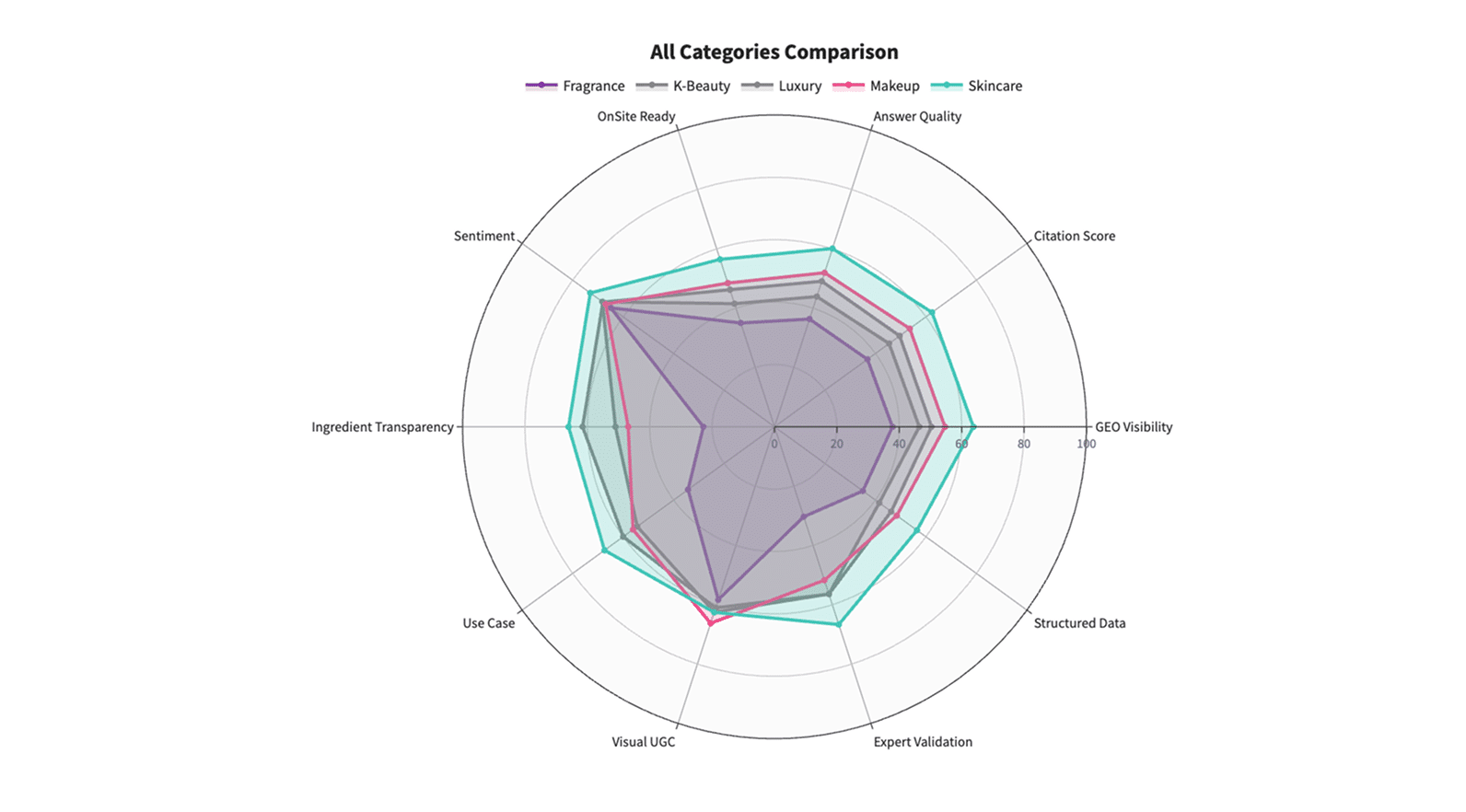
Ingredient transparency correlates with GEO visibility at r=0.78. Nearly perfect correlation. Brands explaining ingredients rank. Brands hiding behind “proprietary complexes” don’t.
Expert validation correlates at r=0.71. “Dermatologist recommended” is the signal AI uses to determine authority. It is also great marketing.
Visual UGC correlates at only r=0.34. Instagram beauty doesn’t equal search visibility. Pretty feeds without scientific backing are digital ghost towns.
Fragmentation penalty correlates at r=-0.82 with use case specificity. The more SKUs without purpose, the worse you perform. Focus wins. Scatter loses.
This math is deterministic. It’s not about budget. Naturium launched in 2019 with minimal funding and scores 89.7. Revlon has infinite resources and scores 47.6.
Based on 127 brands analyzed, here’s how to stay alie:
If you’re in skincare: You won the category lottery. Now execute. Every ingredient needs a hub page. Every concern needs a guide. Every routine needs documentation. Build your own ingredient dictionary. Partner with dermatologists ASAP. Publish concentration percentages. Show pH levels. Explain everything. The Ordinary proved radical transparency wins.
If you’re in makeup: Accept that discovery happens visually. Dominate TikTok and Instagram. Build AR try-on tools. Create video tutorials. But find a skincare angle, “skin-first makeup,” “treatment foundation,” “serum concealer.” Glossier proved hybrid positioning works. Pure makeup brands are algorithmically invisible.
If you’re in fragrance: Stop trying to win at SEO. You’re playing tennis with a bowling ball. Lean into experiential marketing. Build beautiful, Instagram-first content. Create discovery quizzes that capture emails. Focus on brand search, not category search. Or pivot, functional fragrance (aromatherapy benefits), hybrid products (fragrance + skincare), or personalization technology. The pure fragrance play is dead online.
If you’re a legacy brand: Your organizational inertia is killing you. Create a separate digital team with DTC DNA. Hire scientists who can write, not marketers who can’t. Shift 40% of traditional ad spend to content creation. Partner with dermatologists even if it feels weird. Build ingredient transparency even if legal hates it. You have 12-18 months before the gap becomes permanent.
If you’re K-beauty: Consider your target audience and sell solutions. Translate concepts, not words. Organize by skin concern, not philosophy. Partner with Western dermatologists. Build English-first content. COSRX proved it works, 98.0 score by becoming clinically Korean, not culturally Korean.
If you’re starting fresh: Go extreme. Either pure clinical (Paula’s Choice path) or pure community (Glossier path). There is no middle ground. Pick a niche and go deeper than seems reasonable. Build education before products. Create content moats before launching. The winners started publishing two years before selling.
Let me paint you the picture our data reveals:
The Elite (100+): Paula’s Choice (101.6), CeraVe (100.9). They’ve transcended into algorithmic dominance. They don’t compete, they’re the benchmarks others chase.
The Contenders (90-99): The Ordinary (98.6), COSRX (98.0), La Roche-Posay (95.3). One strategic push from elite status. Usually missing time, not tactics.
The Survivors (70-89): Clinique (78.4), Neutrogena (72.3), Olay (71.8). Technically competent but strategically confused. Good enough to survive, not good enough to thrive.
The Zombies (50-69): Nivea (52.1), Revlon (47.6), Shiseido (61.2). Dead brands walking. Surviving on brand equity and retail relationships that erode monthly.
The Ghosts (Under 50): Bath & Body Works (39.9), Innisfree (12.4). Algorithmically invisible. Exist in physical retail and paid ads only. No organic discovery. No AI recommendations. No future.
The gap between Paula’s Choice and Innisfree isn’t 89 points. It’s two different universes. One where content is product and transparency is strategy. Another where pretty packages and celebrity endorsements still matter.
Choose your universe. Then build like your business depends on it.
Because it does.
You can generate your own brand score in 30 minutes, like all of the scores discussed.
I’ve packaged the exact 10-parameter framework we used. Every prompt, every scoring metric, every testing methodology. No black box. No consultants needed. Just you, ChatGPT, and your algorithmic visibility.
Some brands who ran this audit found they were scoring 20+ points below their estimates. Others discovered massive opportunities their competitors hadn’t touched. All of them learned something that changed their strategy within 48 hours.
The bloodbath isn’t waiting for you to be ready. Neither should you.
[Get the Beauty Brand AI Audit Framework here – DIY your death score]
I started this analysis thinking beauty was winning at AI commerce. I was right, but only for 20% of brands. The other 80% are getting slaughtered by a change they don’t even see happening.
The beauty industry hasn’t split, it’s shattered. Into science brands that compound authority daily. Legacy brands that bleed relevance hourly. And a massive graveyard of pretty products that nobody will ever discover.
The math is clear: GEO visibility correlates with ingredient transparency (r=0.78), expert validation (r=0.71), and focused positioning (r=-0.82 fragmentation penalty). It barely correlates with Instagram followers (r=0.34) or advertising spend (r=0.21).
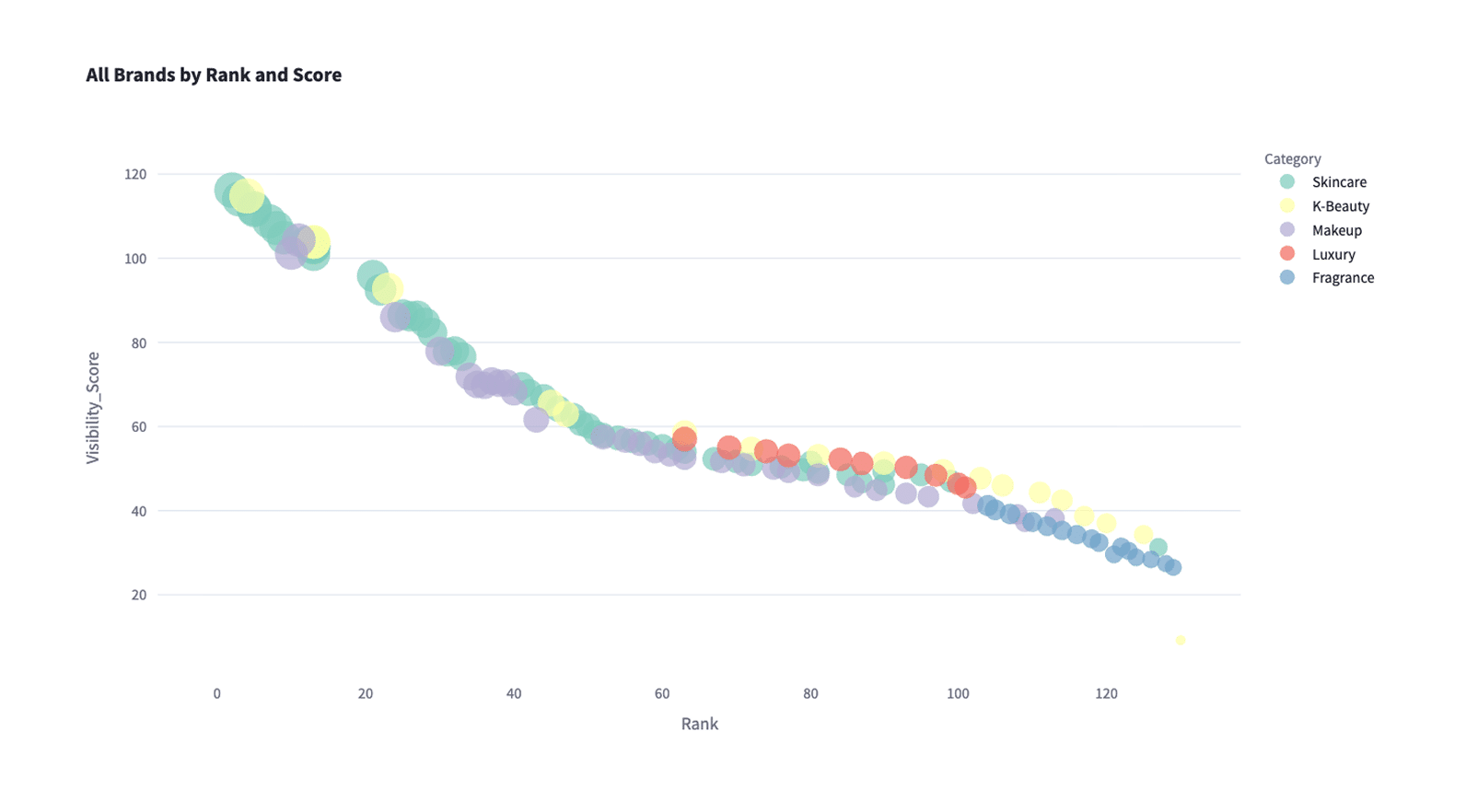
This isn’t a temporary disruption. It’s a fundamental restructuring of how beauty products get discovered, evaluated, and purchased. The brands scoring 95+ today will score 110+ tomorrow. The brands scoring 40 today will score 20 tomorrow.
Look at these 127 scores.
The bloodbath isn’t coming.
It’s here.
– Tomer

“Yotpo is a fundamental part of our recommended tech stack.”
Laura Doonin, Commercial Director




 Join a free demo, personalized to fit your needs