








As an eCommerce professional, you manage numerous metrics daily. If you were to select just one that reveals the health and scalability of your business, which would you choose? Many would point to Customer Acquisition Cost, or CAC. Understanding your CAC isn’t just an accounting exercise; it’s the key to unlocking sustainable growth. An incorrect approach can lead to exhausted marketing budgets, while a strategic one builds a foundation for long-term profitability. This guide provides a definitive analysis of retail CAC, how to calculate it, and most importantly, actionable strategies to lower it.
Key Takeaways
- CAC is Comprehensive: Customer Acquisition Cost (CAC) includes all sales and marketing expenses—not just ad spend—required to gain one new customer.
- The Golden Ratio: For a healthy business, your Customer Lifetime Value (LTV) should be at least three times your CAC (a 3:1 ratio).
- Trust Drives Conversion: Building trust through social proof like customer reviews is one of the most effective ways to increase website conversion rates and lower CAC.
- Retention is Key: It costs significantly more to acquire a new customer than to retain an existing one. Loyalty and referral programs are powerful tools for improving your LTV:CAC ratio.
- Optimize, Don’t Just Cut: Lowering CAC is about making your marketing spend more efficient, not simply cutting your budget.
Understanding Customer Acquisition Cost (CAC): The What and Why
Before diving into optimization strategies, it’s essential to build a solid foundation. Let’s examine what CAC represents, why it demands your attention, and how to measure it accurately.
What exactly is CAC?
At its core, Customer Acquisition Cost (CAC) is the total expense you incur to convince a potential customer to make their first purchase. It represents the price you pay to win a new customer.
This calculation extends beyond your ad spend. A true CAC calculation includes every cost associated with your sales and marketing efforts over a specific period. These costs typically include:
- Advertising Costs: Expenditures on Google Ads, social media advertising (Facebook, Instagram, TikTok), influencer campaigns, and other paid channels.
- Team Salaries: The compensation and benefits for your marketing and sales teams.
- Creative and Content Costs: Expenses for graphic design, video production, copywriting, and blog content development.
- Technical Costs: The fees for software and platforms used in marketing and sales, such as your CRM, marketing automation tools, and analytics software.
- Publishing and Distribution Costs: Any fees associated with delivering your marketing message to potential customers.
Aggregating these costs provides a transparent view of your investment in business growth.
Why CAC is a Critical Metric for Retailers
Why is CAC considered more than just a number on a spreadsheet? Tracking this metric is vital because it directly impacts your profitability and strategic decisions.
- It Gauges Business Viability: If it costs you $50 to acquire a customer who only spends $40, you have an unsustainable business model. CAC helps you understand the immediate profitability of your growth efforts.
- It Optimizes Marketing Spend: Knowing your CAC for different channels allows for more effective budget allocation. You can invest more in what works and reduce spending on what doesn’t.
- It Reveals Campaign Efficiency: CAC acts as a benchmark for your marketing strategies. As you launch new campaigns or refine existing ones, a declining CAC indicates you are on the right track.
- It’s Essential for Financial Planning: Investors and stakeholders will consistently inquire about your CAC. It is a key indicator of your company’s scalability and potential for future profit.
How to Calculate Your Retail CAC
Calculating your CAC is a straightforward process. The formula is:
- CAC = Total Sales & Marketing Costs / Number of New Customers Acquired
Let’s walk through a simple, step-by-step example for an eCommerce store over a single month:
- Sum Your Sales and Marketing Costs:
- Ad Spend: $5,000
- Marketing Team Salaries: $6,000
- Marketing Software Subscriptions: $500
- Total Costs = $11,500
- Count Your New Customers:
- Review your analytics for the same month and identify the number of new customers. For this example, assume you acquired 500 new customers.
- Calculate CAC:
- CAC = $11,500 / 500
- CAC = $23
In this scenario, it cost $23 to acquire each new customer that month. A common pitfall is including only ad spend in the calculation, which produces a misleadingly low CAC. For an accurate assessment, you must be comprehensive.
The Golden Ratio: CAC to LTV
CAC does not tell the whole story on its own. To truly understand its significance, you must compare it to your Customer Lifetime Value (LTV). LTV represents the total revenue a business can reasonably expect from a single customer throughout their relationship with the brand.
The LTV:CAC ratio is the critical figure that reveals the long-term value of your acquisition strategy.
- An LTV:CAC ratio of 1:1 means you are breaking even on each customer.
- An LTV:CAC ratio less than 1:1 indicates you are losing money on every new customer.
- An LTV:CAC ratio of 3:1 is often considered the “gold standard,” signifying a highly profitable and scalable business.
- A ratio of 5:1 or higher may even suggest you are under-investing in marketing and could be growing faster.
A low CAC is beneficial, but a low CAC combined with a high LTV is the formula for success.
Key Factors That Drive Up Your Customer Acquisition Cost
If your CAC is climbing, it signals an inefficiency in your strategy. Pinpointing the cause is the first step toward implementing a solution.
- Ineffective Ad Targeting and Spend: Are you showing your ads to the right people? Targeting an audience with no interest in your product is a fast way to exhaust a budget. High competition can also lead to bidding wars for keywords, driving up your cost-per-click (CPC).
- Poor Website Conversion Rates: You can drive tons of traffic to your website, but if those visitors do not convert, your CAC will escalate. Common causes include a confusing checkout process, slow page load speeds, or a lack of trust signals like product reviews.
- Over-reliance on Paid Channels: Relying exclusively on paid ads makes you vulnerable to rising costs and algorithm changes. A healthy marketing mix balances paid efforts with organic channels like SEO, which deliver customers at a lower long-term CAC.
- Ignoring Customer Retention: This is arguably the most significant factor. It costs substantially more to attract a new customer than to keep an existing one. If your business has a high churn rate, you are forced to spend continuously on acquisition just to maintain your customer base.
Actionable Strategies to Lower Your Retail CAC
Lowering your CAC isn’t about slashing your marketing budget; it’s about spending with greater intelligence and efficiency. The following strategies focus on optimizing your efforts, improving conversion, and maximizing customer value.
Strategy 1: Boost Conversion Rates with Social Proof and UGC
One of the most powerful ways to lower CAC is to increase your website’s conversion rate. If you can convert more of your existing traffic, you acquire more customers for the same ad spend. This is accomplished by building trust.
Social proof—in the form of reviews, ratings, and customer photos—serves as modern word-of-mouth. It eases anxiety for new shoppers and provides authentic validation that your product is a sound choice.
Yotpo’s Role in Building Trust
This is precisely where Yotpo Reviews becomes an essential tool. The objective is not just to collect reviews but to collect and display high-impact user-generated content (UGC) that actively drives sales. Yotpo helps automate the process of requesting reviews and makes it easy for customers to submit them, including photos and videos. This visual UGC is particularly powerful, as it shows potential buyers how your product looks and functions in a real-world context.
By integrating trust signals directly on your product pages, you answer customer questions, handle objections, and increase conversion rates. This means you gain more customers from your existing traffic, effectively lowering your CAC.
Strategy 2: Implement a Strategic Loyalty and Referral Program
A loyalty program is fundamentally a retention tool, but it has a significant impact on your acquisition costs. By increasing repeat purchases, you increase your Customer Lifetime Value (LTV). A higher LTV allows you to afford a higher CAC, giving you a competitive edge.
More directly, a well-designed referral program transforms your existing customers into your most effective marketers. When a satisfied customer refers a friend, that new customer is acquired at a very low cost—one of the most efficient ways to lower your blended CAC.
Yotpo’s Role in Building Loyalty
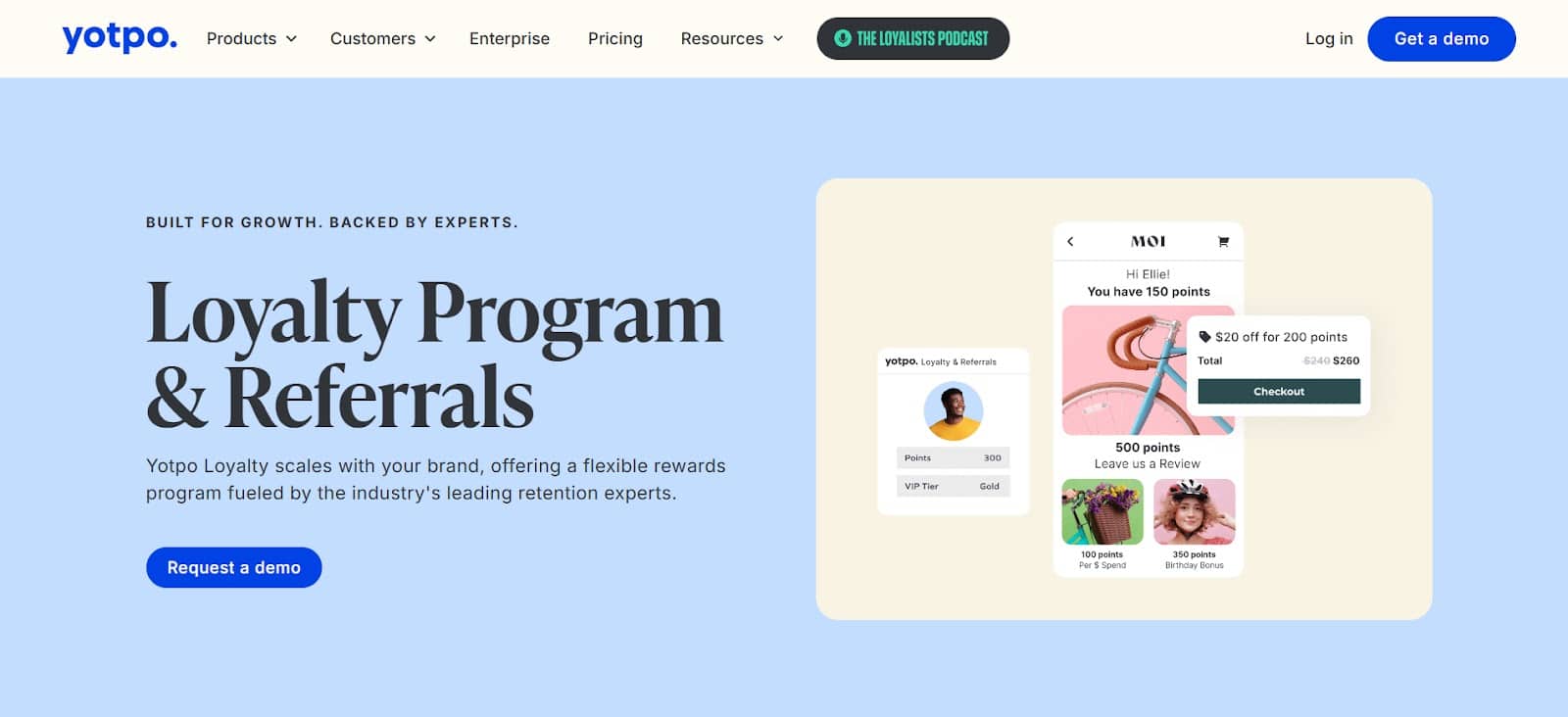
Yotpo Loyalty empowers you to build a customized loyalty and referral program that moves beyond simple points-for-purchase models. With it, you can lower CAC by:
- Creating Powerful Referral Programs: Easily set up campaigns where customers can share a unique link with friends. You can offer incentives to both the referrer and the new customer, driving high-quality, low-cost acquisitions.
- Designing Tiered VIP Programs: Encourage customers to spend more to unlock new levels with exclusive perks. This not only boosts LTV but also creates a dedicated group of brand advocates.
- Rewarding for Engagement: Offer points for actions beyond purchases, such as writing a review or following on social media. This keeps customers engaged and strengthens their loyalty.
While other solutions like Loyalty Lion or Smile are available, Yotpo differentiates itself with a partnership approach, providing strategic guidance to ensure your program is designed for maximum ROI. Yotpo Loyalty is a powerful standalone product, but its value is enhanced when it works in concert with other tools. For instance, you can award loyalty points to customers for leaving feedback with Yotpo Reviews.
Strategy 3: Improve SEO and Content Marketing
While paid channels deliver immediate traffic, organic channels like search engine optimization (SEO) and content marketing are long-term investments that can drastically lower your CAC over time. The goal is to create valuable content that answers the questions your target audience is asking, drawing them to your site naturally.
Once a blog post or guide ranks on the first page of Google, it can generate highly qualified, low-cost traffic for months or years. This strategy requires patience, but the payoff is a sustainable stream of low-cost traffic that isn’t dependent on ad spend.
Strategy 4: Syndicate Reviews to Broaden Reach
Imagine placing your best customer reviews in front of shoppers before they even land on your website. This is the power of review syndication—distributing your collected reviews to third-party retail and search channels.
This strategy lowers CAC by increasing your brand’s effectiveness on these crucial platforms. A product on Google Shopping with dozens of 5-star ratings is far more likely to be clicked than one with no reviews, increasing your click-through rate (CTR) and lowering your effective cost-per-click.
Yotpo’s Role in Syndication
Yotpo Reviews maintains an extensive syndication network, allowing you to push your reviews to major platforms like Google Shopping, Facebook, TikTok Shop, and retail partners such as Target. This places your valuable social proof at the point of discovery, boosting visibility, increasing click-through rates, and enhancing conversion.
Putting It All Together: From Lowering CAC to Driving Growth
Managing your acquisition cost isn’t about a single tactic but about building a holistic system that balances efficient acquisition with robust customer retention. The strategies discussed—building trust with reviews and fostering loyalty—both work toward the same goal: acquiring the right customers efficiently and then maximizing their lifetime value.
Solutions like Yotpo Reviews and Yotpo Loyalty are best-in-class products designed to address these specific challenges. Yotpo Reviews helps you turn customer feedback into conversion-driving assets, building the trust needed to convert visitors into customers. Yotpo Loyalty provides the tools to nurture those relationships, encouraging repeat purchases and turning happy customers into a low-cost acquisition channel through referrals.
By focusing on these core pillars of trust and retention, you can build a more resilient and profitable eCommerce business. You transition from simply renting customers through ads to building lasting, profitable relationships.
Frequently Asked Questions
What is a “good” Customer Acquisition Cost for retail?
There’s no universal figure, as it varies by industry, average order value (AOV), and profit margins. Instead of focusing on a specific number, concentrate on your LTV:CAC ratio. A ratio of 3:1 or better is a widely accepted benchmark for a healthy, scalable business.
How often should I measure my CAC?
It is best practice to calculate your CAC on a recurring basis, typically monthly or quarterly. This allows you to track trends and understand how your marketing initiatives impact your acquisition efficiency over time.
Can I lower my CAC to zero?
While ideal, it’s practically impossible. Even “free” organic channels like SEO have associated costs, such as salaries or software. The goal is not to eliminate acquisition costs but to optimize them continuously.
How do customer reviews directly impact my CAC?
Customer reviews directly lower your CAC by increasing your website’s conversion rate. If you spend $1,000 on ads for 1,000 visitors and convert 1% of them, you get 10 customers at a CAC of $100. By using a tool like Yotpo Reviews to add social proof and lift your conversion rate to 2%, that same ad spend now yields 20 customers, cutting your CAC to $50.
Is it better to focus on lowering CAC or increasing LTV?
You must focus on both, as they are two sides of the same profitability coin. However, many successful brands find that increasing LTV through superior retention has a more sustainable, long-term impact. Happy, loyal customers improve your LTV:CAC ratio and often refer new customers at a very low cost.
What’s the difference between CAC and CPA (Cost Per Acquisition)?
CAC specifically measures the cost to acquire a new customer. CPA is a broader term that can measure the cost of any acquisition, such as a lead, a sign-up, or a download. For an eCommerce business, your CAC is a specific type of CPA focused only on first-time buyers.
How can referral programs specifically lower CAC?
Referral programs turn your existing customers into a marketing channel. The only “cost” is the incentive you offer, which is typically far lower than the expense of paid advertising. This brings in high-quality new customers (referred by a trusted source) at a fraction of the usual cost, lowering your overall blended CAC.
How does a better checkout process lower CAC?
A complicated checkout is a primary reason for cart abandonment. By simplifying the process, you increase the number of visitors who complete their purchase. This improves your conversion rate, meaning more customers are acquired for the same amount of traffic and marketing spend, which directly lowers your CAC.
Can user-generated content (UGC) beyond reviews lower CAC?
Absolutely. Visual UGC, like customer photos and videos, can be repurposed in your social media ads, email campaigns, and on your website. This authentic content often outperforms polished brand assets because it feels more trustworthy, leading to higher ad engagement and better conversion rates for a lower cost.
What are some common mistakes when trying to lower CAC?
A common mistake is cutting the marketing budget without a strategy. Another is focusing only on top-of-funnel metrics (like clicks) instead of conversion rates. Finally, many brands neglect retention, forcing them into an expensive cycle of constantly acquiring new customers to replace the ones who leave.
Is a high CAC always a bad thing?
Not necessarily. A high CAC can be justified if the customers you are acquiring have a very high lifetime value (LTV). For brands selling luxury goods or subscription services, a higher upfront acquisition cost is often acceptable because the long-term payoff is so significant. The key is the LTV:CAC ratio.
How does review syndication lower CAC?
Syndicating your reviews to platforms like Google Shopping means your star ratings appear directly in search results. This social proof makes your listings stand out, increasing your click-through rate (CTR). A higher CTR often leads to a lower cost-per-click (CPC) from the ad platform, directly reducing your acquisition cost for that channel.
Why is segmenting customers important for CAC?
Segmentation allows you to tailor your marketing messages to specific groups of people, making your ads more relevant and effective. Instead of a one-size-fits-all approach, you can target high-value lookalike audiences or re-engage past shoppers with specific offers. This precision reduces wasted ad spend and lowers the cost of acquiring the right kind of customer.











 Join a free demo, personalized to fit your needs