


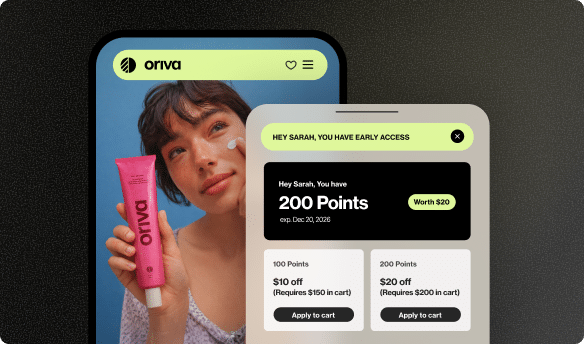






Selecting the optimal loyalty platform is a critical decision for any eCommerce brand. A well-executed program serves as the engine for transforming one-time buyers into high-value, repeat customers. While the Joy Loyalty Program & Rewards app provides a foundational solution for many businesses, scaling brands often find they outgrow its capabilities.
Key Takeaways
- Scaling Requires More: Growing brands often need more than basic loyalty features, seeking advanced customization, segmentation, and support that entry-level apps like Joy can’t provide.
- Strategy is Key: The best loyalty solutions combine a flexible product with expert guidance. A strategic partner can help structure a program that maximizes customer lifetime value (CLTV).
- Integration Matters: A loyalty program delivers the most value when it connects seamlessly with other marketing tools, creating a cohesive and personalized experience for customers.
- Yotpo Loyalty Excels: For brands focused on long-term growth, Yotpo Loyalty offers a powerful combination of a highly customizable product and dedicated strategic support from eCommerce experts.
This guide offers a direct comparison of the leading alternatives to the Joy Loyalty Program. We will analyze why a more advanced solution may be necessary and explore the top contenders in the market. The objective is to provide a clear, strategic analysis to help you select the best platform to drive sustainable, long-term growth.
Why Look for a Joy Loyalty Program Alternative?
The Joy Loyalty program is a solid starting point for businesses initiating their retention efforts, offering basic point and reward functionalities. However, as eCommerce brands scale, their strategic needs become more complex. They begin demanding more sophisticated tools, deeper customization, and dedicated support.
Common limitations that prompt merchants to seek an alternative include:
- Limited Customization and Branding: While Joy allows for basic aesthetic changes, it can be restrictive. Scaling brands require a fully branded loyalty experience that feels like a seamless extension of their website, not a third-party add-on. This includes custom user interface elements, advanced reward structures, and unique campaign logic that Joy’s framework may not support.
- Lack of Advanced VIP Tiers and Segmentation: Joy provides a functional VIP tier system, but it lacks the deep, dynamic segmentation rules necessary for truly personalized rewards. The inability to easily create tiers based on specific customer behaviors, lifetime value (LTV), or granular engagement data limits a brand’s capacity to recognize and cultivate its most valuable customers.
- Need for Deeper Integrations: Loyalty programs deliver maximum value when they operate in sync with other marketing channels, such as email, SMS, and reviews. Joy primarily functions as a standalone point solution. Brands aiming to build cohesive, cross-channel customer journeys require a loyalty program that integrates deeply with their essential marketing tools.
The Top 9 Joy Loyalty Program Alternatives
While Joy provides a functional entry point, scaling brands require a solution that offers superior power, flexibility, and strategic insight. Here are the top nine alternatives designed to elevate your retention marketing.
1. Yotpo: Loyalty Rewards Program

Yotpo Loyalty is engineered for growth-focused eCommerce brands that treat customer retention as a core business strategy. With Yotpo Loyalty, you gain a partner and a team of eCommerce loyalty experts who guide you in building a dynamic program. It’s powered by a flexible platform that can quickly evolve to reflect your brand at every stage.
Key Features:
- Strategic Partnership and Expertise: Yotpo clients are supported by a team of eCommerce loyalty experts and dedicated Customer Success Managers (CSMs) who provide strategic guidance. This partnership is backed by 24/7 technical support, ensuring programs are structured for optimal performance.
- Advanced Flexibility and Customization: The platform allows for the creation of a unique loyalty experience with highly customizable earning campaigns, diverse redemption options, and on-site modules that feel native to your brand. Yotpo supports sophisticated, dynamic segmentation, VIP tiers, and flexible point expiration methods to drive sustained engagement.
- Robust and Accurate Reporting: Yotpo features a comprehensive analytics suite that delivers deep, action-oriented insights into program performance, member LTV, and overall ROI. This data empowers brands to make informed, strategic decisions and continuously refine their retention efforts without inflated metrics.
- Powerful Synergy with Yotpo Reviews: While Yotpo Loyalty is a best-in-class standalone solution, its capabilities are amplified when used with Yotpo Reviews. Brands can award loyalty points to customers for leaving reviews, creating a powerful cycle of engagement and user-generated content.
Pricing Summary:
Yotpo offers a free plan for stores with fewer than 100 monthly orders. Paid plans start at $199/month, and custom pricing is available for enterprise needs.
Pros & Cons:
- Pros:
- Dedicated Customer Success Managers (CSMs) and responsive support for strategic guidance.
- Extensive customization options to build a fully branded loyalty experience.
- Works seamlessly with Yotpo Reviews to reward customers for leaving feedback.
- Provides clear ROI and actionable insights through robust analytics.
- Cons:
- Represents a more significant investment, positioned for brands prioritizing long-term retention strategy.
- The extensive feature set may exceed the needs of businesses requiring only basic loyalty functionality.
2. Smile: Loyalty Rewards Program

Smile.io is a well-known platform in the loyalty space, often considered a subsequent step for businesses graduating from simpler applications. It provides a user-friendly interface with a solid feature set for small to medium-sized businesses.
Key Features:
- Core Loyalty Functions: The platform is structured around points, referrals, and VIP tiers, allowing for the execution of a standard loyalty program.
- Visual Customization: Offers options to modify on-site elements like launcher icons and panel colors.
- Engagement Tools: Features on-site “Nudges” and reminders designed to increase program participation and point redemption.
Pricing Summary:
Smile has a free plan with limited features. The $199/month plan includes up to 2,500 monthly orders, and the $999/month plan includes up to 7,500 monthly orders.
Pros & Cons:
- Pros:
- User-friendly interface is straightforward to configure.
- Offers core loyalty features (points, referrals, VIPs).
- Maintains a large library of third-party app integrations.
- Cons:
- The pricing model can become costly as a brand’s member list expands.
- Advanced customization and API access are restricted to the highest-tier plans.
3. Rivo: Loyalty Program, Rewards

Rivo presents itself as a solution for loyalty, referrals, and wishlists. It is an option for stores looking to source these functions from a single vendor, though each component may offer less depth than a dedicated, specialized platform.
Key Features:
- Loyalty & Referrals: Includes standard points-based loyalty and referral program capabilities.
- Bundled Features: The platform combines loyalty, wishlist, and referral functionalities.
- UI Customization: Provides tools for making visual adjustments to the on-site loyalty widget.
Pricing Summary:
The free plan is for up to 200 orders/month. The “Scale” plan ranges from $49/month to $499/month for up to 2,500 orders/month.
Pros & Cons:
- Pros:
- Combines loyalty, referrals, and wishlists from a single vendor.
- Features a clean, modern user interface.
- Order-based pricing can offer predictability.
- Cons:
- Individual features are less robust than those offered by specialized providers.
- Functions more as a product bundle than a truly integrated ecosystem.
4. Okendo: Reviews & Loyalty

Okendo is highly regarded for its powerful product reviews platform and has expanded its offering to include loyalty. It is an option for brands prioritizing an integrated reviews-and-loyalty solution, with a focus on leveraging customer data to fuel growth.
Key Features:
- Reviews and Loyalty Integration: Okendo’s primary strength is the close integration between its reviews engine and loyalty program.
- Headless Commerce Support: Provides robust APIs and tools for custom-built websites.
- Unified Customer Profiles: Offers detailed customer profiles that consolidate review data, loyalty status, and purchase history.
Pricing Summary:
Okendo offers a free plan (up to 50 orders/month), then $19/month (up to 200 orders/month), and $119/month (up to 1,500 orders/month) before moving to quote-based enterprise tiers.
Pros & Cons:
- Pros:
- Offers strong integration between its reviews and loyalty products.
- Well-suited for brands operating on headless or custom eCommerce architecture.
- Maintains a strong focus on customer data and analytics.
- Cons:
- Premium pricing on higher tiers places it outside the budget for many smaller businesses.
- The user interface may present a steeper learning curve than simpler applications.
5. LoyaltyLion Rewards & Referral
 LoyaltyLionLoyaltyLion is a data-driven loyalty platform designed to increase customer lifetime value and engagement. It is a popular choice for established eCommerce brands looking to implement more sophisticated, personalized retention strategies beyond basic rewards.
Key Features:
- Customer Insights: Provides a dedicated analytics dashboard to help merchants understand customer behavior and identify at-risk segments.
- A/B Testing: Enables testing of different reward structures and campaigns to optimize for engagement.
- High-Level Customization: Offers significant flexibility for customizing on-site elements and provides strong APIs for custom development.
Pricing Summary:
There is a free plan for up to 400 monthly orders. The starting paid plan is $199/month, which includes 1,000 orders.
Pros & Cons:
- Pros:
- Offers powerful data-driven features and analytics.
- Provides a high degree of customization and flexibility.
- Focuses on proving ROI and increasing customer LTV.
- Cons:
- The platform’s complexity may require a dedicated manager to realize its full potential.
- The pricing structure can be a significant investment for smaller businesses.
6. Growave: Loyalty & Wishlist

Growave positions itself as an all-in-one solution that includes loyalty, reviews, wishlists, and more. It’s designed for brands that want to consolidate their marketing apps and simplify their tech stack, particularly in the early stages.
Key Features:
- Multi-Feature Suite: Its main value proposition is offering a wide range of marketing tools under one roof.
- Social Login: Allows customers to sign up and log in using their social media accounts.
- Instagram Galleries: Lets brands create shoppable Instagram galleries on their site.
Pricing Summary:
Pricing starts with a free plan (100 orders/month), then goes to $49/month (500 monthly orders), $199/month, and $499/month for higher volumes.
Pros & Cons:
- Pros:
- Cost-effective for the number of features provided.
- Simplifies the tech stack by replacing several individual apps.
- A practical option for early-stage brands seeking broad functionality on a budget.
- Cons:
- Offers broad functionality, but each feature may have less depth than a specialized tool.
- Customization options can be limited compared to more specialized platforms.
7. Rise.ai: Gift Cards & Loyalty

Rise.ai focuses on a unique angle of retention: using store credit as a primary tool for loyalty, referrals, and refunds. It’s less about points and more about creating a cash-like incentive for customers to return.
Key Features:
- Store Credit Focus: Everything revolves around issuing and managing store credit, which can be easier for customers to understand than points.
- Gift Card Workflows: Advanced capabilities for selling, scheduling, and managing gift cards.
- Bulk Issuance: Allows merchants to send store credit to customer segments in bulk.
Pricing Summary:
Plans start at $19.99/month (100 monthly orders) and scale up to $599.99/month (12k monthly orders).
Pros & Cons:
- Pros:
- Excellent for brands that want to build their retention strategy around gift cards and store credit.
- Simplifies the rewards concept for customers.
- Strong automation for store credit-based refunds and customer service.
- Cons:
- Lacks the gamification and engagement elements of traditional points-based loyalty programs.
- The feature set is highly specialized and may not suit all business models.
8. Appstle Loyalty & Rewards

From the makers of the popular Appstle Subscriptions app, Appstle Loyalty & Rewards is designed to work seamlessly within their ecosystem. It offers a straightforward loyalty solution that is particularly compelling for brands already using other Appstle products.
Key Features:
- Ecosystem Integration: Its primary advantage is its tight integration with Appstle Subscriptions.
- Comprehensive Features: Covers all the standard loyalty program elements, including points, VIP tiers, and referrals.
- Gamification: Includes features like milestone rewards to keep customers engaged.
Pricing Summary:
Appstle has a free plan (up to 500 orders/month). Paid plans start at $10/month and scale up to $100/month for unlimited orders.
Pros & Cons:
- Pros:
- A practical choice for merchants already invested in the Appstle ecosystem.
- Offers a robust feature set for its price point.
- 24/7 customer support is a key selling point.
- Cons:
- Still building its reputation and feature set compared to long-standing market leaders.
- Does not have the broad integration capabilities of other market leaders outside its own ecosystem.
9. Nector: Loyalty & Rewards

Nector is a modern loyalty and rewards platform that aims to provide a robust, enterprise-grade feature set at a price point accessible to small and medium-sized businesses. It emphasizes flexibility and customization.
Key Features:
- Flexible Rewards: Allows for the creation of unique rewards, including percentage discounts, fixed amounts, free shipping, and free products.
- Points-for-Action: Offers a wide range of ways for customers to earn points beyond purchases.
- Email & SMS Integration: Provides integrations with major communication platforms like Klaviyo and SMSBump.
Pricing Summary:
Nector’s free plan is for up to 300 monthly orders. Paid plans are based on monthly orders, starting at $49/month.
Pros & Cons:
- Pros:
- Provides a strong, flexible feature set that rivals more expensive platforms.
- Highly customizable on-site displays.
- Transparent, order-based pricing.
- Cons:
- Relies on third-party integrations for key marketing functions rather than offering its own.
Conclusion
While the Joy Loyalty program serves as a functional entry point, scaling eCommerce brands requires a more powerful and strategic solution. The alternatives presented offer a spectrum of capabilities, from the all-in-one convenience of Growave to the specialized store-credit focus of Rise.ai. Each represents a clear advancement over Joy’s basic functionality.
However, for ambitious brands focused on sustainable, long-term growth, Yotpo Loyalty emerges as the most strategic choice.
Yotpo provides a unique combination of two critical pillars: a powerful and highly customizable standalone loyalty solution and a dedicated team of strategic experts for guidance. This synthesis empowers brands to move beyond rewarding transactions and begin building genuine, lasting customer relationships. For businesses ready to make retention a core pillar of their growth strategy, Yotpo offers the definitive solution.
Frequently Asked Questions
How does a loyalty program directly impact customer retention?
A loyalty program directly impacts retention by creating a value-based incentive for customers to choose your brand repeatedly. By rewarding behaviors from purchases to social engagement, you build an economic and emotional connection that increases a customer’s motivation to stick with your brand. This process provides the data needed to create personalized experiences, making customers feel recognized and valued while measurably boosting their lifetime value.
Why are deep integrations important for a loyalty program?
Deep integrations allow your loyalty program to connect natively with other essential marketing tools like email, SMS, and reviews. This creates a unified customer profile and enables powerful, data-driven experiences. For example, you can automatically send a targeted email campaign to a specific VIP tier or instantly reward points for submitting a photo review, all managed through connected systems.
What are the most critical features to look for in a modern loyalty program?
Beyond basic points, critical features include differentiated VIP tiers to reward high-value customers, integrated referral programs to leverage word-of-mouth marketing, and flexible earning and redemption rules to create unique, on-brand campaigns. Most importantly, look for robust analytics to measure ROI and deep integrations to connect with your entire marketing technology stack.
How much should a business expect to invest in a loyalty program?
Investment levels vary significantly based on a platform’s capabilities. Entry-level apps often provide free or low-cost plans. Mid-tier solutions typically range from $50 to over $500 per month, often priced by member count or order volume. Premium, enterprise-grade platforms offer custom pricing, reflecting their role as a more comprehensive, strategic investment.
Is it possible to migrate members from an existing loyalty program to a new one?
Yes, most advanced loyalty platforms provide tools and dedicated support for migrating existing members and their point balances. The process typically involves a straightforward data export and import, ensuring a seamless and undisrupted transition for your most loyal customers.
What is the difference between a points-based program and a store-credit program?
A points-based program allows customers to earn points for various actions and redeem them for rewards, creating a gamified experience. A store-credit program, like that from Rise.ai, simplifies the reward by providing customers with a cash-like balance. While store credit can be easier to understand, points-based systems generally offer greater flexibility for creative customer engagement.
How can I measure the ROI of my loyalty program?
You can measure ROI by tracking key metrics through your loyalty platform’s analytics dashboard. Look for metrics like repeat purchase rate, customer lifetime value (CLTV) of members vs. non-members, and redemption rate. A strong platform will provide a clear view of the revenue directly generated by loyalty program activities.
What are VIP tiers and why are they important?
VIP tiers are different levels within a loyalty program that customers can achieve by reaching certain spending or engagement thresholds. They are important because they allow you to recognize and reward your best customers with exclusive benefits, such as early access to sales or bonus points. This makes your most valuable shoppers feel appreciated and encourages others to increase their spending to reach the next level.
How do referral programs fit into a loyalty strategy?
Referral programs are a natural fit for a loyalty strategy because they reward your existing loyal customers for bringing in new ones. By offering points or other rewards for successful referrals, you turn your best customers into powerful advocates for your brand. This is a highly effective way to acquire new, high-intent customers.
What kind of rewards are most effective?
The most effective rewards depend on your customers and brand. Popular options include percentage or fixed-amount discounts, free shipping, and free products. Experiential rewards, like early access to new collections or exclusive content, can also be very effective for building an emotional connection with your brand. The key is to offer a variety of rewards that appeal to different customer segments.
How long does it take to launch a new loyalty program?
The time to launch varies by platform. Simpler programs can be set up in a few hours. More complex and highly customized programs, especially those requiring custom development or detailed strategic planning, can take several weeks. A platform with strong onboarding support can significantly speed up the process.
Can a loyalty program help me acquire new customers?
Yes, absolutely. While loyalty programs are primarily for retention, they are also excellent acquisition tools. An integrated referral program is the most direct way they drive new customer growth. Additionally, promoting your loyalty program’s benefits on your site can convince new visitors to make their first purchase and sign up.
What’s the biggest mistake brands make with loyalty programs?
The biggest mistake is the “set it and forget it” approach. A successful loyalty program is not static; it needs to be actively managed and optimized. This means regularly analyzing performance, testing new rewards and campaigns, and communicating with members to keep them engaged. Without ongoing attention, even the best-designed program can become stale.











 Join a free demo, personalized to fit your needs