









Winning a new customer almost always costs more than keeping one you already have, and Harvard Business Review puts the gap at anywhere from five to 25 times depending on the industry. Repeat buyers also convert more easily and tend to spend more. Below you’ll find both costs side by side, the formulas for CAC, CLV and the CLV:CAC ratio, and ways loyalty programs and reviews help you keep customers.
Key Takeaways: Customer Acquisition vs. Retention
- Acquisition costs more: According to Harvard Business Review, a new customer typically costs 5 to 25 times more to win than an existing one costs to keep, and where you land in that range depends on your industry.
- Retention drives profit: Bain & Company research, cited by Harvard Business Review, links a 5% increase in retention to profits rising by 25% to 95%, because loyal customers keep buying and are cheaper to serve.
- Existing customers are easier to sell to: The Marketing Centre puts your odds with a current customer at about 60% to 70%, while a brand-new prospect converts only 5% to 20% of the time.
- The CLV:CAC ratio shows where you stand: Compare what a customer is worth with what it cost to win them and you get a plain read on marketing ROI, and many teams aim for 3:1 or higher.
- Loyalty and reviews support retention: Rewards give people a reason to come back, while honest reviews from other shoppers make that second order feel like a safe bet.
The Core E-commerce Dilemma: Balancing Acquisition and Retention
Picture your business as a bucket with a slow leak. Winning new customers is the tap running at the top, and it’s satisfying to watch because the water level climbs. Retention is the patch on the side. Nobody celebrates a patch the way they celebrate a record ad month, yet it decides how much of that water is still in the bucket next quarter.
You still need new customers to grow. The trouble starts when they’re the whole plan, because then you keep paying to replace shoppers who bought once and drifted off, and that bill gets bigger every year. Growth that lasts comes from people who come back. That’s why customer acquisition cost (CAC) and customer retention belong on the same dashboard.
Acquisition is about getting that first order. Retention is about the second, the third and the tenth, and those repeat buyers are what a business can actually build on.
Customer Acquisition and Retention: What the Terms Mean
The two terms get mixed up more often than you’d think, so it’s worth starting with what each one covers.
What Is Customer Acquisition Cost (CAC)?
Customer acquisition cost, or CAC, is the price of turning a stranger into a first-time buyer. You’ll usually find most of it in your ad accounts, spread across Google Ads, Facebook and Instagram, TikTok, sponsored placements and any other paid channel.
What gets missed are the costs that don’t show up in those accounts. A share of the salaries for your marketing and sales people belongs here, since part of their week goes into chasing new customers. So do the fees for design, video and copywriting behind every ad and landing page, plus the analytics, SEO and CRM tools you pay for each month. Leave them out and your CAC looks better than it actually is.
Watch the trend more than the number itself. When CAC creeps up quarter after quarter, the cause is usually a channel that’s wearing out or more rivals bidding for the same shoppers.
What Is Customer Retention?
Customer retention is about what happens after the first order: whether people come back. Most teams track it as a retention rate, which is the share of customers who stuck around over a given period.
The rate says a lot about the whole experience. People rarely announce that they’re leaving after a disappointing product or an unanswered support ticket, and instead they just stop ordering. Customers who keep coming back are therefore a fair sign that the basics are working. They also make revenue steadier and often send friends your way.
Cost of Customer Acquisition vs. Retention: The Numbers
If you’re weighing where the next dollar goes, the research leans one way. Some of these studies are a few years old and the multiples vary by industry, so they work better as a strong signal than as a precise forecast.
- Acquisition is much more expensive. Harvard Business Review reports that winning a new customer costs anywhere from five to 25 times more than keeping an existing one, depending on the study and the industry.
- Retention drives profit. The same article cites Frederick Reichheld of Bain & Company, who found that raising retention by 5% increases profits by 25% to 95%, partly because repeat customers spend more over time and cost less to serve.
- Existing customers are more likely to buy. According to The Marketing Centre, the chance of selling to an existing customer is between 60% and 70%, compared with 5% to 20% for a new prospect.
- Loyal customers spend more and try new products. A Forbes Business Council article notes that existing customers are 50% more likely to try new products and spend 31% more than new customers.
None of this argues for dropping acquisition. It does suggest that your most reliable opportunity for growth lies with the people who already know your name.
Why Retaining Customers Costs Less
The savings begin with how returning customers reach you. They click an email or a text, open your app or come straight to your site, so the visit costs you little or nothing. Because they already know your sizing and how returns work, you rarely have to discount to win the sale.
A second and third order can turn a customer who barely broke even into a profitable one, because each new order spreads the first acquisition cost a little thinner. Happy customers also do some of your marketing for you by writing reviews, posting photos and recommending you to friends.
Retention isn’t free, since rewards, service and software all cost money. You just pay for them across many orders instead of starting from scratch with every new buyer.
Acquisition vs. Retention at a Glance
Seen side by side, the two chase the same goal from opposite ends. Acquisition is the expensive end, since a first order usually takes paid ads and sales time to win, and CAC tells you what each of those customers cost.
Retention is about the people who have already bought from you, and you reach them through email, your app and your rewards program, all channels you own outright. You can measure how well it’s working with retention rate, repeat purchase rate and customer lifetime value (CLV).
Still, the two aren’t rivals. Customers drift away for all sorts of reasons, from moving house to simply forgetting you exist, and new buyers are how you top the list back up. The better your retention, the less of that topping up you have to pay full price for. B2B works the same way, with renewals doing the job of repeat orders, so the formulas below work whether you sell to shoppers or to businesses.
How to Calculate Your Brand’s Key Growth Metrics
A few simple formulas go a long way here, and working out CAC and lifetime value is the first step toward knowing how healthy your marketing is.
Calculating Your Customer Acquisition Cost (CAC)
The math is simple: divide what you spent winning customers in a period by the number of new customers you gained in it.
The formula: CAC = (Total Cost of Sales & Marketing) / (Number of New Customers Acquired).
Imagine a store going through last quarter’s books. It spent $15,000 on Google and Facebook ads and estimated that roughly $10,000 of its marketing salaries went toward winning customers. Add $1,000 for software and the quarter’s acquisition costs come to $26,000. The store gained 1,000 new customers over the same stretch, which gives CAC = $26,000 / 1,000 = $26.
In other words, every new customer cost this store $26 to win. It’s worth recalculating monthly, or at least every quarter, since a slow climb is easy to miss until it hurts.
Calculating Customer Lifetime Value (CLV)
CAC is only half the picture, of course. Customer lifetime value (CLV) is the other half: the revenue you can reasonably expect from one customer over their whole relationship with your brand.
The simplified formula: CLV = (Average Purchase Value) × (Average Purchase Frequency) × (Average Customer Lifespan).
The same store works as an example here. It brought in $150,000 across 3,000 orders, so its average purchase value (APV), which is revenue divided by orders, is $50. Those 3,000 orders came from 1,500 different people, so the typical customer ordered twice. That’s an average purchase frequency (APF) of 2 orders per customer.
Lifespan is the slippery one. Your own order history is the best guide to how long people keep buying, and we’ll assume 3 years here. That gives CLV = $50 (APV) × 2 (APF) × 3 (lifespan) = $300, so the average customer is worth $300 to the brand over their lifetime.
Calculating Your Customer Retention Rate
To work out retention, you need three numbers for the quarter: the customers you started with, the customers you ended with and how many of those were new.
The formula: Retention Rate = ((Customers at End of Period minus New Customers Acquired) / Customers at Start of Period) × 100.
Our example store opens the quarter with 1,000 customers and closes with 1,100, but 300 of those are new. Set them aside and 800 of the original group are still around, a retention rate of 800 / 1,000, or 80%. Whether that rate is good depends on your category, so the most useful comparison is with your own past quarters rather than anyone else’s.
The All-Important CLV:CAC Ratio
The CLV:CAC ratio sets a customer’s value against what it cost to win them, which makes it a handy report card for your marketing ROI.
In our example, $300 : $26 works out to about 11.5 : 1. As a rough guide to reading any ratio:
- 1:1. You lose money on every new customer once the cost of goods sold is counted.
- 3:1. Your marketing earns a solid return, and this widely used rule of thumb is generally treated as a healthy ratio.
- 5:1 or higher. Your marketing is efficient, although a ratio above 5:1 may also mean you are underinvesting in growth.
A word of caution about the example: it uses revenue, so the ratio looks rosier than it would on a profit basis. Improvado estimates that using revenue instead of margin-adjusted revenue can inflate CLV by 30% to 50%. At a 40% gross margin, for instance, the $300 becomes $120 and the ratio falls to about 4.6 : 1, which is still healthy.
Tracking this ratio over time pulls your attention away from simple cost-cutting and toward the channels that bring in your best customers.
Actionable Strategies to Optimize Customer Acquisition
Retention may be cheaper, but growth still depends on new customers, so the goal here is to get more out of every dollar you spend on acquisition.
Refining Your Paid Advertising Spend
For most online stores, paid advertising is the largest piece of CAC, and it’s also the piece you control most directly. Start by asking how much the customers from each channel are actually worth. A budget spread thinly across every platform rarely pays off, and ranking channels by lifetime value shows you where to move the money.
Fresh creative matters just as much, since a steady rotation of new images, headlines and calls-to-action adds up to small lifts in clicks and sales that bring CAC down over time. Lookalike audiences give you another lever: upload a list of your highest-CLV customers to Facebook and Google and let the platforms find people who resemble them.
Common Mistakes in Customer Acquisition
Most acquisition budgets that leak money do it in the same few ways. One is spending on channels that look busy but bring in customers who are worth very little, which you’ll only catch if you judge channels by lifetime value rather than clicks. Another is aiming at an audience so wide that half of it was never going to buy.
A third is a checkout that loses shoppers who have already cost you the click, and fixing that step is often cheaper than buying more traffic. The last, and one of the most common, is simply not measuring the CLV of new customers, which is how brands end up paying for buyers who never come back.
Leveraging Organic and Owned Channels
The cheapest customer is the one you never paid for directly. Organic channels take time, and you won’t see much from a blog in its first few months, but a guide that answers a real question can rank in search and keep sending qualified visitors long after you’ve moved on to other work. Videos and how-to posts do the same, at very little cost per visit.
On social, product shots alone won’t build much. The brands that grow there run contests, join conversations and share the photos their customers take. Referral programs are the other cheap lever: reward customers for bringing in new buyers and your happiest fans become a low-cost source of growth.
Smarter ad spending is a good start, but the biggest gains are on the other side of the growth equation.
The Ultimate Guide to Boosting Customer Retention
This is where the strongest e-commerce brands pull ahead. Good retention raises CLV and builds a community that is less swayed by price and rival ads, and over time a one-off sale turns into a relationship.
Strategy 1: Build a World-Class Loyalty & Rewards Program
We’ve watched plenty of brands start with a loyalty program, and the ones that get the most out of it treat points as the beginning rather than the whole idea. Their programs make customers feel like members of something, which is what keeps a competitor’s discount from luring them away.
Yotpo Loyalty is designed to help brands build programs like these. You can set your own earning rules, rewards and tiers, launch them and keep adjusting without waiting on a developer. If you’d like a second opinion along the way, its expert services include ongoing strategy help from loyalty specialists.

This short video shows how Yotpo Loyalty programs come together.
Strategy 2: Leverage the Power of Authentic Reviews and UGC
Shoppers rarely buy a second time from a brand they don’t believe in. The proof that convinces them most often comes from other customers, whether that’s an honest review, a photo of the product in someone’s home or a short video of it in use.
Gathering that content is the easy part. What makes the difference is showing the best of it to shoppers while they’re still making up their minds, and Yotpo Reviews was built to do exactly that.
The reviews shoppers trust most tend to be the ones with photos and videos attached, and the platform makes those easy to gather. You can show them in widgets you customize and read AI-powered summaries of what customers are saying, while syndication to partners including Google, Target and TikTok carries that social proof to wherever shoppers happen to be browsing.
Strategy 3: Create VIP Tiers That Feel Worth Reaching
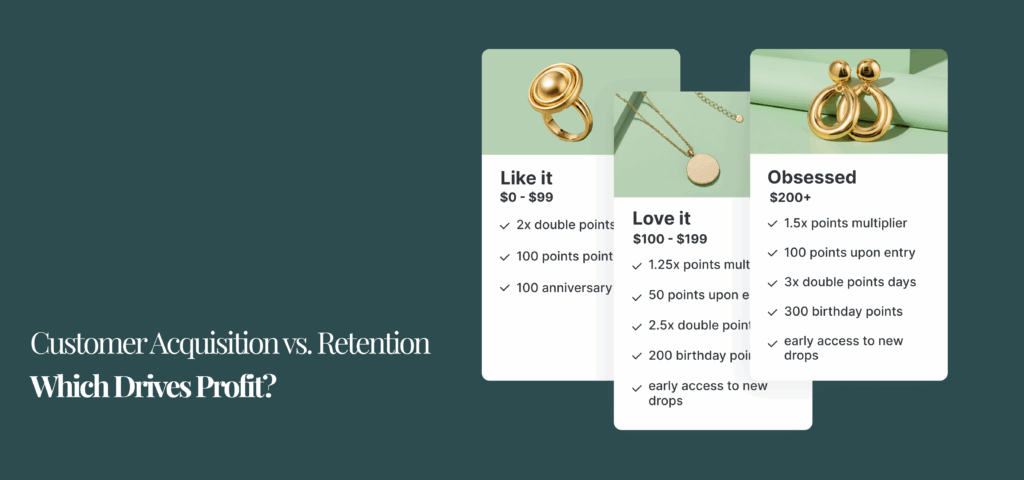
Tiers give loyal customers something to aim for, and having a goal keeps them engaged between orders. Keep the entry rules simple, whether that’s points earned or money spent, and make each level feel noticeably better than the one below it.
Free shipping, early access to new products and exclusive gifts are all solid perks. A tier nobody remembers doesn’t change behavior, so tell members regularly where they stand and what the next level would give them. In Yotpo Loyalty the structure is flexible enough to base entry on customer behavior, include experiences among the rewards and pick which actions each level recognizes.
Strategy 4: Improve the Post-Purchase Experience and Build Community
Retention starts the moment checkout ends. A clear confirmation email, quick delivery and painless returns make that first order feel safe, and a thoughtful follow-up makes the second one more likely.
Community is the step most brands skip. Customers who feel part of a group with shared values have more reasons to stay and pay far less attention to a rival’s discount, so give them ways to take part, from sharing photos to answering each other’s questions and joining your programs.
Conclusion: Shifting Your Focus from Cost to Long-Term Value
Chasing new customers nonstop is tiring for a team and hard on a budget. A dollar spent keeping an existing customer happy usually goes further than a dollar spent finding someone new, and once you start judging marketing by the value it builds over years rather than the cost of a single sale, retention looks a lot less like an expense and a lot more like an investment.
That’s the real case for retention. Loyalty programs and authentic reviews build a brand people feel connected to, and growth built on that holds up far better than growth you have to keep buying.
Frequently Asked Questions
What’s the difference between customer acquisition and customer retention?
Acquisition is the work of winning new customers, from the first ad someone sees to their first order. Retention is everything after that, getting those customers to buy again and stay loyal. The first adds to your customer count, while the second adds to the lifetime value of each customer you already have.
Is it cheaper to retain a customer than to acquire a new one?
Almost always. Depending on the industry, a new customer can cost as much as 25 times more to win than an existing one costs to keep. Picture the path each one takes to a purchase: a stranger usually has to see several ads, maybe talk to sales and get a discount code, while someone who has bought from you before might need nothing more than a friendly email.
Why is the CLV:CAC ratio so important?
It shows whether each customer earns back what you paid to win them, and by how much. Near 1:1 you’re only covering your costs, while at 3:1 or above most teams would call the ratio healthy. It’s also handy for comparing channels, since the ones with the best ratio are usually where the next slice of budget should go.
How does a loyalty program affect profitability?
Most of the gain comes from repeat purchases, because every extra order adds to customer lifetime value. Loyal members tend to place bigger orders too, and the happiest of them recommend you to friends, bringing in new buyers for very little. The result is the same revenue on a smaller marketing budget.
What are some common mistakes brands make with customer acquisition?
Many brands pour money into high-spend, low-return channels without checking the data. Others aim at an audience that’s too broad. Some overlook the conversion funnel, so shoppers drop off at checkout. A few never measure the CLV of new customers, which can mean paying for buyers who never return.
What makes a VIP tier program effective?
Three things make the difference: entry rules people understand at a glance, perks that get better at each level, and rewards members want, such as free shipping, early access or exclusive gifts. Then keep talking to them. Members who regularly hear where they stand, and what the next level would give them, stay far more engaged than members who forget they joined.
What is user-generated content (UGC) and why does it matter?
User-generated content, or UGC, is anything customers create about your brand, whether that’s a photo, a video, a review or a social post. Shoppers tend to believe it more than any other content, because it comes from people like them and not from a polished ad. Put it on your product pages and a hesitant buyer has a much easier time picturing the product in their own life.
Can small businesses benefit from loyalty and reviews solutions?
They can, and in our experience small brands often benefit the most. A loyalty program gives a small shop a core of repeat buyers who keep revenue steady. Good reviews do something just as useful, earning the trust that big companies get from name recognition alone. With both in place, a small brand can compete on community and reputation.
How do you measure the success of a retention strategy?
The core trio is customer lifetime value, customer retention rate (the share of customers who stay over a period) and repeat purchase rate. Get those on a dashboard first. Loyalty metrics come next, redemption rates especially, and the conversion lift on product pages once reviews go live is worth watching as well.
How do customer reviews influence SEO?
Reviews give your search visibility a welcome boost on the side. Every new one adds fresh text to a product page, and since shoppers tend to write in the same words they type into a search bar, a lot of that text lines up with long-tail queries. With review markup in place, your star ratings can show up in the results too. The extra organic traffic means you can lean a little less on paid ads.
Are points-based loyalty programs outdated?
Not at all, and shoppers still enjoy earning them. What has changed is that the programs pulling ahead combine points with tiers, early access and rewards that have nothing to do with discounts, which gives members a reason to stay for the experience as well as the savings.
What’s the first step to improving customer retention?
Before you change anything, find out where you stand. That means your current retention rate and CLV, and also the story behind them, which you can get from a short survey asking existing customers why they stay and what might make them leave. Once the numbers and the answers are in front of you, it’s usually obvious whether service, rewards or the post-purchase experience should come first.






 Join a free demo, personalized to fit your needs
